Wen Kejia, Yang Lijuan, Xiong Tuanlin, Di Chao, Ma Danhui, Wu Menghua, Xue Zhaoyu, Zhang Xuedi, Long Li, Zhang Weimin, Zhang Jiaying, Bi Xiaolin, Dai Junbiao, Zhang Qiangfeng, Lu Zhi John, Gao Guanjun
MOE Key Laboratory of Bioinformatics, Tsinghua-Peking Center for Life Sciences, School of Life Sciences, Tsinghua University, Beijing 100084, China;
MOE Key Laboratory of Bioinformatics, Tsinghua-Peking Center for Life Sciences, School of Life Sciences, Tsinghua University, Beijing 100084, China; College of Animal Science, Tarim University, Xinjiang 843300, China;
Genome Res. 2016 Sep;26(9):1233-44. doi: 10.1101/gr.199547.115. Epub 2016 Aug 11.
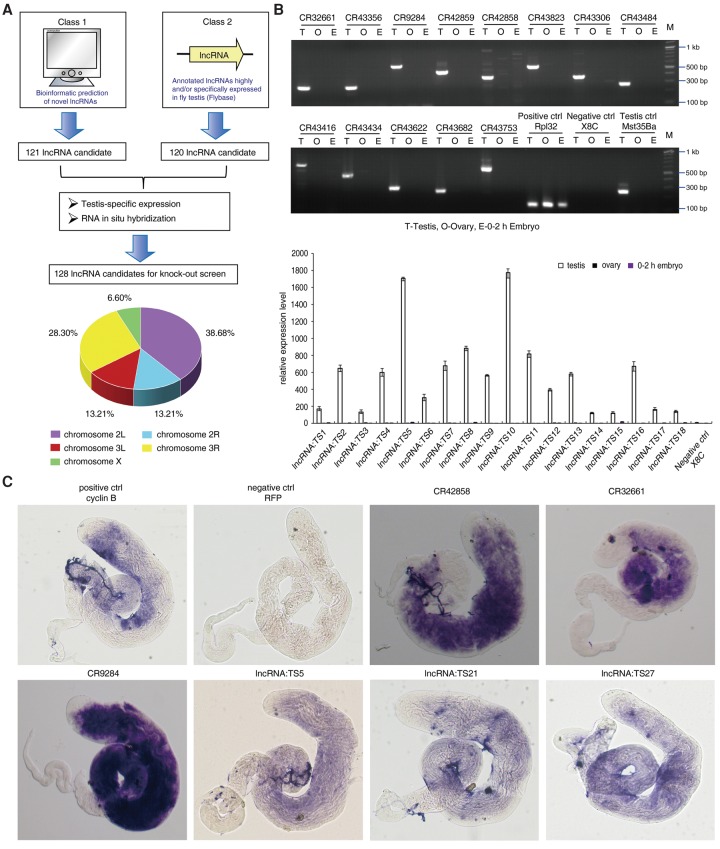
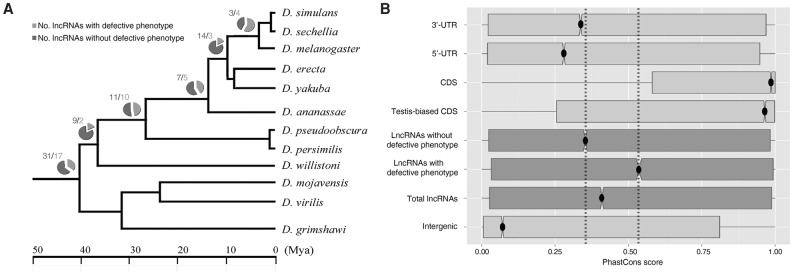
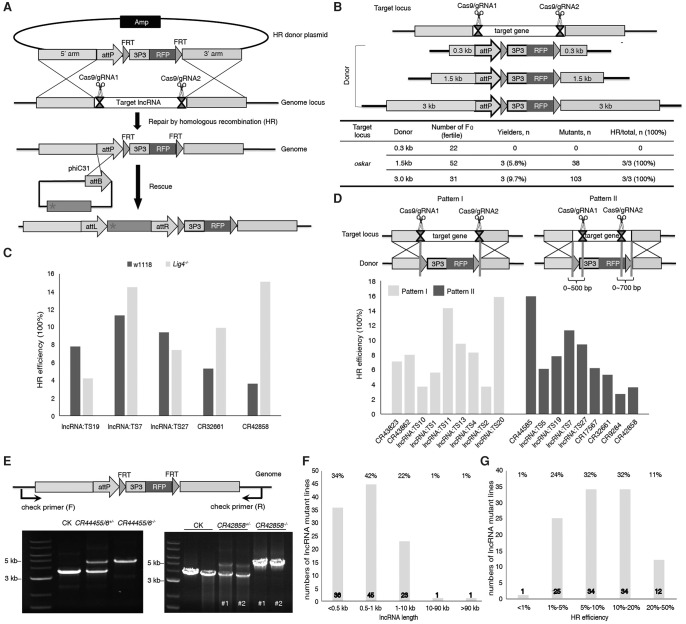
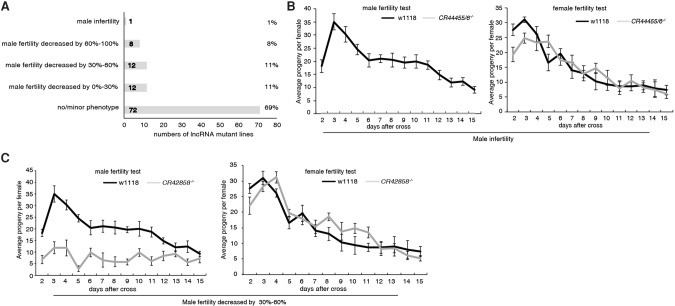
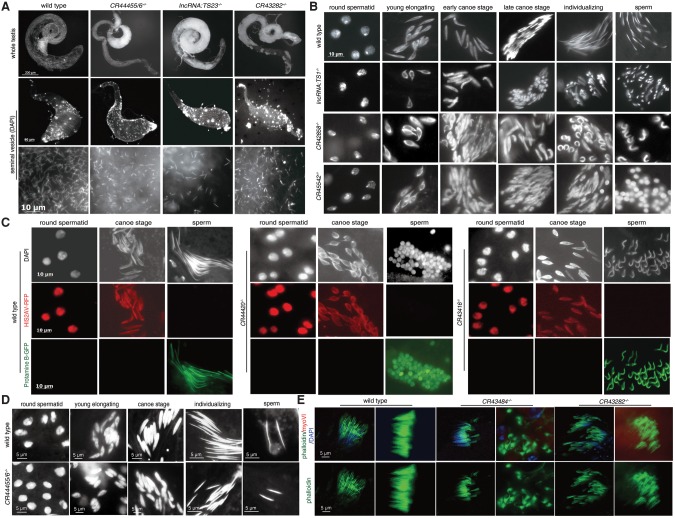
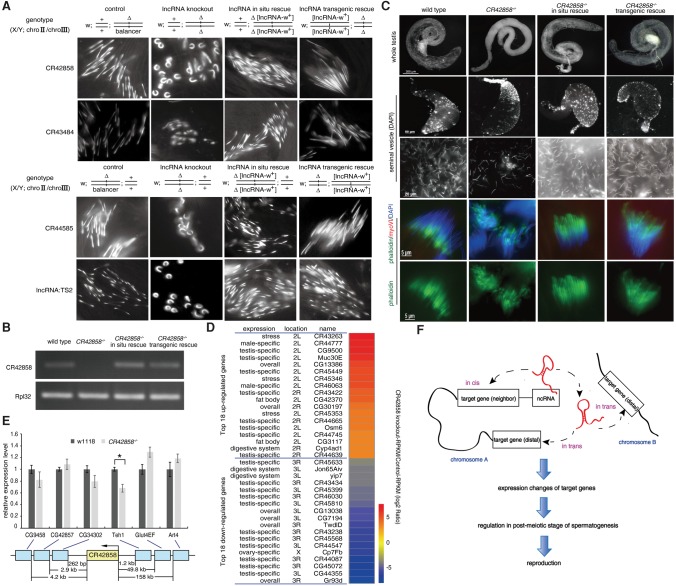
Long noncoding RNAs (lncRNAs), a recently discovered class of cellular RNAs, play important roles in the regulation of many cellular developmental processes. Although lncRNAs have been systematically identified in various systems, most of them have not been functionally characterized in vivo in animal models. In this study, we identified 128 testis-specific Drosophila lncRNAs and knocked out 105 of them using an optimized three-component CRISPR/Cas9 system. Among the lncRNA knockouts, 33 (31%) exhibited a partial or complete loss of male fertility, accompanied by visual developmental defects in late spermatogenesis. In addition, six knockouts were fully or partially rescued by transgenes in a trans configuration, indicating that those lncRNAs primarily work in trans Furthermore, gene expression profiles for five lncRNA mutants revealed that testis-specific lncRNAs regulate global gene expression, orchestrating late male germ cell differentiation. Compared with coding genes, the testis-specific lncRNAs evolved much faster. Moreover, lncRNAs of greater functional importance exhibited higher sequence conservation, suggesting that they are under constant evolutionary selection. Collectively, our results reveal critical functions of rapidly evolving testis-specific lncRNAs in late Drosophila spermatogenesis.
长链非编码RNA(lncRNAs)是最近发现的一类细胞RNA,在许多细胞发育过程的调控中发挥重要作用。尽管lncRNAs已在各种系统中被系统鉴定,但它们中的大多数在动物模型体内尚未进行功能表征。在本研究中,我们鉴定了128个果蝇睾丸特异性lncRNAs,并使用优化的三元CRISPR/Cas9系统敲除了其中105个。在lncRNA敲除品系中,33个(31%)表现出部分或完全雄性育性丧失,伴随着精子发生后期明显的发育缺陷。此外,6个敲除品系通过反式转基因得到了完全或部分拯救,表明这些lncRNAs主要以反式发挥作用。此外,5个lncRNA突变体的基因表达谱显示,睾丸特异性lncRNAs调节全局基因表达,协调雄性生殖细胞后期分化。与编码基因相比,睾丸特异性lncRNAs进化得更快。此外,具有更重要功能的lncRNAs表现出更高的序列保守性,表明它们处于持续的进化选择之下。总之,我们的结果揭示了快速进化的睾丸特异性lncRNAs在果蝇精子发生后期的关键功能。