Ala-Nikkola Taina, Sadeniemi Minna, Kaila Minna, Saarni Samuli, Kontio Raija, Pirkola Sami, Joffe Grigori, Oranta Olli, Wahlbeck Kristian
University of Helsinki and Helsinki University Hospital, Psychiatry, Välskärinkatu 12, FI-00029, Helsinki, Finland.
Mental Health Unit, National Institute for Health and Welfare (THL), Mannerheimintie 170, FI-00270, Helsinki, Finland.
BMC Psychiatry. 2016 Aug 12;16:289. doi: 10.1186/s12888-016-0992-5.
The diversity of mental health and substance abuse services (MHS) available to service users is seen as an indicator of the quality of the service system. In most countries MHS are provided by a mix of public, private and third sector providers. In Finland, officially, the municipalities are responsible for organizing the services needed, but the real extent and roles of private and third sector service providers are not known. Our previous study showed that the catchment area population size was strongly associated with diversity of mental health services. It is not known whether this was due to some types of services or some provider types being more sensitive to the size effect than others. The aim of this study was to investigate the association between area population size and diversity of mental health services, i.e. which types of services and which service providers' contributions are sensitive to population size.
To map and classify services, we used the ESMS-R. The diversity of services was defined as the count of main types of care. Providers were classified as public, private or third sectors.
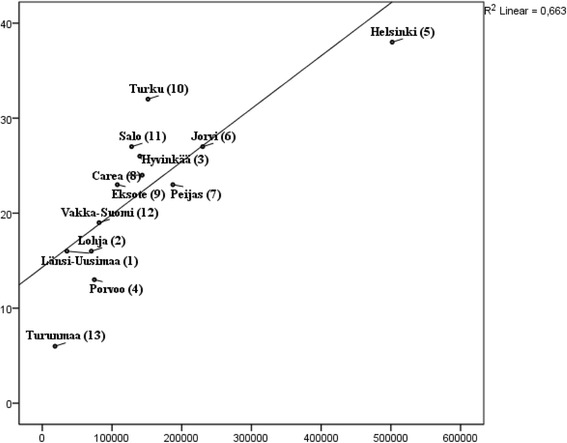
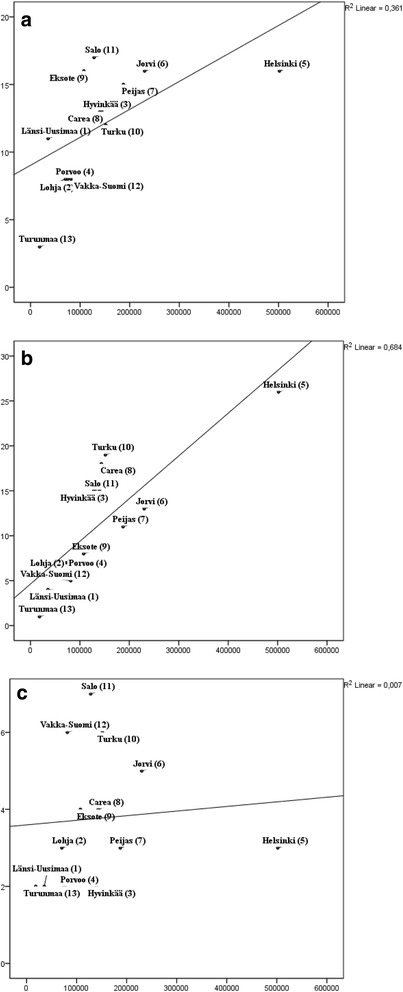
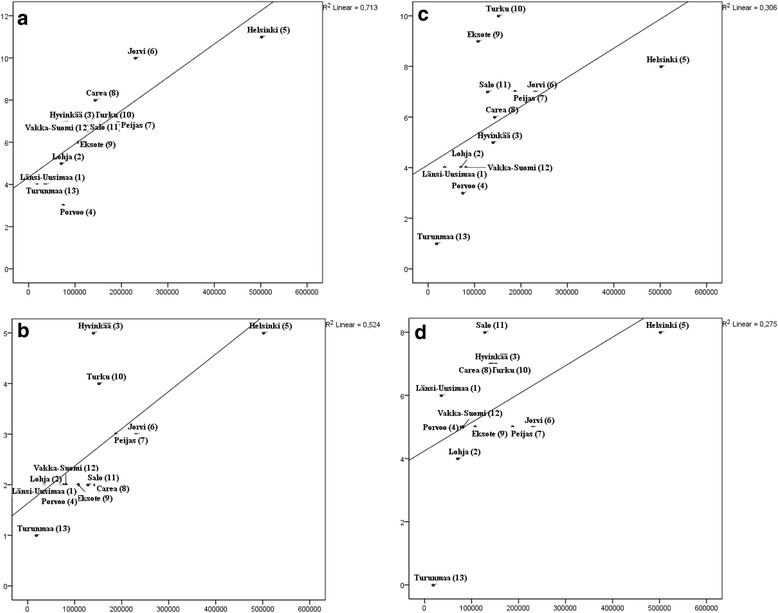
The diversity of outpatient, residential and voluntary services correlated positively with catchment area population size. The strongest positive correlation between the size of population and services available was found in third sector activities followed by public providers, but no correlation was found for diversity of private services. The third sector and public corporations each provided 44 % of the service units. Third sector providers produced all self-help services and most of the day care services. Third sector and private companies provided a significant part (59 %) of the residential care service units.
Significant positive correlations were found between size of catchment area population and diversity of residential, outpatient and voluntary services, indicating that these services concentrate on areas with larger population bases. The third sector seems to significantly complement the public sector in providing different services. Thus the third sector be needs to be functionally integrated with other MHS services to achieve a diversified and integrated service system.
服务使用者可获得的心理健康与药物滥用服务(MHS)的多样性被视为服务系统质量的一个指标。在大多数国家,心理健康与药物滥用服务由公共、私人和第三部门的提供者共同提供。在芬兰,官方规定市政当局负责组织所需的服务,但私人和第三部门服务提供者的实际规模和作用尚不清楚。我们之前的研究表明,集水区人口规模与心理健康服务的多样性密切相关。尚不清楚这是由于某些类型的服务还是某些提供者类型比其他类型对规模效应更敏感。本研究的目的是调查地区人口规模与心理健康服务多样性之间的关联,即哪些类型的服务以及哪些服务提供者的贡献对人口规模敏感。
为了绘制和分类服务,我们使用了ESMS-R。服务的多样性被定义为主要护理类型的数量。提供者被分为公共、私人或第三部门。
门诊、住院和志愿性服务的多样性与集水区人口规模呈正相关。在第三部门活动中,人口规模与可用服务之间的正相关最强,其次是公共提供者,但未发现私人服务多样性与人口规模之间的相关性。第三部门和公共公司各提供了44%的服务单位。第三部门提供者提供了所有自助服务和大部分日托服务。第三部门和私人公司提供了相当一部分(59%)的住院护理服务单位。
发现集水区人口规模与住院、门诊和志愿性服务的多样性之间存在显著的正相关,表明这些服务集中在人口基数较大的地区。第三部门似乎在提供不同服务方面对公共部门起到了显著的补充作用。因此,第三部门需要在功能上与其他心理健康与药物滥用服务整合,以实现多元化和一体化的服务系统。