Department of Social Services and Health Care, City of Helsinki, Southern Psychiatric Outpatient Clinic, Työpajankatu 14, FI-00099 Helsinki, Finland.
University of Helsinki and Helsinki University Hospital, Välskärinkatu 12, Helsinki FI-00029, Finland.
Int J Environ Res Public Health. 2018 May 31;15(6):1133. doi: 10.3390/ijerph15061133.
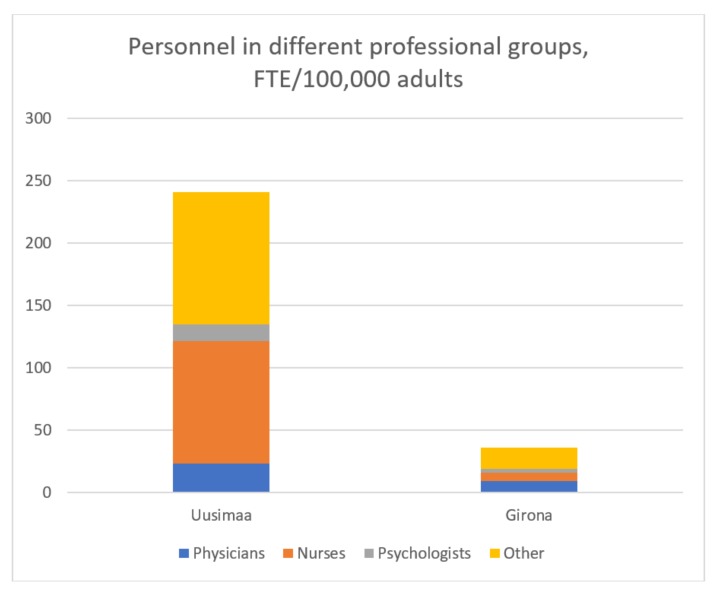
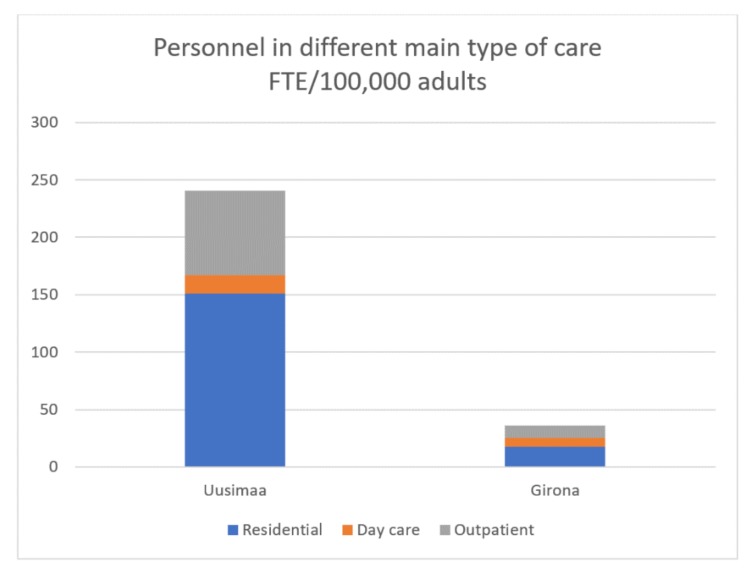
Mental health services (MHS) have gone through vast changes during the last decades, shifting from hospital to community-based care. Developing the optimal balance and use of resources requires standard comparisons of mental health care systems across countries. This study aimed to compare the structure, personnel resource allocation, and the productivity of the MHS in two benchmark health districts in a Nordic welfare state and a southern European, family-centered country. The study is part of the REFINEMENT (Research on Financing Systems' Effect on the Quality of Mental Health Care) project. The study areas were the Helsinki and Uusimaa region in Finland and the Girona region in Spain. The MHS were mapped by using the DESDE-LTC (Description and Evaluation of Services and Directories for Long Term Care) tool. There were 6.7 times more personnel resources in the MHS in Helsinki and Uusimaa than in Girona. The resource allocation was more residential-service-oriented in Helsinki and Uusimaa. The difference in mental health personnel resources is not explained by the respective differences in the need for MHS among the population. It is important to make a standard comparison of the MHS for supporting policymaking and to ensure equal access to care across European countries.
精神卫生服务在过去几十年中经历了巨大的变化,从医院转向以社区为基础的护理。为了发展最佳的资源平衡和利用,需要对各国的精神卫生保健系统进行标准比较。本研究旨在比较北欧福利国家和南欧以家庭为中心的国家的两个基准卫生区的精神卫生服务结构、人员资源分配和生产力。该研究是 REFINEMENT(研究融资系统对精神卫生保健质量的影响)项目的一部分。研究区域是芬兰的赫尔辛基和乌西马地区以及西班牙的赫罗纳地区。使用 DESDE-LTC(长期护理服务和目录的描述和评估)工具对精神卫生服务进行了映射。赫尔辛基和乌西马地区的精神卫生服务人员资源是赫罗纳的 6.7 倍。赫尔辛基和乌西马地区的资源分配更倾向于住宅服务。精神卫生人员资源的差异不能用人口对精神卫生服务的需求差异来解释。对精神卫生服务进行标准比较对于支持决策制定和确保欧洲各国平等获得护理非常重要。