Fereres Alberto, Peñaflor Maria Fernanda G V, Favaro Carla F, Azevedo Kamila E X, Landi Carolina H, Maluta Nathalie K P, Bento José Mauricio S, Lopes Joao R S
Departamento de Protección Vegetal, ICA-CSIC, c/Serrano 115 dpdo., Madrid 28006, Spain.
Department of Entomology, Federal University of Lavras, Lavras, MG 37200-000, Brazil.
Viruses. 2016 Aug 11;8(8):225. doi: 10.3390/v8080225.
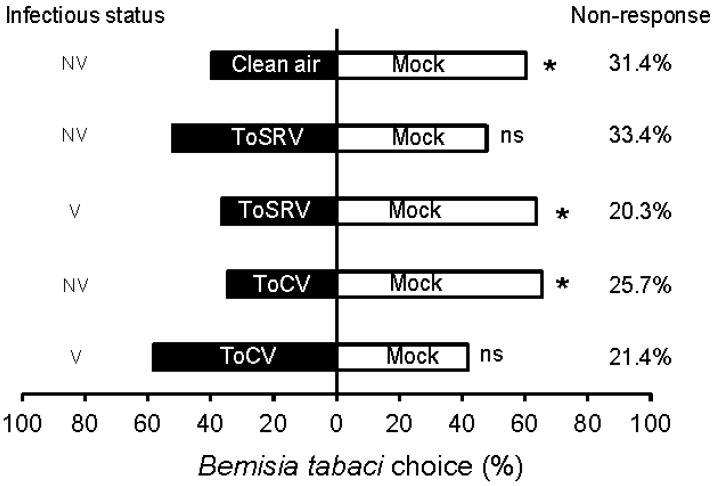
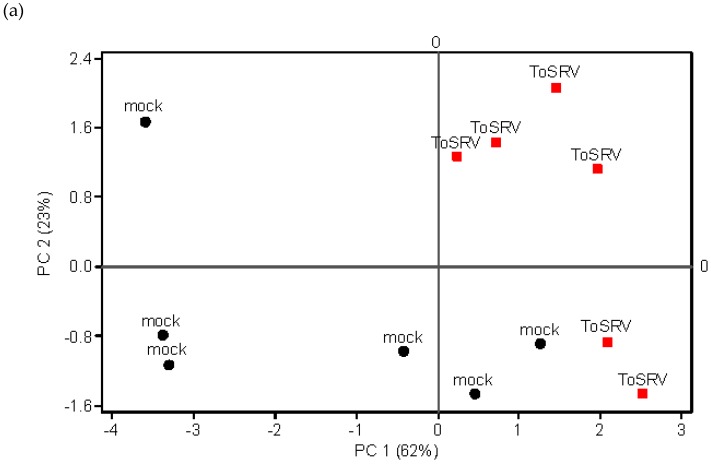
Virus infection frequently modifies plant phenotypes, leading to changes in behaviour and performance of their insect vectors in a way that transmission is enhanced, although this may not always be the case. Here, we investigated Bemisia tabaci response to tomato plants infected by Tomato chlorosis virus (ToCV), a non-circulative-transmitted crinivirus, and Tomato severe rugose virus (ToSRV), a circulative-transmitted begomovirus. Moreover, we examined the role of visual and olfactory cues in host plant selection by both viruliferous and non-viruliferous B. tabaci. Visual cues alone were assessed as targets for whitefly landing by placing leaves underneath a Plexiglas plate. A dual-choice arena was used to assess whitefly response to virus-infected and mock-inoculated tomato leaves under light and dark conditions. Thereafter, we tested the whitefly response to volatiles using an active air-flow Y-tube olfactometer, and chemically characterized the blends using gas chromatography coupled to mass spectrometry. Visual stimuli tests showed that whiteflies, irrespective of their infectious status, always preferred to land on virus-infected rather than on mock-inoculated leaves. Furthermore, whiteflies had no preference for either virus-infected or mock-inoculated leaves under dark conditions, but preferred virus-infected leaves in the presence of light. ToSRV-infection promoted a sharp decline in the concentration of some tomato volatiles, while an increase in the emission of some terpenes after ToCV infection was found. ToSRV-viruliferous whiteflies preferred volatiles emitted from mock-inoculated plants, a conducive behaviour to enhance virus spread, while volatiles from ToCV-infected plants were avoided by non-viruliferous whiteflies, a behaviour that is likely detrimental to the secondary spread of the virus. In conclusion, the circulative persistent begomovirus, ToSRV, seems to have evolved together with its vector B. tabaci to optimise its own spread. However, this type of virus-induced manipulation of vector behaviour was not observed for the semi persistent crinivirus, ToCV, which is not specifically transmitted by B. tabaci and has a much less intimate virus-vector relationship.
病毒感染常常会改变植物表型,导致其昆虫传毒介体的行为和表现发生变化,从而增强传毒效率,不过情况并非总是如此。在此,我们研究了烟粉虱对感染番茄褪绿病毒(ToCV,一种非循环传播的纤细病毒)和番茄严重皱叶病毒(ToSRV,一种循环传播的双生病毒)的番茄植株的反应。此外,我们还研究了带毒和无毒烟粉虱在寄主植物选择过程中视觉和嗅觉线索的作用。仅通过将叶片放置在有机玻璃板下方,以评估视觉线索作为粉虱降落的目标。使用双选试验场来评估粉虱在光照和黑暗条件下对病毒感染和模拟接种的番茄叶片的反应。之后,我们使用主动气流Y型管嗅觉仪测试粉虱对挥发物的反应,并通过气相色谱-质谱联用对混合物进行化学表征。视觉刺激试验表明,无论感染状态如何,粉虱总是更喜欢降落在病毒感染的叶片上,而不是模拟接种的叶片上。此外,粉虱在黑暗条件下对病毒感染或模拟接种的叶片没有偏好,但在有光照的情况下更喜欢病毒感染的叶片。ToSRV感染导致一些番茄挥发物浓度急剧下降,而ToCV感染后发现一些萜类化合物的释放增加。携带ToSRV的粉虱更喜欢模拟接种植物释放的挥发物,这是一种有利于病毒传播的行为,而无毒粉虱则避开ToCV感染植物释放的挥发物,这种行为可能对病毒的二次传播不利。总之,循环持久性双生病毒ToSRV似乎与其传毒介体烟粉虱共同进化,以优化自身传播。然而,对于半持久性纤细病毒ToCV,未观察到这种类型的病毒诱导的介体行为操纵,ToCV并非由烟粉虱特异性传播,且病毒与介体的关系远没有那么密切。