
微小RNA-497-5p通过靶向血管肉瘤中的钾钙通道蛋白3.1抑制细胞增殖和侵袭。
miR-497-5p inhibits cell proliferation and invasion by targeting KCa3.1 in angiosarcoma.
作者信息
Chen Yaobing, Kuang Dong, Zhao Xia, Chen Dong, Wang Xiaoyan, Yang Qin, Wan Jie, Zhu Yuanli, Wang Yu, Zhang Shiying, Wang Ying, Tang Qiang, Masuzawa Mikio, Wang Guoping, Duan Yaqi
机构信息
Institute of Pathology, Tongji Hospital, Tongji Medical College, Huazhong University of Science and Technology, Wuhan 430030, China.
Department of Pathology, School of Basic Medicine, Tongji Medical College, Huazhong University of Science and Technology, Wuhan 430030, China.
出版信息
Oncotarget. 2016 Sep 6;7(36):58148-58161. doi: 10.18632/oncotarget.11252.
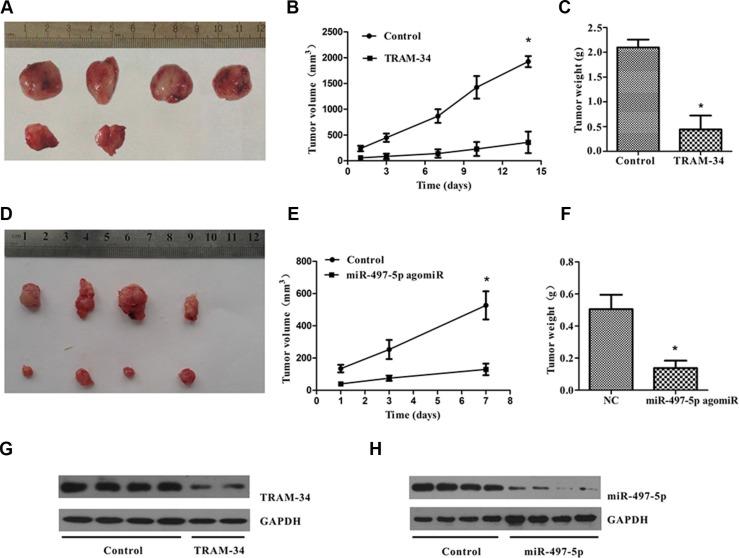
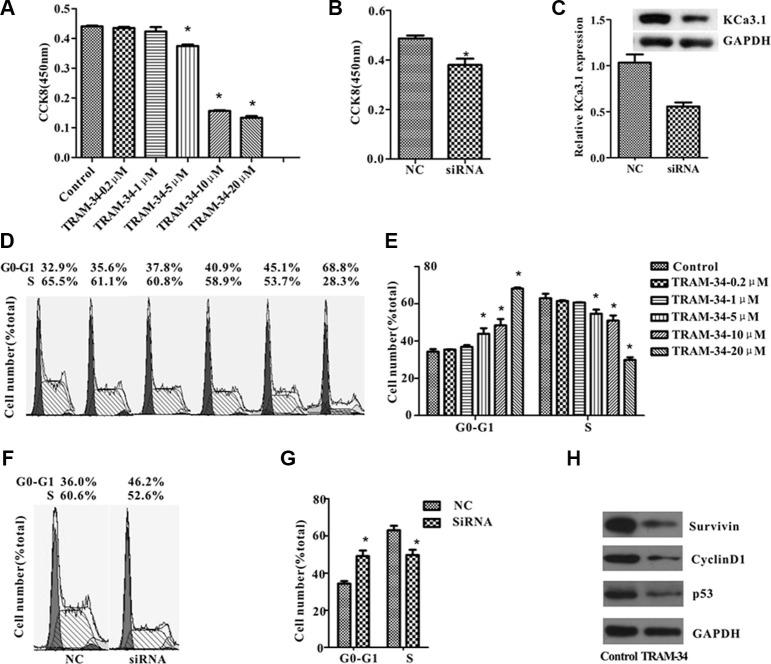
Angiosarcoma is a rare malignant mesenchymal tumor with poor prognosis. We aimed to identify malignancy-associated miRNAs and their target genes, and explore biological functions of miRNA and its target in angiosarcoma. By miRNA microarrays and reverse transcription polymerase chain reaction, we identified 1 up-regulated miRNA (miR-222-3p) and 3 down-regulated miRNAs (miR-497-5p, miR-378-3p and miR-483-5p) in human angiosarcomas compared with human capillary hemangiomas. The intermediate-conductance calcium activated potassium channel KCa3.1 was one of the putative target genes of miR-497-5p, and marked up-regulation of KCa3.1 was detected in angiosarcoma biopsy specimens by immunohistochemistry. The inverse correlation of miR-497-5p and KCa3.1 also was observed in the ISO-HAS angiosarcoma cell line at the mRNA and protein levels. The direct targeting of KCa3.1 by miR-497-5p was evidenced by reduced luciferase activity due to complementary binding of miR-497-5p to KCa3.1 mRNA 3' untranslated region. For the functional role of miR-497-5p/KCa3.1 pair, we showed that application of TRAM-34, a specific KCa3.1 channel blocker, or transfection of ISO-HAS cells with KCa3.1 siRNA or miR-497-5p mimics inhibited cell proliferation, cell cycle progression, and invasion by down-regulating cell-cycle related proteins including cyclin D1, surviving and P53 and down-regulating matrix metallopeptidase 9. In an in vivo angiosarcoma xenograft model, TRAM-34 or miR-497-5p mimics both inhibited tumor growth. In conclusion, the tumor suppressor miR-497-5p down-regulates KCa3.1 expression and contributes to the inhibition of angiosarcoma malignancy development. The miR-497-5p or KCa3.1 might be potential new targets for angiosarcoma treatment.
血管肉瘤是一种预后较差的罕见恶性间充质肿瘤。我们旨在鉴定与恶性肿瘤相关的miRNA及其靶基因,并探讨miRNA及其靶标在血管肉瘤中的生物学功能。通过miRNA微阵列和逆转录聚合酶链反应,与人类毛细血管瘤相比,我们在人类血管肉瘤中鉴定出1种上调的miRNA(miR-222-3p)和3种下调的miRNA(miR-497-5p、miR-378-3p和miR-483-5p)。中间电导钙激活钾通道KCa3.1是miR-497-5p的推定靶基因之一,通过免疫组织化学在血管肉瘤活检标本中检测到KCa3.1明显上调。在ISO-HAS血管肉瘤细胞系的mRNA和蛋白质水平上也观察到miR-497-5p与KCa3.1呈负相关。由于miR-497-5p与KCa3.1 mRNA 3'非翻译区的互补结合导致荧光素酶活性降低,证明了miR-497-5p对KCa3.1的直接靶向作用。对于miR-497-5p/KCa3.1对的功能作用,我们表明应用TRAM-34(一种特异性KCa3.1通道阻滞剂),或用KCa3.1 siRNA或miR-497-5p模拟物转染ISO-HAS细胞,通过下调包括细胞周期蛋白D1、存活蛋白和P53在内的细胞周期相关蛋白以及下调基质金属肽酶9来抑制细胞增殖、细胞周期进程和侵袭。在体内血管肉瘤异种移植模型中,TRAM-34或miR-497-5p模拟物均抑制肿瘤生长。总之,肿瘤抑制性miR-497-5p下调KCa3.1表达并有助于抑制血管肉瘤的恶性发展。miR-497-5p或KCa3.1可能是血管肉瘤治疗的潜在新靶点。




 Zotero 插件