Han Chang-Dong, Shin Keun-Young, Lee Hyun-Hee, Park Kwan-Kyu, Yang Ick-Hwan, Lee Woo-Suk
Department of Orthopaedic Surgery, Yonsei University College of Medicine, Seoul, Korea.
Hip Pelvis. 2015 Dec;27(4):209-15. doi: 10.5371/hp.2015.27.4.209. Epub 2015 Dec 30.
The aim of this study was to report the long-term outcome and the failure mechanism of cementless total hip arthroplasty (THA) using hydroxyapatite (HA)-coated acetabular cup.
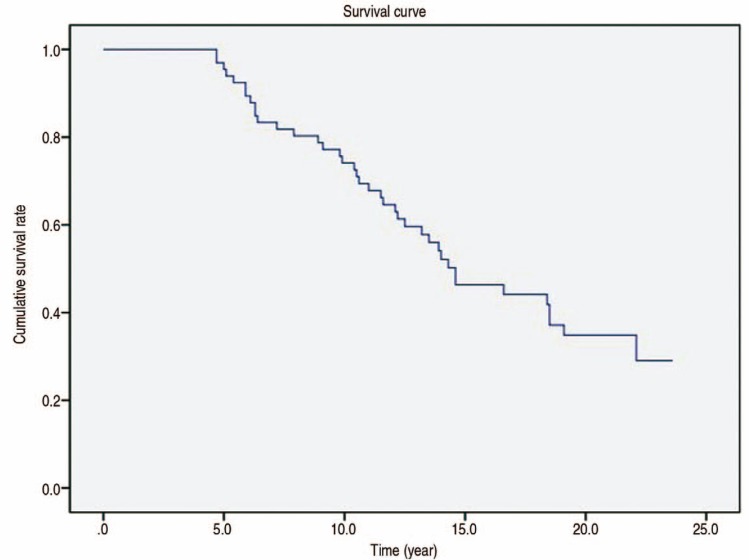
From January 1992 to May 1994, a total of 123 consecutive cementless primary THAs were performed using a HA-coated acetabular cup with metal-on-polyethylene articulation. We retrospectively evaluated 66 hips available for follow-up at a mean 18.3 years (range, 10.4-23.6 years). The survival analysis was performed by the Kaplan-Meier method. We defined end point as any failure that required a reoperation of acetabular component.
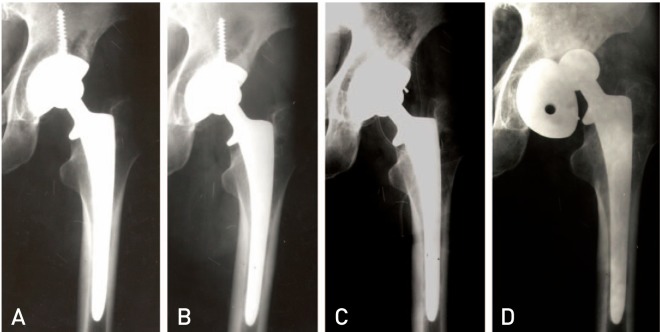
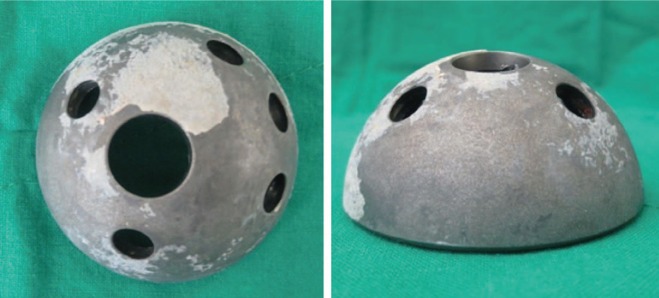
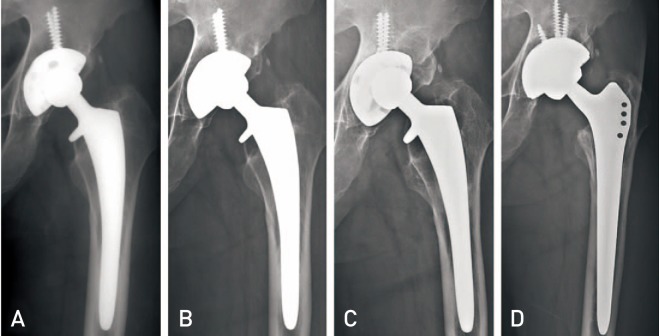
Thirty-nine of 66 hips (59.1%) were defined as a failure for progressive acetabular osteolysis or aseptic loosening of the cup. Acetabular osteolysis was observed in 47 hips (71.2%) and 33 hips (50.0%) were revised because of cup loosening. The Kaplan-Meier method showed the survival rate of the acetabular cup to be 46.3% at 15 years and 34.8% at 20 years for any failure that required a reoperation of acetabular component.
The long-term survival rate of THA using HA-coated acetabular cup was unsatisfactory, and it was attributed to vulnerable property of HA coating and progressive osteolysis.
本研究旨在报告使用羟基磷灰石(HA)涂层髋臼杯的非骨水泥型全髋关节置换术(THA)的长期疗效及失败机制。
1992年1月至1994年5月,连续进行了123例使用HA涂层髋臼杯及金属对聚乙烯关节的非骨水泥初次THA手术。我们回顾性评估了66例可随访的髋关节,平均随访时间为18.3年(范围10.4 - 23.6年)。采用Kaplan-Meier法进行生存分析。我们将终点定义为任何需要对髋臼组件进行再次手术的失败情况。
66例髋关节中有39例(59.1%)因髋臼进行性骨溶解或髋臼杯无菌性松动被定义为失败。47例髋关节(71.2%)观察到髋臼骨溶解,33例髋关节(50.0%)因髋臼杯松动进行了翻修。Kaplan-Meier法显示,对于任何需要对髋臼组件进行再次手术的失败情况,髋臼杯在15年时的生存率为46.3%,在20年时为34.8%。
使用HA涂层髋臼杯的THA长期生存率不理想,这归因于HA涂层的易损性和进行性骨溶解。