Monnereau Claire, Vogelezang Suzanne, Kruithof Claudia J, Jaddoe Vincent W V, Felix Janine F
The Generation R Study Group, Erasmus MC, University Medical Center Rotterdam, P.O. Box 2040, 3000, CA, Rotterdam, The Netherlands.
Department of Epidemiology, Erasmus MC, University Medical Center Rotterdam, P.O. Box 2040, 3000, CA, Rotterdam, The Netherlands.
BMC Genet. 2016 Aug 18;17(1):120. doi: 10.1186/s12863-016-0425-y.
Results from genome-wide association studies (GWAS) identified many loci and biological pathways that influence adult body mass index (BMI). We aimed to identify if biological pathways related to adult BMI also affect infant growth and childhood adiposity measures.
We used data from a population-based prospective cohort study among 3,975 children with a mean age of 6 years. Genetic risk scores were constructed based on the 97 SNPs associated with adult BMI previously identified with GWAS and on 28 BMI related biological pathways based on subsets of these 97 SNPs. Outcomes were infant peak weight velocity, BMI at adiposity peak and age at adiposity peak, and childhood BMI, total fat mass percentage, android/gynoid fat ratio, and preperitoneal fat area. Analyses were performed using linear regression models.
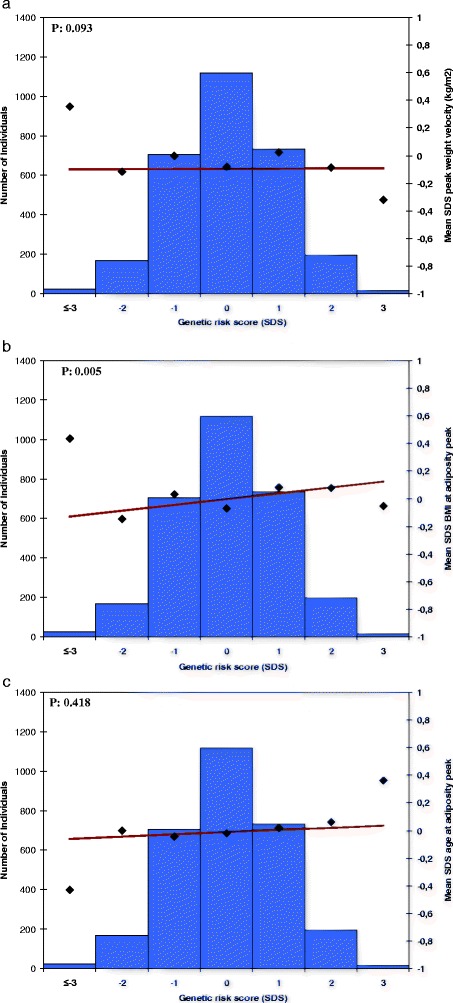
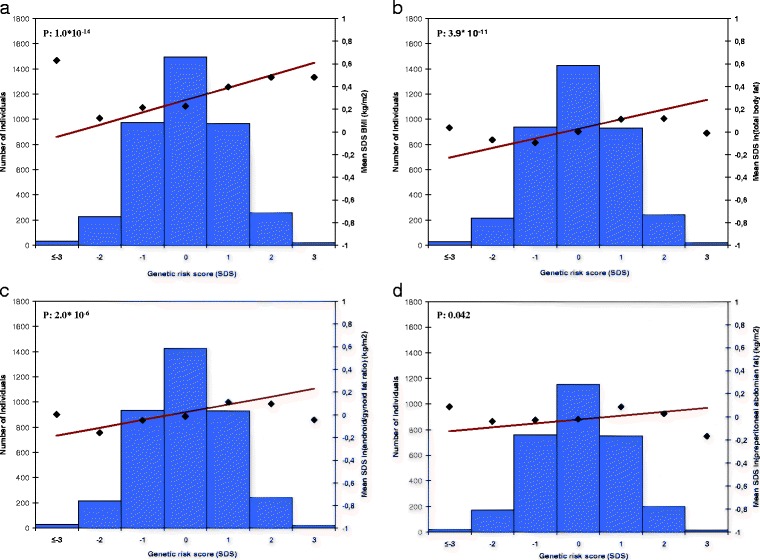
A higher overall adult BMI risk score was associated with infant BMI at adiposity peak and childhood BMI, total fat mass, android/gynoid fat ratio, and preperitoneal fat area (all p-values < 0.05). Analyses focused on specific biological pathways showed that the membrane proteins genetic risk score was associated with infant peak weight velocity, and the genetic risk scores related to neuronal developmental processes, hypothalamic processes, cyclicAMP, WNT-signaling, membrane proteins, monogenic obesity and/or energy homeostasis, glucose homeostasis, cell cycle, and muscle biology pathways were associated with childhood adiposity measures (all p-values <0.05). None of the pathways were associated with childhood preperitoneal fat area.
A genetic risk score based on 97 SNPs related to adult BMI was associated with peak weight velocity during infancy and general and abdominal fat measurements at the age of 6 years. Risk scores based on genetic variants linked to specific biological pathways, including central nervous system and hypothalamic processes, influence body fat development from early life onwards.
全基因组关联研究(GWAS)的结果确定了许多影响成人体重指数(BMI)的基因座和生物学途径。我们旨在确定与成人体重指数相关的生物学途径是否也会影响婴儿生长和儿童肥胖指标。
我们使用了一项基于人群的前瞻性队列研究的数据,该研究涉及3975名平均年龄为6岁的儿童。基于先前通过GWAS鉴定出的与成人体重指数相关的97个单核苷酸多态性(SNP)以及基于这97个SNP子集的28条与BMI相关的生物学途径构建遗传风险评分。结局指标为婴儿体重峰值速度、肥胖峰值时的BMI和肥胖峰值年龄,以及儿童期BMI、总脂肪质量百分比、男性化/女性化脂肪比例和腹膜前脂肪面积。使用线性回归模型进行分析。
较高的总体成人体重指数风险评分与肥胖峰值时的婴儿BMI以及儿童期BMI、总脂肪质量、男性化/女性化脂肪比例和腹膜前脂肪面积相关(所有p值<0.05)。对特定生物学途径的分析表明,膜蛋白遗传风险评分与婴儿体重峰值速度相关,与神经元发育过程、下丘脑过程、环磷酸腺苷(cAMP)、WNT信号传导、膜蛋白、单基因肥胖和/或能量稳态、葡萄糖稳态、细胞周期以及肌肉生物学途径相关的遗传风险评分与儿童肥胖指标相关(所有p值<0.05)。没有任何途径与儿童腹膜前脂肪面积相关。
基于与成人体重指数相关的97个SNP的遗传风险评分与婴儿期的体重峰值速度以及6岁时的总体和腹部脂肪测量相关。基于与特定生物学途径(包括中枢神经系统和下丘脑过程)相关的基因变异的风险评分从生命早期就影响身体脂肪发育。