Folkhälsan Research Center, Topeliuksenkatu 20, 00250, Helsinki, Finland.
Faculty of Medicine, University of Helsinki, Helsinki, Finland.
Sci Rep. 2023 Sep 14;13(1):15265. doi: 10.1038/s41598-023-42430-5.
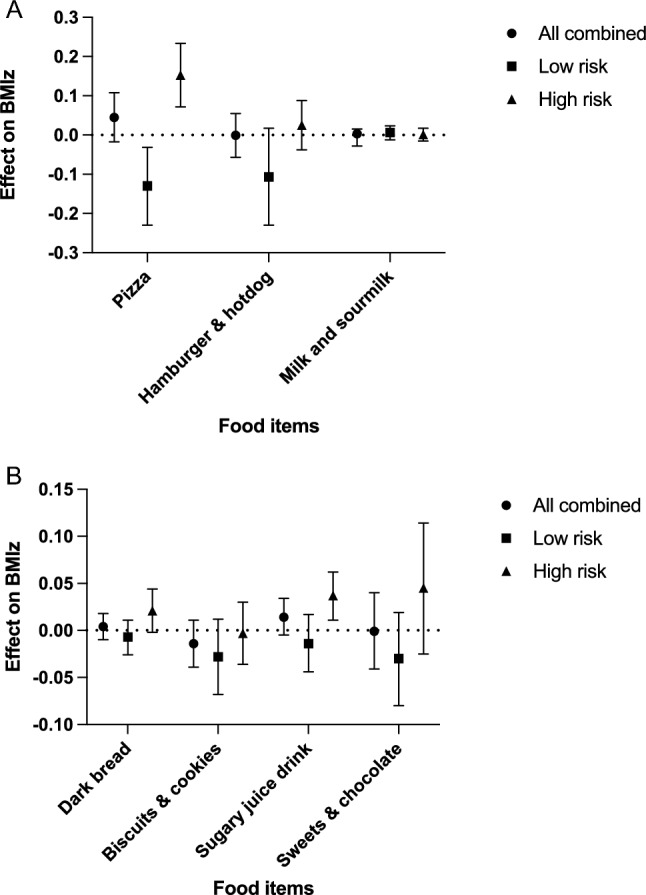
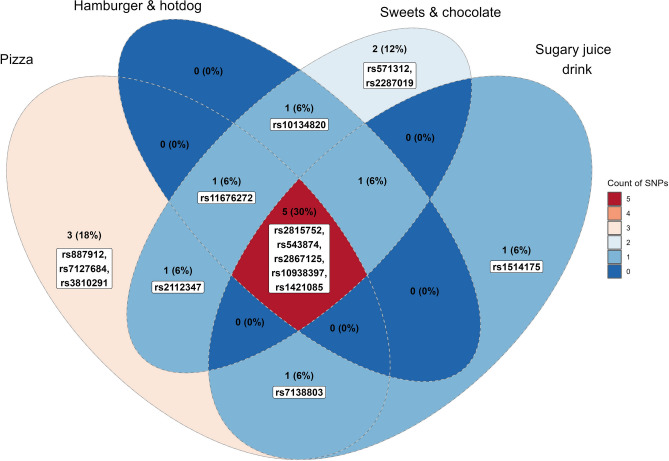
Diet modulates the genetic risk of obesity, but the modulation has been rarely studied using genetic risk scores (GRSs) in children. Our objectives were to identify single nucleotide polymorphisms (SNPs) that drive the interaction of specific foods with obesity and combine these into GRSs. Genetic and food frequency data from Finnish Health in Teens study was utilized. In total, 1142 11-year-old subjects were genotyped on the Metabochip array. BMI-GRS with 30 well-known SNPs was computed and the interaction of individual SNPs with food items and their summary dietary scores were examined in relation to age- and sex-specific BMI z-score (BMIz). The whole BMI-GRS interacted with several foods on BMIz. We identified 7-11 SNPs responsible for each interaction and these were combined into food-specific GRS. The most predominant interaction was witnessed for pizza (p < 0.001): the effect on BMIz was b - 0.130 (95% CI - 0.23; - 0.031) in those with low-risk, and 0.153 (95% CI 0.072; 0.234) in high-risk. Corresponding, but weaker interactions were verified for sweets and chocolate, sugary juice drink, and hamburger and hotdog. In total 5 SNPs close to genes NEGR1, SEC16B, TMEM18, GNPDA2, and FTO were shared between these interactions. Our results suggested that children genetically prone to obesity showed a stronger association of unhealthy foods with BMIz than those with lower genetic susceptibility. Shared SNPs of the interactions suggest common differences in metabolic gene-diet interactions, which warrants further investigation.
饮食可以调节肥胖的遗传风险,但很少有研究使用遗传风险评分(GRS)来研究儿童的这种调节作用。我们的目的是确定驱动特定食物与肥胖相互作用的单核苷酸多态性(SNP),并将这些 SNP 组合成 GRS。我们利用了芬兰青少年健康研究中的遗传和食物频率数据。共有 1142 名 11 岁的受试者在代谢芯片上进行了基因分型。计算了包含 30 个已知 SNP 的 BMI-GRS,并研究了个体 SNP 与食物及其综合饮食评分与年龄和性别特异性 BMIz 分数的相互作用。整个 BMI-GRS 与多种食物的 BMIz 相互作用。我们确定了每个相互作用的 7-11 个 SNP,并将这些 SNP 组合成特定食物的 GRS。最主要的相互作用发生在披萨(p<0.001):低风险人群的 BMIz 效应为 b-0.130(95%CI-0.23;-0.031),高风险人群的 BMIz 效应为 0.153(95%CI0.072;0.234)。相应地,我们还验证了甜食和巧克力、含糖果汁饮料、汉堡和热狗之间较弱的相互作用。这些相互作用共有 5 个 SNP,它们靠近 NEGR1、SEC16B、TMEM18、GNPDA2 和 FTO 基因。我们的研究结果表明,遗传上易患肥胖的儿童与 BMIz 之间的不健康食物的相关性比遗传易感性较低的儿童更强。这些相互作用的共享 SNP 表明代谢基因-饮食相互作用的共同差异,这值得进一步研究。