Growth, Exercise, NUtrition and Development (GENUD) Research Group, Instituto Agroalimentario de Aragón (IA2), Instituto de Investigación Sanitaria Aragón (IIS Aragón), Universidad de Zaragoza, Zaragoza, Spain.
Spanish National Cancer Research Centre (CNIO), Madrid, Spain.
Sci Rep. 2021 Feb 4;11(1):3067. doi: 10.1038/s41598-021-82712-4.
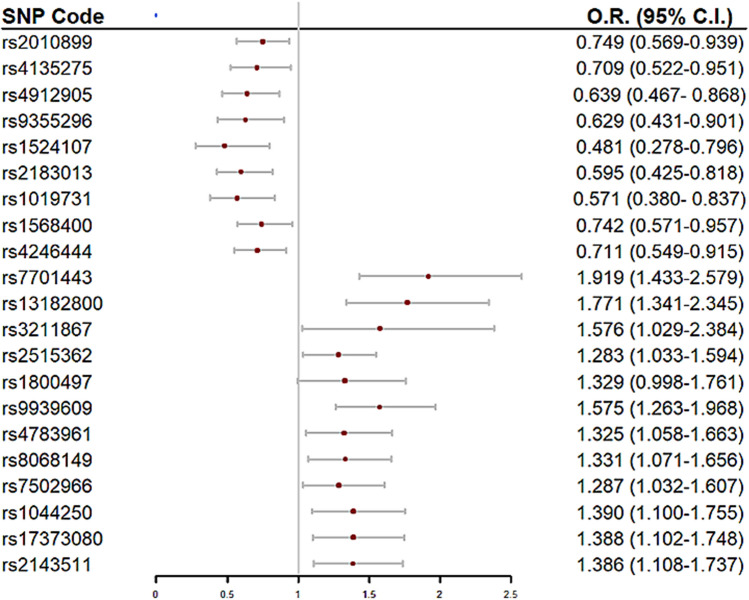
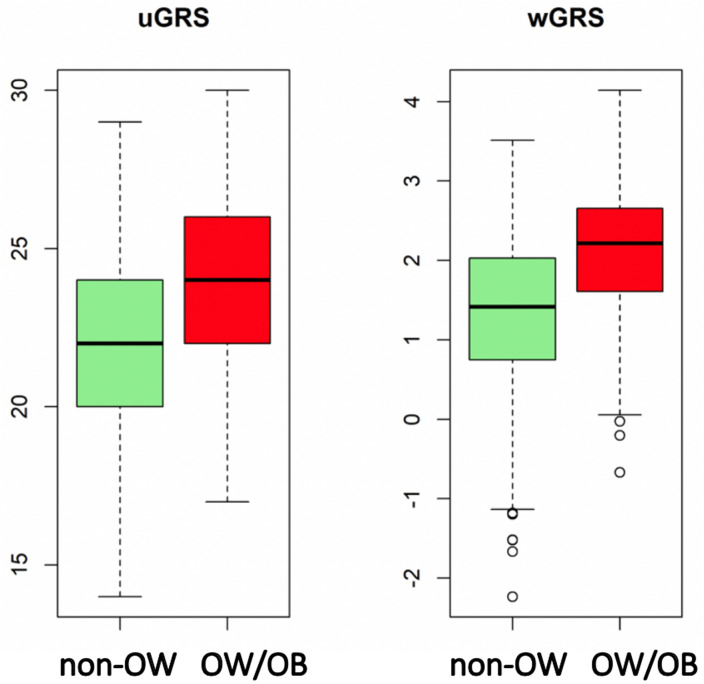
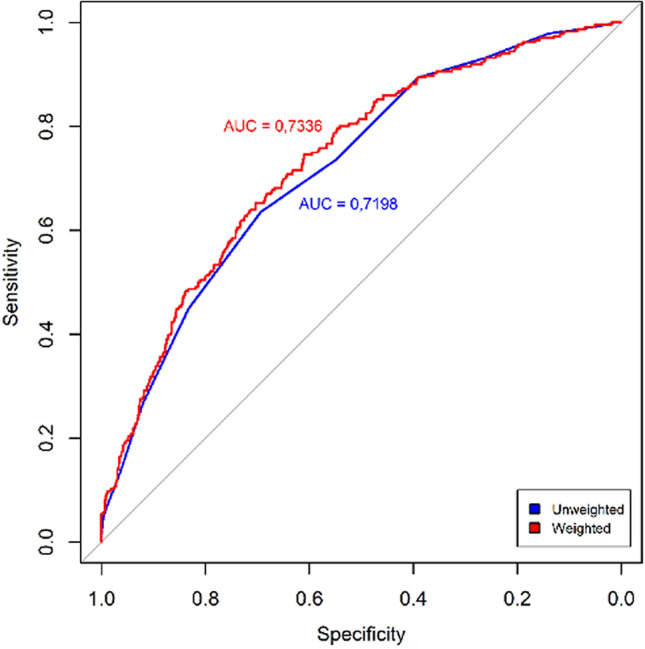
Obesity is the result of interactions between genes and environmental factors. Since monogenic etiology is only known in some obesity-related genes, a genetic risk score (GRS) could be useful to determine the genetic predisposition to obesity. Therefore, the aim of our study was to build a GRS able to predict genetic predisposition to overweight and obesity in European adolescents. A total of 1069 adolescents (51.3% female), aged 11-19 years participating in the Healthy Lifestyle in Europe by Nutrition in Adolescence (HELENA) cross-sectional study were genotyped. The sample was divided in non-overweight (non-OW) and overweight/obesity (OW/OB). From 611 single nucleotide polymorphisms (SNP) available, a first screening of 104 SNPs univariately associated with obesity (p < 0.20) was established selecting 21 significant SNPs (p < 0.05) in the multivariate model. Unweighted GRS (uGRS) was calculated by summing the number of risk alleles and weighted GRS (wGRS) by multiplying the risk alleles to each estimated coefficient. The area under curve (AUC) was calculated in uGRS (0.723) and wGRS (0.734) using tenfold internal cross-validation. Both uGRS and wGRS were significantly associated with body mass index (BMI) (p < .001). Both GRSs could potentially be considered as useful genetic tools to evaluate individual's predisposition to overweight/obesity in European adolescents.
肥胖是基因和环境因素相互作用的结果。由于单基因病因仅在一些与肥胖相关的基因中可知,遗传风险评分 (GRS) 可用于确定肥胖的遗传易感性。因此,我们的研究目的是建立一个能够预测欧洲青少年超重和肥胖遗传易感性的 GRS。共有 1069 名年龄在 11-19 岁的青少年(51.3%为女性)参加了欧洲青少年营养与健康生活方式(HELENA)的横断面研究,对其进行了基因分型。该样本分为非超重(非 OW)和超重/肥胖(OW/OB)两组。从可用的 611 个单核苷酸多态性 (SNP) 中,首先对 104 个与肥胖相关的 SNP(p<0.20)进行了单变量筛选,选择了多变量模型中 21 个有意义的 SNP(p<0.05)。通过将风险等位基因相加来计算未加权 GRS (uGRS),并通过将风险等位基因乘以每个估计系数来计算加权 GRS (wGRS)。在 uGRS(0.723)和 wGRS(0.734)中使用十折内部交叉验证计算曲线下面积 (AUC)。uGRS 和 wGRS 均与体重指数 (BMI) 显著相关(p<0.001)。这两种 GRS 都可以被认为是评估欧洲青少年超重/肥胖遗传易感性的有用遗传工具。