Gupta Nidhi, Wu Heng, Terman Jonathan R
Departments of Neuroscience and Pharmacology, Harold C. Simmons Comprehensive Cancer Center, The University of Texas Southwestern Medical Center, Dallas, TX 75390, USA.
Data Brief. 2016 Jul 21;8:1227-31. doi: 10.1016/j.dib.2016.07.032. eCollection 2016 Sep.
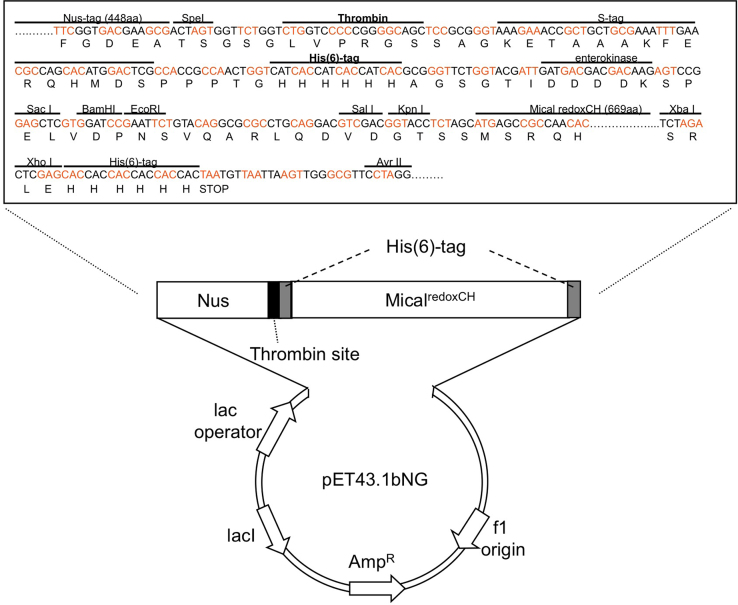
Bacteria are the predominant source for producing recombinant proteins but while many exogenous proteins are expressed, only a fraction of those are soluble. We have found that a new actin regulatory enzyme Mical is poorly soluble when expressed in bacteria but the use of a Nus fusion protein tag greatly increases its solubility. However, available vectors containing a Nus tag have been engineered in a way that hinders the separation of target proteins from the Nus tag during protein purification. We have now used recombinant DNA approaches to overcome these issues and reengineer a Nus solubility tag-containing bacterial expression vector. The data herein present a modified bacterial expression vector useful for expressing proteins fused to the Nus solubility tag and separating such target proteins from the Nus tag during protein purification.
细菌是生产重组蛋白的主要来源,但尽管表达了许多外源蛋白,其中只有一小部分是可溶的。我们发现,一种新的肌动蛋白调节酶Mical在细菌中表达时溶解性很差,但使用Nus融合蛋白标签可大大提高其溶解度。然而,现有的含有Nus标签的载体在设计上阻碍了蛋白质纯化过程中目标蛋白与Nus标签的分离。我们现在利用重组DNA方法来克服这些问题,并重新构建了一种含有Nus溶解度标签的细菌表达载体。本文的数据展示了一种改良的细菌表达载体,可用于表达与Nus溶解度标签融合的蛋白质,并在蛋白质纯化过程中将此类目标蛋白与Nus标签分离。