Peeters Elien, Hooyberghs Geert, Robijns Stijn, Waldrant Kai, De Weerdt Ami, Delattin Nicolas, Liebens Veerle, Kucharíková Soňa, Tournu Hélène, Verstraeten Natalie, Dovgan Barbara, Girandon Lenart, Fröhlich Mirjam, De Brucker Katrijn, Van Dijck Patrick, Michiels Jan, Cammue Bruno P A, Thevissen Karin, Vanderleyden Jozef, Van der Eycken Erik, Steenackers Hans P
Centre of Microbial and Plant Genetics (CMPG), Department of Microbial and Molecular Systems, KU Leuven, Leuven, Belgium.
Laboratory for Organic & Microwave-Assisted Chemistry (LOMAC), Department of Chemistry, KU Leuven, Leuven, Belgium.
Antimicrob Agents Chemother. 2016 Oct 21;60(11):6483-6497. doi: 10.1128/AAC.00035-16. Print 2016 Nov.
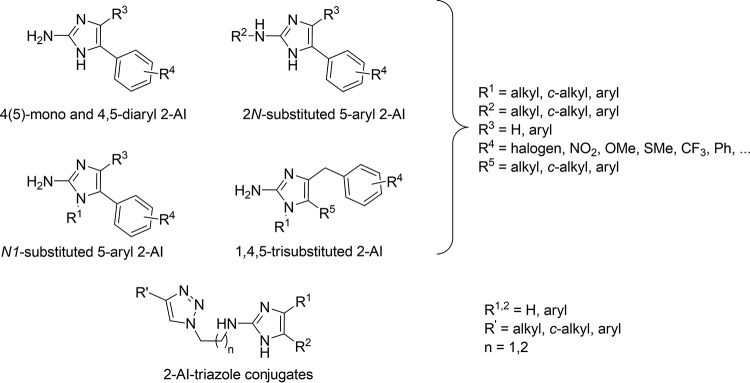
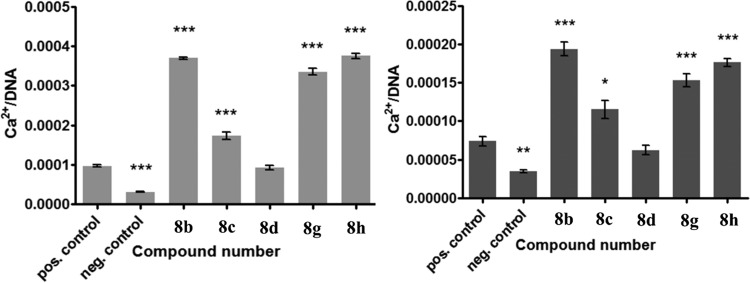
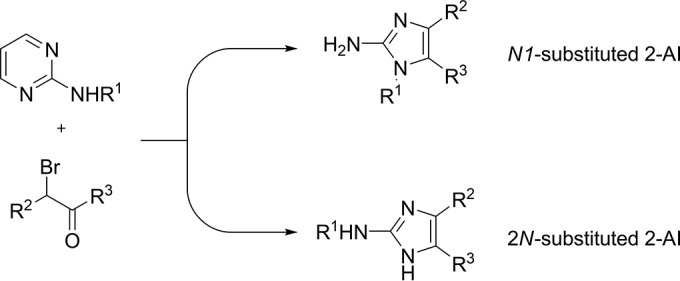
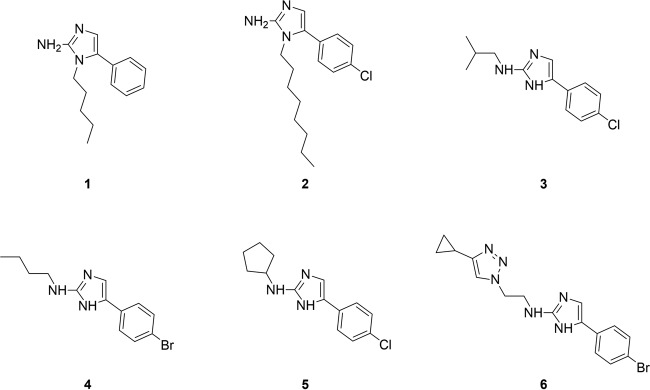
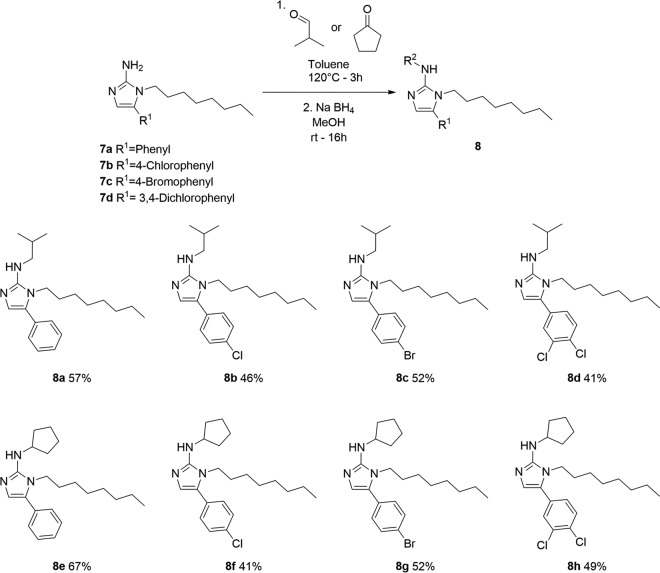
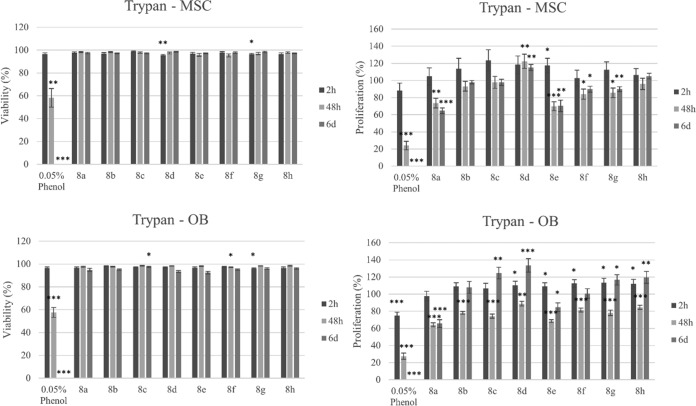
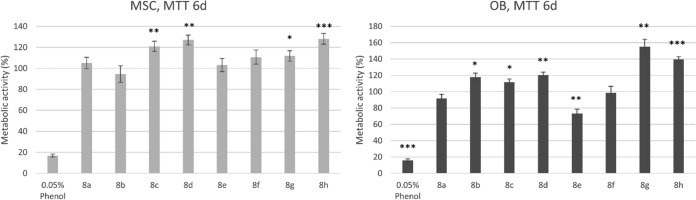
We previously synthesized several series of compounds, based on the 5-aryl-2-aminoimidazole scaffold, that showed activity preventing the formation of Salmonella enterica serovar Typhimurium and Pseudomonas aeruginosa biofilms. Here, we further studied the activity spectrum of a number of the most active N1- and 2N-substituted 5-aryl-2-aminoimidazoles against a broad panel of biofilms formed by monospecies and mixed species of bacteria and fungi. An N1-substituted compound showed very strong activity against the biofilms formed by Gram-negative and Gram-positive bacteria and the fungus Candida albicans but was previously shown to be toxic against various eukaryotic cell lines. In contrast, 2N-substituted compounds were nontoxic and active against biofilms formed by Gram-negative bacteria and C. albicans but had reduced activity against biofilms formed by Gram-positive bacteria. In an attempt to develop nontoxic compounds with potent activity against biofilms formed by Gram-positive bacteria for application in antibiofilm coatings for medical implants, we synthesized novel compounds with substituents at both the N1 and 2N positions and tested these compounds for antibiofilm activity and toxicity. Interestingly, most of these N1-,2N-disubstituted 5-aryl-2-aminoimidazoles showed very strong activity against biofilms formed by Gram-positive bacteria and C. albicans in various setups with biofilms formed by monospecies and mixed species but lost activity against biofilms formed by Gram-negative bacteria. In light of application of these compounds as anti-infective coatings on orthopedic implants, toxicity against two bone cell lines and the functionality of these cells were tested. The N1-,2N-disubstituted 5-aryl-2-aminoimidazoles in general did not affect the viability of bone cells and even induced calcium deposition. This indicates that modulating the substitution pattern on positions N1 and 2N of the 5-aryl-2-aminoimidazole scaffold allows fine-tuning of both the antibiofilm activity spectrum and toxicity.
我们之前基于5-芳基-2-氨基咪唑支架合成了几个系列的化合物,这些化合物显示出预防鼠伤寒沙门氏菌和铜绿假单胞菌生物膜形成的活性。在此,我们进一步研究了一些活性最强的N1-和2N-取代的5-芳基-2-氨基咪唑对由单一物种及混合物种的细菌和真菌形成的多种生物膜的活性谱。一种N1-取代的化合物对革兰氏阴性菌、革兰氏阳性菌和白色念珠菌形成的生物膜显示出非常强的活性,但之前已证明其对各种真核细胞系有毒性。相比之下,2N-取代的化合物无毒,对革兰氏阴性菌和白色念珠菌形成的生物膜有活性,但对革兰氏阳性菌形成的生物膜活性降低。为了开发对革兰氏阳性菌形成的生物膜具有强效活性的无毒化合物,用于医疗植入物的抗生物膜涂层,我们合成了在N1和2N位置均有取代基的新型化合物,并测试了这些化合物的抗生物膜活性和毒性。有趣的是,大多数这些N1、2N-二取代的5-芳基-2-氨基咪唑在各种单一物种和混合物种形成生物膜的实验设置中,对革兰氏阳性菌和白色念珠菌形成的生物膜显示出非常强的活性,但对革兰氏阴性菌形成的生物膜失去了活性。鉴于将这些化合物用作骨科植入物上的抗感染涂层,测试了其对两种骨细胞系的毒性以及这些细胞的功能。一般来说,N1、2N-二取代的5-芳基-2-氨基咪唑不会影响骨细胞的活力,甚至会诱导钙沉积。这表明调节5-芳基-2-氨基咪唑支架N1和2N位置上的取代模式,可以对抗生物膜活性谱和毒性进行微调。