Finstad Anders G, Andersen Tom, Larsen Søren, Tominaga Koji, Blumentrath Stefan, de Wit Heleen A, Tømmervik Hans, Hessen Dag Olav
Department of Natural History, NTNU University Museum, Norwegian University of Science and Technology, N-7491 Trondheim, Norway.
Norwegian Institute for Nature Research, P.O. Box 5685 Sluppen, NO-7485 Trondheim, Norway.
Sci Rep. 2016 Aug 24;6:31944. doi: 10.1038/srep31944.
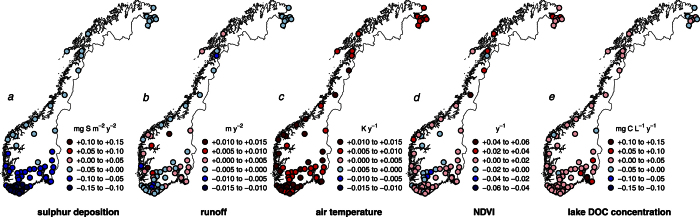
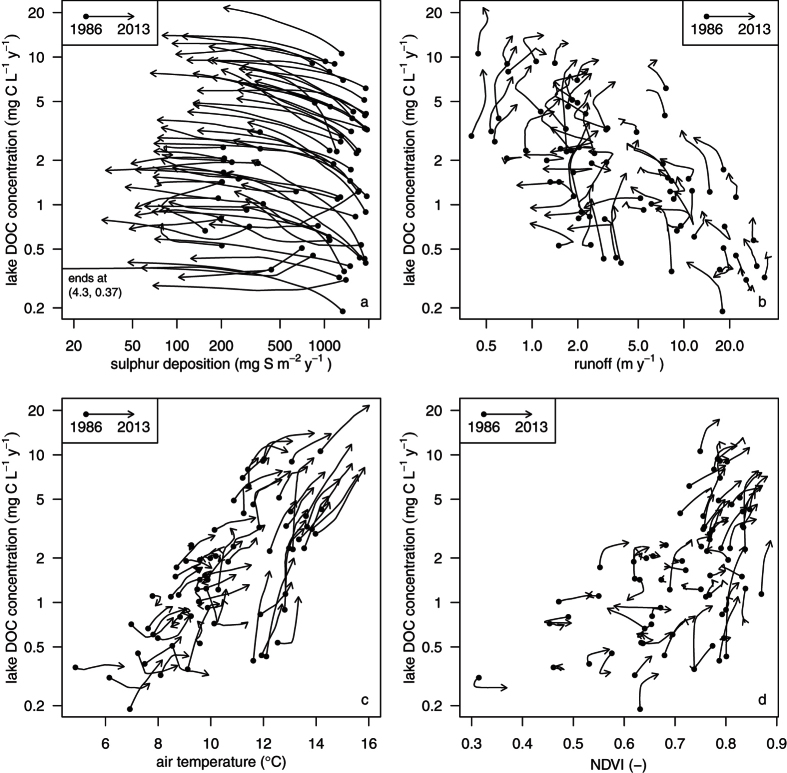
Increased concentrations of dissolved organic carbon (DOC), often labelled "browning", is a current trend in northern, particularly boreal, freshwaters. The browning has been attributed to the recent reduction in sulphate (S) deposition during the last 2 to 3 decades. Over the last century, climate and land use change have also caused an increasing trend in vegetation cover ("greening"), and this terrestrially fixed carbon represents another potential source for export of organic carbon to lakes and rivers. The impact of this greening on the observed browning of lakes and rivers on decadal time scales remains poorly investigated, however. Here, we explore time-series both on water chemistry and catchment vegetation cover (using NDVI as proxy) from 70 Norwegian lakes and catchments over a 30-year period. We show that the increase in terrestrial vegetation as well as temperature and runoff significantly adds to the reduced SO4-deposition as a driver of freshwater DOC concentration. Over extended periods (centuries), climate mediated changes in vegetation cover may cause major browning of northern surface waters, with severe impact on ecosystem productivity and functioning.
溶解有机碳(DOC)浓度增加,通常被称为“褐变”,是目前北方尤其是北方寒带淡水的一个趋势。褐变被归因于过去2至3十年间硫酸盐(S)沉降的减少。在过去的一个世纪里,气候和土地利用变化也导致了植被覆盖的增加趋势(“绿化”),而这种陆地固定碳是有机碳向湖泊和河流输出的另一个潜在来源。然而,这种绿化对湖泊和河流在十年时间尺度上观测到的褐变的影响仍未得到充分研究。在这里,我们探讨了70个挪威湖泊及其集水区在30年时间里的水化学和集水区植被覆盖(以归一化植被指数(NDVI)为代理)的时间序列。我们表明,陆地植被以及温度和径流的增加,作为淡水DOC浓度的驱动因素,显著加剧了硫酸盐沉降的减少。在较长时期(几个世纪)内,气候介导的植被覆盖变化可能导致北方地表水的重大褐变,对生态系统生产力和功能产生严重影响。