Ledda Fernanda, Paratcha Gustavo
Division of Molecular and Cellular Neuroscience, Institute of Cell Biology and Neuroscience (IBCN)-CONICET, School of Medicine-University of Buenos Aires (UBA) Buenos Aires, Argentina.
Front Cell Neurosci. 2016 Aug 9;10:199. doi: 10.3389/fncel.2016.00199. eCollection 2016.
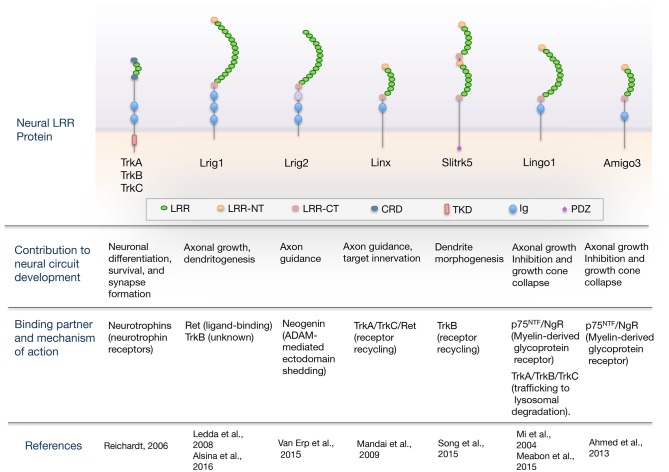
Proper function of the nervous system critically relies on sophisticated neuronal networks interconnected in a highly specific pattern. The architecture of these connections arises from sequential developmental steps such as axonal growth and guidance, dendrite development, target determination, synapse formation and plasticity. Leucine-rich repeat (LRR) transmembrane proteins have been involved in cell-type specific signaling pathways that underlie these developmental processes. The members of this superfamily of proteins execute their functions acting as trans-synaptic cell adhesion molecules involved in target specificity and synapse formation or working in cis as cell-intrinsic modulators of neurotrophic factor receptor trafficking and signaling. In this review, we will focus on novel physiological mechanisms through which LRR proteins regulate neurotrophic factor receptor signaling, highlighting the importance of these modulatory events for proper axonal extension and guidance, tissue innervation and dendrite morphogenesis. Additionally, we discuss few examples linking this set of LRR proteins to neurodevelopmental and psychiatric disorders.
神经系统的正常功能严重依赖于以高度特定模式相互连接的复杂神经元网络。这些连接的架构源于一系列发育步骤,如轴突生长与导向、树突发育、靶标确定、突触形成和可塑性。富含亮氨酸重复序列(LRR)的跨膜蛋白参与了构成这些发育过程基础的细胞类型特异性信号通路。该蛋白超家族的成员作为跨突触细胞粘附分子发挥作用,参与靶标特异性和突触形成,或作为神经生长因子受体转运和信号传导的细胞内在调节剂发挥作用。在本综述中,我们将聚焦于LRR蛋白调节神经生长因子受体信号传导的新生理机制,强调这些调节事件对轴突正常延伸和导向、组织神经支配和树突形态发生的重要性。此外,我们还讨论了将这组LRR蛋白与神经发育和精神疾病联系起来的几个例子。