Zakiev E R, Sukhorukov V N, Melnichenko A A, Sobenin I A, Ivanova E A, Orekhov A N
Laboratory of Angiopathology, Institute of General Pathology and Pathophysiology, 125315, Moscow, Russia.
Department of Development and Regeneration, KU Leuven, 3000, Leuven, Belgium.
Lipids Health Dis. 2016 Aug 24;15(1):134. doi: 10.1186/s12944-016-0308-2.
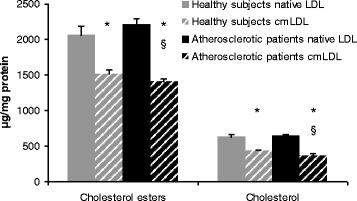
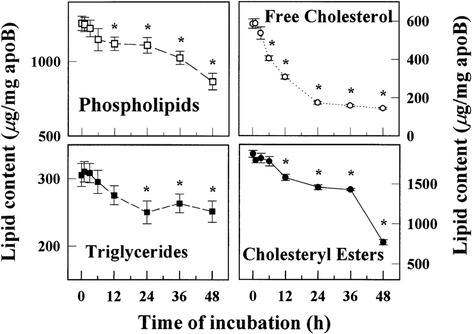
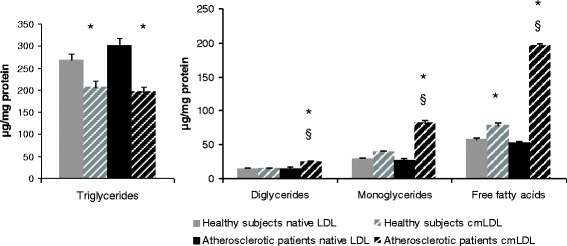
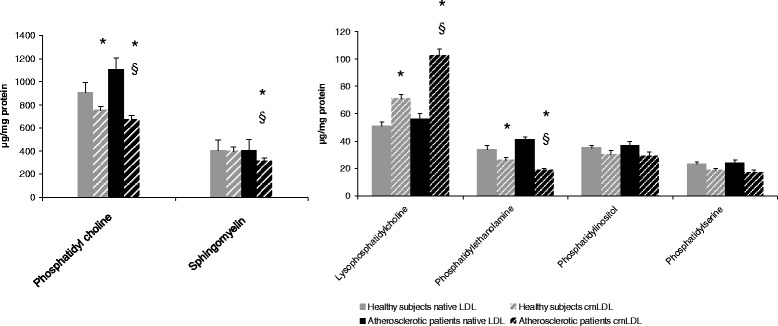
Atherogenic modified low- density lipoprotein (LDL) induces pronounced accumulation of cholesterol and lipids in the arterial wall, while native LDL seems to lack such capability. Therefore, modified LDL appears to be a major causative agent in the pathogenesis of atherosclerosis. Possible modifications of LDL particles include changes in size and density, desialylation, oxidation and acquisition of negative charge. Total LDL isolated from pooled plasma of patients with coronary atherosclerosis, as well as from healthy subjects contains two distinct subfractions: normally sialylated LDL and desialylated LDL, which can be isolated by binding to a lectin affinity column. We called the desialylated LDL subfraction circulating modified LDL (cmLDL). In this study, we focused on lipid composition of LDL particles, analysing the total LDL preparation and two LDL subfractions: cmLDL and native LDL. The composition of LDL was studied using thin-layer chromatography. We found that cmLDL subfraction had decreased levels of free and esterified cholesterol, triglycerides, phospholipids (except for lysophosphatidylcholine) and sphingomyelin in comparison to native LDL. On the other hand, levels of mono-, and diglycerides, lysophosphatidylcholine and free fatty acids were higher in cmLDL than in native LDL. Our study demonstrated that lipid composition of cmLDL from atherosclerotic patients was altered in comparison to healthy subjects. In particular, phospholipid content was decreased, and free fatty acids levels were increased in cmLDL. This strengthens the hypothesis of multiple modification of LDL particles in the bloodstream and underscores the clinical importance of desialylated LDL as a possible marker of atherosclerosis progression.
致动脉粥样硬化的修饰低密度脂蛋白(LDL)可促使胆固醇和脂质在动脉壁中显著蓄积,而天然LDL似乎缺乏这种能力。因此,修饰LDL似乎是动脉粥样硬化发病机制中的主要致病因素。LDL颗粒可能的修饰包括大小和密度的改变、去唾液酸化、氧化以及获得负电荷。从冠状动脉粥样硬化患者以及健康受试者的混合血浆中分离出的总LDL包含两个不同的亚组分:正常唾液酸化的LDL和去唾液酸化的LDL,后者可通过与凝集素亲和柱结合进行分离。我们将去唾液酸化的LDL亚组分称为循环修饰LDL(cmLDL)。在本研究中,我们重点关注LDL颗粒的脂质组成,分析了总LDL制剂以及两个LDL亚组分:cmLDL和天然LDL。使用薄层色谱法研究了LDL的组成。我们发现,与天然LDL相比cmLDL亚组分中游离胆固醇、酯化胆固醇、甘油三酯、磷脂(溶血磷脂酰胆碱除外)和鞘磷脂的水平降低。另一方面,cmLDL中甘油一酯、甘油二酯、溶血磷脂酰胆碱和游离脂肪酸的水平高于天然LDL。我们的研究表明,与健康受试者相比,动脉粥样硬化患者的cmLDL脂质组成发生了改变。特别是,cmLDL中的磷脂含量降低,游离脂肪酸水平升高。这强化了LDL颗粒在血流中发生多种修饰的假说,并强调了去唾液酸化LDL作为动脉粥样硬化进展可能标志物的临床重要性。