Mirkovic Jelena, Kristjansdottir Olöf Birna, Stenberg Una, Krogseth Tonje, Stange Kurt C, Ruland Cornelia M
Centre for Shared Decision Making and Collaborative Care Research, Division of Medicine, Oslo University Hospital HF, Oslo, Norway.
JMIR Res Protoc. 2016 Aug 24;5(3):e175. doi: 10.2196/resprot.5906.
An increasing number of research studies in the psychological and biobehavioral sciences support incorporating patients' personal strengths into illness management as a way to empower and activate the patients, thus improving their health and well-being. However, lack of attention to patients' personal strengths is still reported in patient-provider communication. Information technology (IT) has great potential to support strengths-based patient-provider communication and collaboration, but knowledge about the users' requirements and preferences is inadequate.
This study explored the aspirations and requirements of patients with chronic conditions concerning IT tools that could help increase their awareness of their own personal strengths and resources, and support discussion of these assets in consultations with health care providers.
We included patients with different chronic conditions (chronic pain, morbid obesity, and chronic obstructive pulmonary disease) and used various participatory research methods to gain insight into the participants' needs, values, and opinions, and the contexts in which they felt strengths-based IT tools could be used.
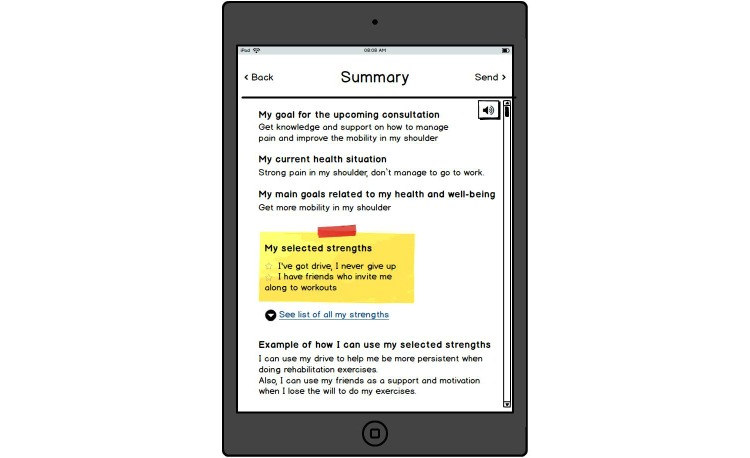
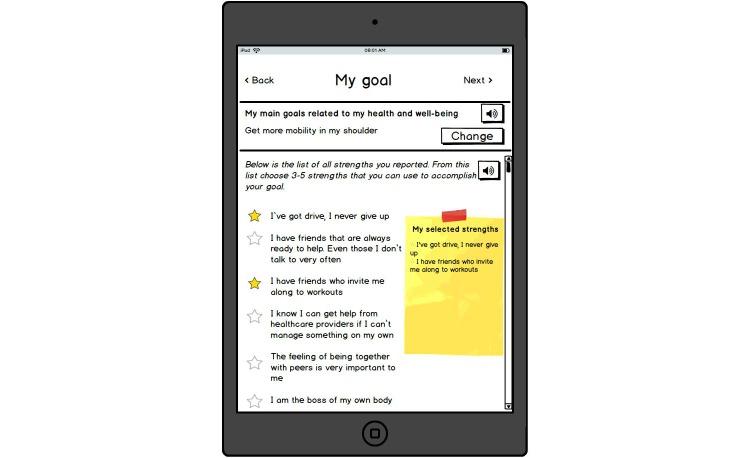
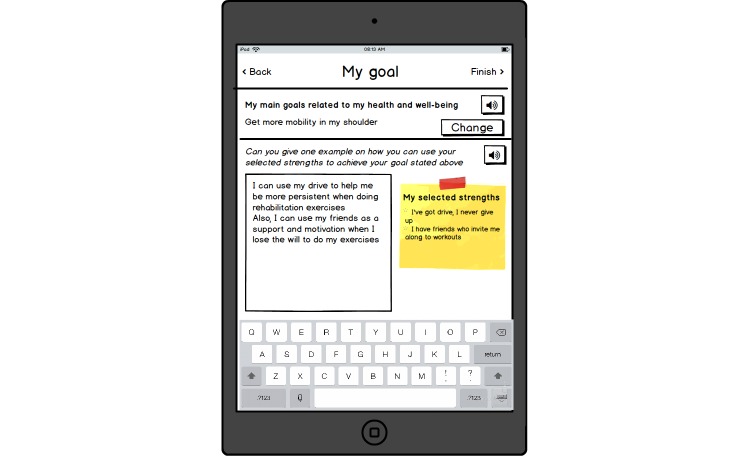
Participants were positive toward using technology to support them in identifying and discussing their personal strengths in clinical consultation, but also underlined the importance of fitting it to their specific requirements and the right contexts of use. Participants recommended that technology be designed for use in preconsultation settings (eg, at home) and felt that it should support them in both identifying strengths and in finding out new ways how strengths can be used to attain personal health-related goals. Participants advocated use of technology to support advance preparation for consultations and empower them to take a more active role. IT tools were suggested to be potentially useful in specific contexts, including individual or group consultations with health care providers (physician, nurse, specialist, care team) in clinical consultations but also outside health care settings (eg, as a part of a self-management program). Participants' requirements for functionality and design include, among others: providing examples of strengths reported by other patients with chronic conditions, along with an option to extend the list with personal examples; giving an option to briefly summarize health-related history; using intuitive, easy-to-use but also engaging user interface design. Additionally, the findings are exemplified with a description of a low-fidelity paper prototype of a strengths-based tool, developed with participants in this study.
Users requirements for IT support of a strengths-based approach to health care appear feasible. The presented findings reflect patients' values and lists potential contexts where they feel that technology could facilitate meaningful patient-provider communication that focuses not just on symptoms and problems, but also takes into account patients' strengths and resources. The findings can be used to inform further development of IT tools for use in clinical consultations.

心理和生物行为科学领域越来越多的研究支持将患者的个人优势纳入疾病管理,以此增强患者的能力并激发其积极性,从而改善他们的健康状况和幸福感。然而,患者与医疗服务提供者的沟通中仍存在对患者个人优势关注不足的情况。信息技术(IT)在支持基于优势的患者与医疗服务提供者的沟通与协作方面具有巨大潜力,但对用户需求和偏好的了解却不够充分。
本研究探讨了慢性病患者对IT工具的期望和需求,这些工具可帮助他们提高对自身个人优势和资源的认识,并在与医疗保健提供者的会诊中支持对这些资产的讨论。
我们纳入了患有不同慢性病(慢性疼痛、病态肥胖和慢性阻塞性肺疾病)的患者,并使用了各种参与式研究方法,以深入了解参与者的需求、价值观和意见,以及他们认为可以使用基于优势的IT工具的情境。
参与者对使用技术来支持他们在临床会诊中识别和讨论个人优势持积极态度,但也强调了使其符合他们的特定要求和正确使用情境的重要性。参与者建议技术应设计用于会诊前的环境(如在家中),并认为它应在识别优势以及找出如何利用优势实现个人健康相关目标的新方法方面为他们提供支持。参与者主张使用技术来支持会诊的前期准备,并使他们能够发挥更积极的作用。IT工具被认为在特定情境中可能有用,包括在临床会诊中与医疗保健提供者(医生、护士、专科医生、护理团队)进行的个人或小组会诊,以及在医疗保健环境之外(如作为自我管理计划的一部分)。参与者对功能和设计的要求包括:提供其他慢性病患者报告的优势示例,并提供用个人示例扩展列表的选项;提供简要总结健康相关病史的选项;使用直观、易于使用且引人入胜的用户界面设计。此外,通过描述与本研究参与者共同开发的基于优势的工具的低保真纸质原型对研究结果进行了举例说明。
用户对基于优势的医疗保健IT支持的要求似乎是可行的。所呈现的研究结果反映了患者的价值观,并列出了他们认为技术可以促进有意义的患者与医疗服务提供者沟通的潜在情境,这种沟通不仅关注症状和问题,还考虑到患者的优势和资源。这些研究结果可用于为临床会诊中使用的IT工具的进一步开发提供参考。