Institute for Maternal and Child Health IRCCS Burlo Garofolo, Trieste Italy.
University of Trieste, Trieste, Italy.
Sci Rep. 2016 Aug 25;6:31590. doi: 10.1038/srep31590.
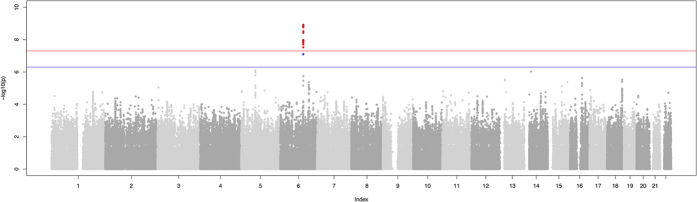
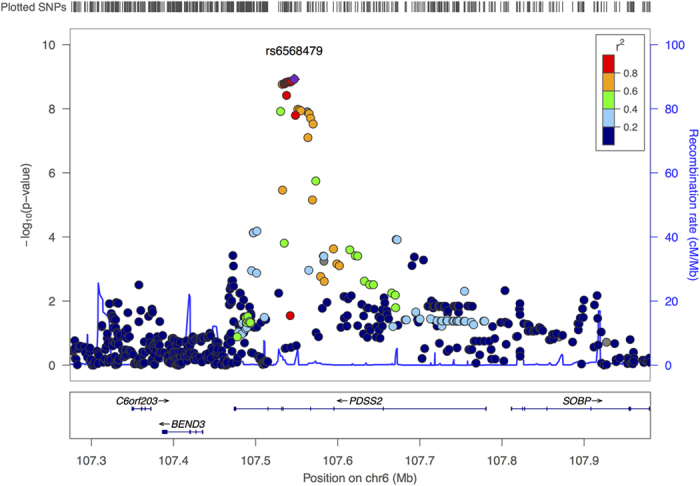
Coffee is one of the most consumed beverages world-wide and one of the primary sources of caffeine intake. Given its important health and economic impact, the underlying genetics of its consumption has been widely studied. Despite these efforts, much has still to be uncovered. In particular, the use of non-additive genetic models may uncover new information about the genetic variants driving coffee consumption. We have conducted a genome-wide association study in two Italian populations using additive, recessive and dominant models for analysis. This has uncovered a significant association in the PDSS2 gene under the recessive model that has been replicated in an independent cohort from the Netherlands (ERF). The identified gene has been shown to negatively regulate the expression of the caffeine metabolism genes and can thus be linked to coffee consumption. Further bioinformatics analysis of eQTL and histone marks from Roadmap data has evidenced a possible role of the identified SNPs in regulating PDSS2 gene expression through enhancers present in its intron. Our results highlight a novel gene which regulates coffee consumption by regulating the expression of the genes linked to caffeine metabolism. Further studies will be needed to clarify the biological mechanism which links PDSS2 and coffee consumption.
咖啡是全球范围内最受欢迎的饮品之一,也是咖啡因的主要摄入来源之一。鉴于其对健康和经济的重要影响,人们广泛研究了其消费的潜在遗传因素。尽管已经做出了这些努力,但仍有许多未知之处。特别是,使用非加性遗传模型可能会揭示有关驱动咖啡消费的遗传变异的新信息。我们使用加性、隐性和显性模型在两个意大利人群中进行了全基因组关联研究。这揭示了在隐性模型下 PDSS2 基因中的一个显著关联,该关联在荷兰的一个独立队列(ERF)中得到了复制。已鉴定的基因已被证明可负调控咖啡因代谢基因的表达,因此可与咖啡消费相关联。对 Roadmap 数据中的 eQTL 和组蛋白标记的进一步生物信息学分析表明,所鉴定的 SNP 可能通过其内含子中的增强子来调节 PDSS2 基因表达。我们的研究结果强调了一个新的基因,它通过调节与咖啡因代谢相关的基因的表达来调节咖啡消费。需要进一步的研究来阐明 PDSS2 和咖啡消费之间的生物学机制。