Lorenzetti Martina, Gongadze Ekaterina, Kulkarni Mukta, Junkar Ita, Iglič Aleš
Jožef Stefan Institute, Jamova cesta 39, 1000, Ljubljana, Slovenia.
Faculty of Electrical Engineering, University of Ljubljana, 1000, Ljubljana, Slovenia.
Nanoscale Res Lett. 2016 Dec;11(1):378. doi: 10.1186/s11671-016-1594-3. Epub 2016 Aug 25.
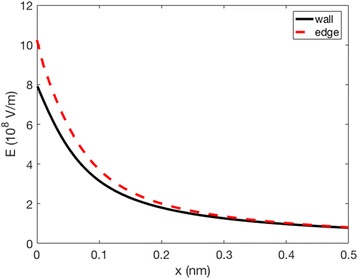
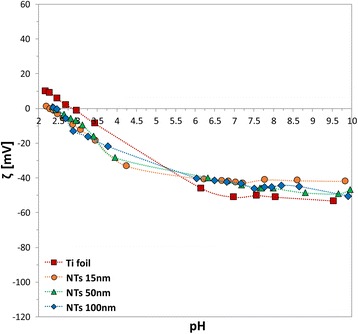
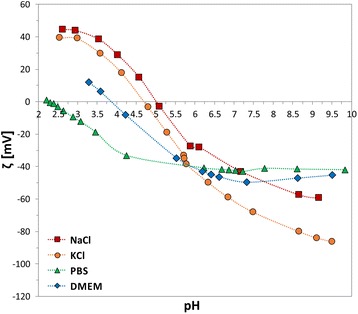
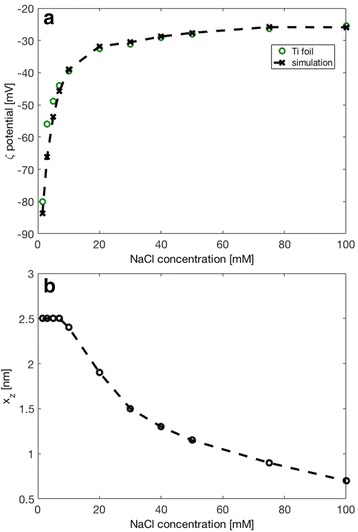
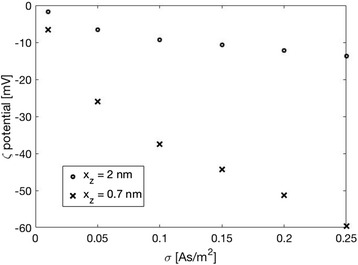
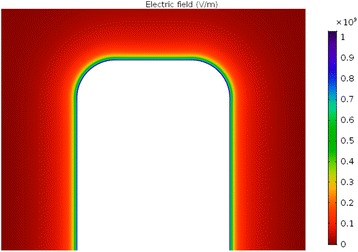
Surface charge is one of the most significant properties for the characterisation of a biomaterial, being a key parameter in the interaction of the body implant with the surrounding living tissues. The present study concerns the systematic assessment of the surface charge of electrochemically anodized TiO2 nanotubular surfaces, proposed as coating material for Ti body implants. Biologically relevant electrolytes (NaCl, PBS, cell medium) were chosen to simulate the physiological conditions. The measurements were accomplished as titration curves at low electrolytic concentration (10(-3) M) and as single points at fixed pH but at various electrolytic concentrations (up to 0.1 M). The results showed that all the surfaces were negatively charged at physiological pH. However, the zeta potential values were dependent on the electrolytic conditions (electrolyte ion concentration, multivalence of the electrolyte ions, etc.) and on the surface characteristics (nanotubes top diameter, average porosity, exposed surface area, wettability, affinity to specific ions, etc.). Accordingly, various explanations were proposed to support the different experimental data among the surfaces. Theoretical model of electric double layer which takes into account the asymmetric finite size of ions in electrolyte and orientational ordering of water dipoles was modified according to our specific system in order to interpret the experimental data. Experimental results were in agreement with the theoretical predictions. Overall, our results contribute to enrich the state-of-art on the characterisation of nanostructured implant surfaces at the bio-interface, especially in case of topographically porous and rough surfaces.
表面电荷是生物材料表征中最重要的特性之一,是人体植入物与周围活组织相互作用的关键参数。本研究关注对电化学阳极氧化TiO₂纳米管表面的表面电荷进行系统评估,该表面被提议用作钛制人体植入物的涂层材料。选择了与生物相关的电解质(NaCl、PBS、细胞培养基)来模拟生理条件。测量是在低电解质浓度(10⁻³ M)下作为滴定曲线进行的,并在固定pH值但不同电解质浓度(高达0.1 M)下作为单点进行。结果表明,在生理pH值下所有表面均带负电荷。然而,ζ电位值取决于电解条件(电解质离子浓度、电解质离子的多价性等)以及表面特性(纳米管顶部直径、平均孔隙率、暴露表面积、润湿性、对特定离子的亲和力等)。因此,提出了各种解释来支持不同表面之间的不同实验数据。考虑到电解质中离子的不对称有限尺寸和水偶极子的取向有序性的双电层理论模型根据我们的特定系统进行了修改,以便解释实验数据。实验结果与理论预测一致。总体而言,我们的结果有助于丰富生物界面处纳米结构植入物表面表征的最新技术水平,特别是在具有地形孔隙和粗糙表面的情况下。