Eberbach Andreas, Becker Annette, Rochon Justine, Finkemeler Holger, Wagner Achim, Donner-Banzhoff Norbert
Department of Family and Community Medicine, Philipp University of Marburg, Marburg, Germany.
Institute of Medical Biometry and Informatics, University of Heidelberg, Heidelberg, Germany.
Adv Med Educ Pract. 2016 Aug 4;7:433-41. doi: 10.2147/AMEP.S78385. eCollection 2016.
General practitioners (GPs) are confronted with a wide variety of clinical questions, many of which remain unanswered.
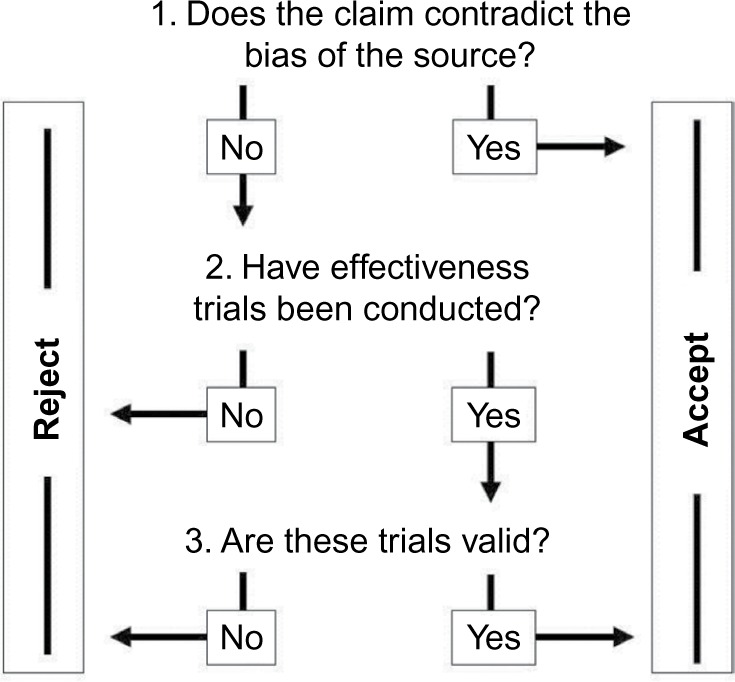
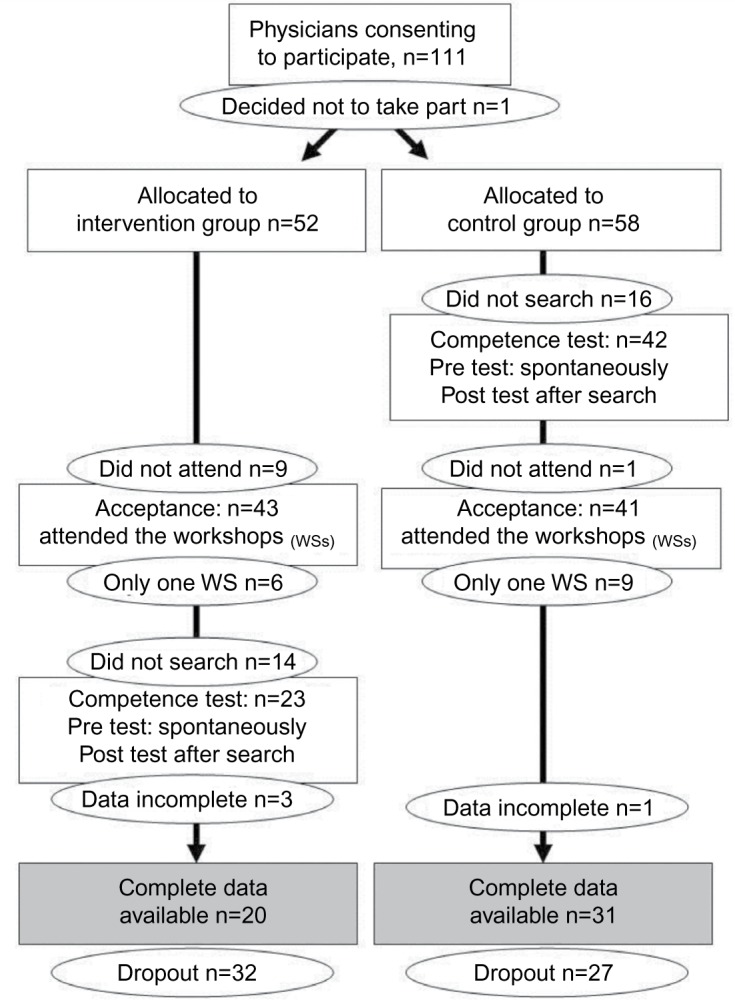
In order to assist GPs in finding quick, evidence-based answers, we developed a learning program (LP) with a short interactive workshop based on a simple three-step-heuristic to improve their search and appraisal competence (SAC). We evaluated the LP effectiveness with a randomized controlled trial (RCT). Participants (intervention group [IG] n=20; control group [CG] n=31) rated acceptance and satisfaction and also answered 39 knowledge questions to assess their SAC. We controlled for previous knowledge in content areas covered by the test.
Main outcome - SAC: within both groups, the pre-post test shows significant (P=0.00) improvements in correctness (IG 15% vs CG 11%) and confidence (32% vs 26%) to find evidence-based answers. However, the SAC difference was not significant in the RCT.
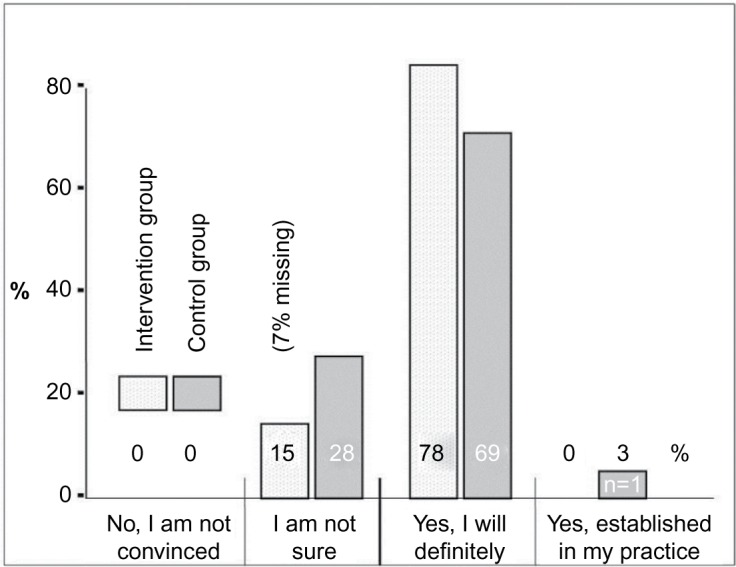
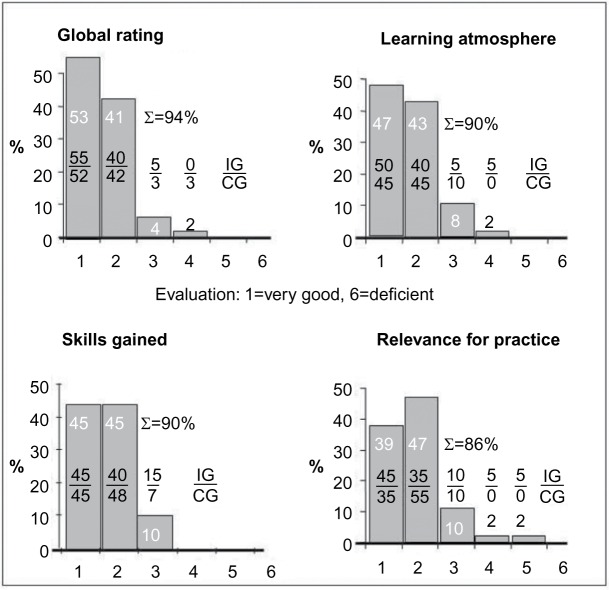
Most workshop participants rated "learning atmosphere" (90%), "skills acquired" (90%), and "relevancy to my practice" (86%) as good or very good. The LP-recommendations were implemented by 67% of the IG, whereas 15% of the CG already conformed to LP recommendations spontaneously (odds ratio 9.6, P=0.00). After literature search, the IG showed a (not significantly) higher satisfaction regarding "time spent" (IG 80% vs CG 65%), "quality of information" (65% vs 54%), and "amount of information" (53% vs 47%).
Long-standing established GPs have a good SAC. Despite high acceptance, strong learning effects, positive search experience, and significant increase of SAC in the pre-post test, the RCT of our LP showed no significant difference in SAC between IG and CG. However, we suggest that our simple decision heuristic merits further investigation.
全科医生(GPs)面临各种各样的临床问题,其中许多问题仍未得到解答。
为了帮助全科医生快速找到基于证据的答案,我们开发了一个学习项目(LP),该项目有一个简短的互动研讨会,基于一种简单的三步启发法来提高他们的搜索和评估能力(SAC)。我们通过随机对照试验(RCT)评估了LP的有效性。参与者(干预组[IG]n = 20;对照组[CG]n = 31)对接受度和满意度进行了评分,并回答了39个知识问题以评估他们的SAC。我们对测试所涵盖内容领域的先前知识进行了控制。
主要结果 - SAC:在两组中,前后测试显示在找到基于证据的答案的正确性(IG为15%,CG为11%)和信心(32%对26%)方面有显著(P = 0.00)提高。然而,RCT中SAC差异不显著。
大多数研讨会参与者将“学习氛围”(90%)、“获得的技能”(90%)和“与我的实践的相关性”(86%)评为良好或非常好。IG中有67%实施了LP建议,而CG中有15%已经自发符合LP建议(优势比9.6,P = 0.00)。在文献检索后,IG在“花费的时间”(IG为80%,CG为65%)、“信息质量”(65%对54%)和“信息量”(53%对47%)方面显示出(不显著)更高的满意度。
长期执业的全科医生有良好的SAC。尽管接受度高、学习效果强、搜索体验积极且前后测试中SAC显著提高,但我们LP的RCT显示IG和CG之间的SAC没有显著差异。然而,我们建议我们简单的决策启发法值得进一步研究。