Department of Primary Health Care and General Practice, Wellington School of Medicine, University of Otago, New Zealand.
BMC Fam Pract. 2011 Aug 23;12:90. doi: 10.1186/1471-2296-12-90.
General Practitioners (GPs) employ strategies to identify and retrieve medical evidence for clinical decision making which take workload and time constraints into account. Optimal Foraging Theory (OFT) initially developed to study animal foraging for food is used to explore the information searching behaviour of General Practitioners. This study is the first to apply foraging theory within this context.Study objectives were: 1. To identify the sequence and steps deployed in identifiying and retrieving evidence for clinical decision making. 2. To utilise Optimal Foraging Theory to assess the effectiveness and efficiency of General Practitioner information searching.
GPs from the Wellington region of New Zealand were asked to document in a pre-formatted logbook the steps and outcomes of an information search linked to their clinical decision making, and fill in a questionnaire about their personal, practice and information-searching backgrounds.
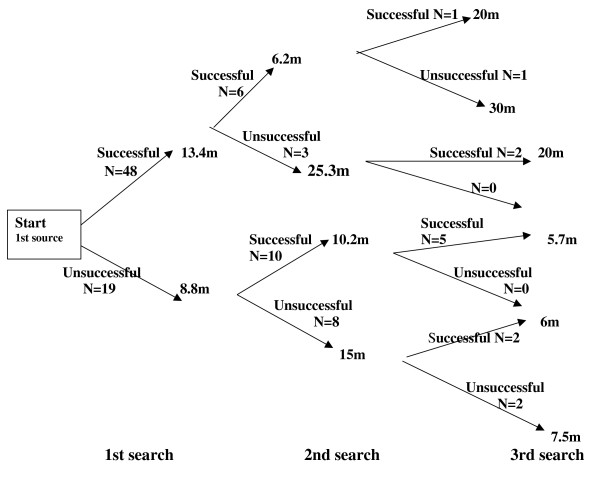
A total of 115/155 eligible GPs returned a background questionnaire, and 71 completed their information search logbook. GPs spent an average of 17.7 minutes addressing their search for clinical information. Their preferred information sources were discussions with colleagues (38% of sources) and books (22%). These were the two most profitable information foraging sources (15.9 min and 9.5 min search time per answer, compared to 34.3 minutes in databases). GPs nearly always accessed another source when unsuccessful (95% after 1st source), and frequently when successful (43% after 2nd source). Use of multiple sources accounted for 41% of searches, and increased search success from 70% to 89%.
By consulting in foraging terms the most 'profitable' sources of information (colleagues, books), rapidly switching sources when unsuccessful, and frequently double checking, GPs achieve an efficient trade-off between maximizing search success and information reliability, and minimizing searching time. As predicted by foraging theory, GPs trade time-consuming evidence-based (electronic) information sources for sources with a higher information reward per unit time searched. Evidence-based practice must accommodate these 'real world' foraging pressures, and Internet resources should evolve to deliver information as effectively as traditional methods of information gathering.
全科医生(GPs)采用策略来识别和检索医学证据,以进行临床决策,同时考虑到工作负荷和时间限制。最初用于研究动物觅食食物的最优觅食理论(OFT)被用于探索全科医生的信息搜索行为。这是首次在该背景下应用觅食理论。研究目的是:1. 确定识别和检索临床决策证据的顺序和步骤。2. 利用最优觅食理论评估全科医生信息搜索的有效性和效率。
要求新西兰惠灵顿地区的全科医生在预先格式化的日志中记录与临床决策相关的信息搜索步骤和结果,并填写一份关于个人、实践和信息搜索背景的问卷。
共有 155 名符合条件的全科医生中的 115 名返回了背景问卷,71 名完成了他们的信息搜索日志。全科医生平均花费 17.7 分钟解决他们对临床信息的搜索。他们首选的信息来源是与同事的讨论(38%的来源)和书籍(22%)。这是两个最有利可图的信息觅食来源(每个答案的搜索时间为 15.9 分钟和 9.5 分钟,而数据库中的搜索时间为 34.3 分钟)。当不成功时,全科医生几乎总是会访问另一个来源(95%在第一个来源后),并且在成功时也经常会访问(43%在第二个来源后)。多个来源的使用占搜索的 41%,并将搜索成功率从 70%提高到 89%。
通过以觅食术语咨询最“有利可图”的信息来源(同事、书籍),在不成功时迅速切换来源,并经常进行双重检查,全科医生在最大限度地提高搜索成功率和信息可靠性与最小化搜索时间之间实现了有效的权衡。正如觅食理论所预测的那样,全科医生会权衡耗时的基于证据的(电子)信息源,以换取单位时间搜索的信息回报更高的来源。基于证据的实践必须适应这些“现实世界”的觅食压力,互联网资源应该发展到与传统信息收集方法一样有效地提供信息。