Massen Jorg J M, Šlipogor Vedrana, Gallup Andrew C
Department of Cognitive Biology, University of Vienna Vienna, Austria.
Psychology Department, State University of New York at Oneonta Oneonta, NY, USA.
Front Psychol. 2016 Aug 9;7:1190. doi: 10.3389/fpsyg.2016.01190. eCollection 2016.
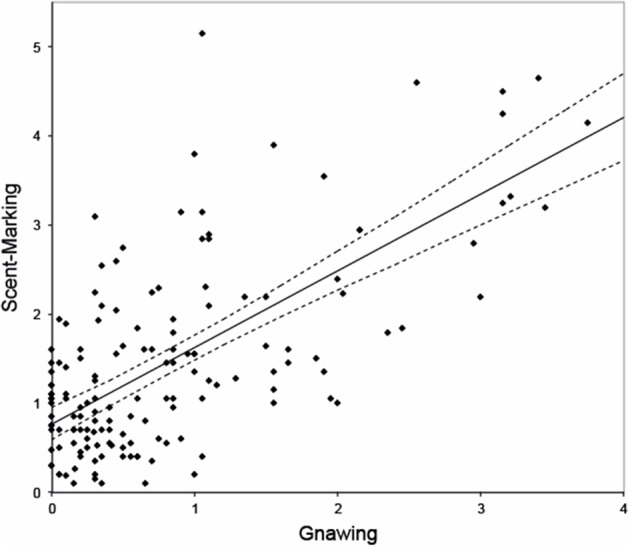
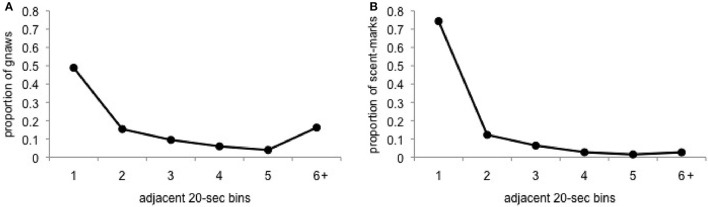
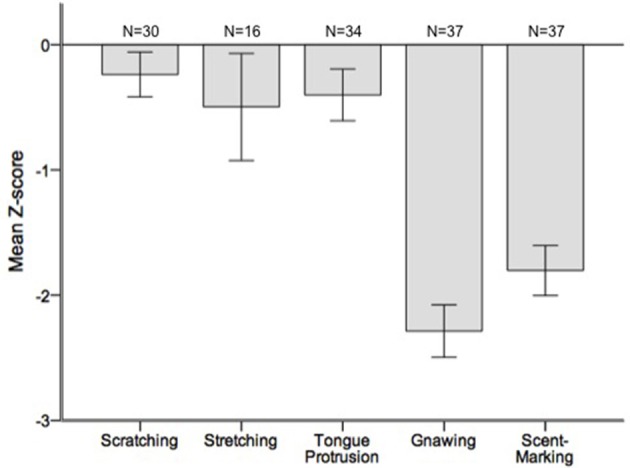
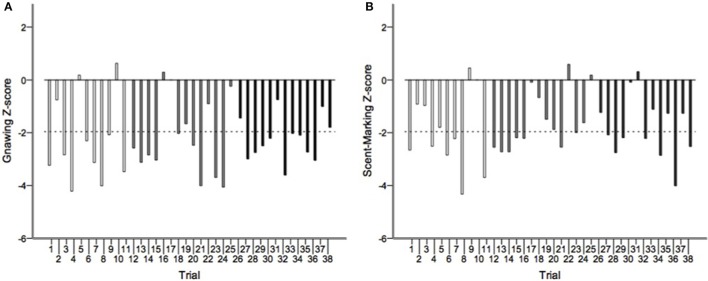
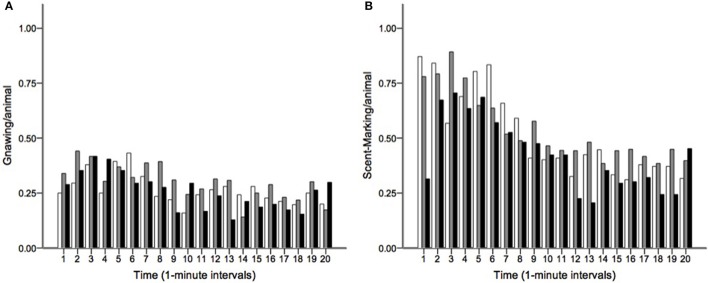
Behavioral contagion is suggested to promote group coordination that may facilitate activity transitions, increased vigilance, and state matching. Apart from contagious yawning, however, very little attention has been given to this phenomenon, and studies on contagious yawning in primates have so far only focused on Old World monkeys and apes. Here we studied behavioral contagion in common marmosets, a species for which group coordination and vigilance are paramount. In particular, we investigated the contagiousness of yawning, stretching, scratching, tongue protrusion, gnawing, and scent-marking. We coded these behaviors from 14 adult marmosets, from two different social groups. During testing sessions, animals were separated into groups of four individuals for 20-min observation periods, across three distinct diurnal time points (morning, midday, and afternoon) to test for circadian patterns. We observed almost no yawning (0.12 yawns/h) and very little stretching behavior. For all other behaviors, which were more common, we found several temporal and inter-individual differences (i.e., sex, age, dominance status) predictive of these responses. Moreover, we found that gnawing and scent-marking, which almost always co-occurred as a fixed-action pattern, were highly temporally clustered within observation sessions. We discuss the relative absence of yawning in marmosets as well as the possible function of contagious scent-marking, and provide suggestions for future research into the proximate and ultimate functions of these behaviors in marmosets.
行为传染被认为有助于促进群体协调,这可能会促进活动转换、提高警惕性和状态匹配。然而,除了传染性打哈欠之外,这种现象很少受到关注,并且迄今为止,对灵长类动物传染性打哈欠的研究仅集中在旧世界猴和猿类上。在这里,我们研究了普通狨猴的行为传染,对于这个物种来说,群体协调和警惕性至关重要。特别是,我们调查了打哈欠、伸展、抓挠、伸舌头、啃咬和气味标记的传染性。我们对来自两个不同社会群体的14只成年狨猴的这些行为进行了编码。在测试期间,动物被分成每组四只个体,进行20分钟的观察期,跨越三个不同的昼夜时间点(早上、中午和下午),以测试昼夜节律模式。我们观察到几乎没有打哈欠(每小时0.12次哈欠),伸展行为也很少。对于所有其他更常见的行为,我们发现了一些时间和个体间的差异(即性别、年龄、优势地位)可以预测这些反应。此外,我们发现啃咬和气味标记几乎总是作为一种固定行为模式同时出现,在观察期内高度集中在特定时间。我们讨论了狨猴中打哈欠相对较少的情况以及传染性气味标记的可能功能,并为未来研究这些行为在狨猴中的近端和最终功能提供了建议。