Blank Cornelia, Kopp Martin, Niedermeier Martin, Schnitzer Martin, Schobersberger Wolfgang
Institute for Sports Medicine, Alpine Medicine & Health Tourism, UMIT, Eduard-Wallnöfer-Zentrum 1, 6060 Hall in Tyrol, Austria.
Department of Sport Science, University Innsbruck, Fürstenweg 185, 6020 Innsbruck, Austria.
Springerplus. 2016 Aug 11;5(1):1333. doi: 10.1186/s40064-016-3000-0. eCollection 2016.
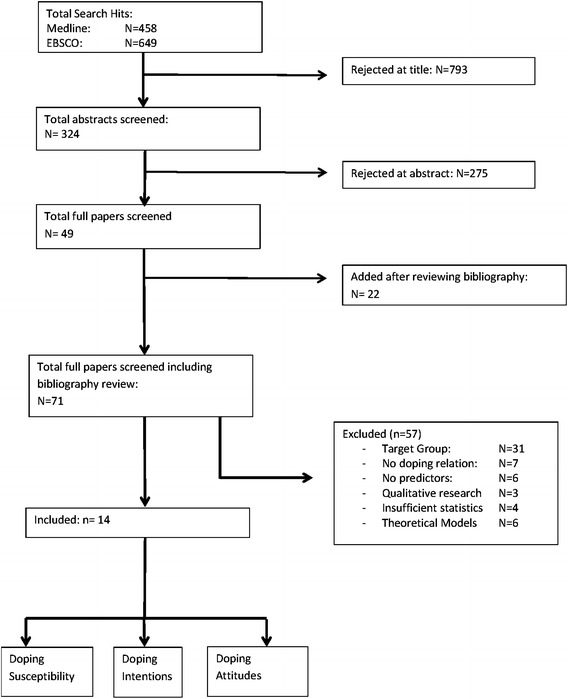
Research in doping has focused on potential intervention strategies, increasingly targeting predicting factors. Yet, findings are inconsistent, mostly athlete-centred and explain only limited variances in behaviour. This critical review aims to (a) summarize studies that identified predictors of doping intentions, susceptibility, and behaviour in elite athletes and to (b) analyse in how far previous research included aspects beyond athlete-centred approaches, such as context and sporting culture. We reviewed 14 studies that focused on elite athletes. Situational temptation, attitudes, and subjective norms seem to be strong predicting variables of doping intentions (r ≥ 0.50), but intention was no predictor for behaviour. Attitudes were a significant predictor for both, doping susceptibility (r = 0.47) and behaviour (r = 0.30). Most of the predictors are athlete-centred and ignore macro-level factors that might help to explain how certain individual traits impact on the decision making process. The findings from this review call for a critical discussion of whether current doping-prevention research needs to take new directions. We propose future research to bridge findings of psychologists and sociologists, as it appears that doping behaviour cannot be explained by ignoring the one or the other. Impacts of sporting culture that have been identified in qualitative approaches need to be integrated in future quantitative approaches to test for its external validity. Inclusion of both, micro- and macro level factors may enable an integrative prevention program that creates a sporting culture without doping.
兴奋剂研究主要聚焦于潜在的干预策略,越来越多地以预测因素为目标。然而,研究结果并不一致,大多以运动员为中心,且只能解释行为中有限的差异。本综述旨在:(a)总结确定精英运动员使用兴奋剂意图、易感性和行为预测因素的研究;(b)分析以往研究在多大程度上纳入了以运动员为中心的方法之外的方面,如环境和体育文化。我们回顾了14项针对精英运动员的研究。情境诱惑、态度和主观规范似乎是使用兴奋剂意图的强有力预测变量(r≥0.50),但意图并不是行为的预测因素。态度是使用兴奋剂易感性(r=0.47)和行为(r=0.30)的重要预测因素。大多数预测因素以运动员为中心,忽略了可能有助于解释某些个体特征如何影响决策过程的宏观层面因素。本综述的研究结果呼吁对当前的反兴奋剂研究是否需要转向进行批判性讨论。我们建议未来的研究将心理学家和社会学家的研究结果联系起来,因为似乎忽视任何一方都无法解释使用兴奋剂的行为。定性研究中确定的体育文化影响需要纳入未来的定量研究方法中,以检验其外部有效性。纳入微观和宏观层面的因素可能会促成一个综合性的预防计划,营造一个无兴奋剂的体育文化。