Department of Urology, Renji Hospital, School of Medicine, Shanghai Jiao Tong University, Shanghai 200127, China.
Department of Pathology, Renji Hospital, School of Medicine, Shanghai Jiao Tong University, Shanghai 200127, China.
Asian J Androl. 2017 Sep-Oct;19(5):579-585. doi: 10.4103/1008-682X.186185.
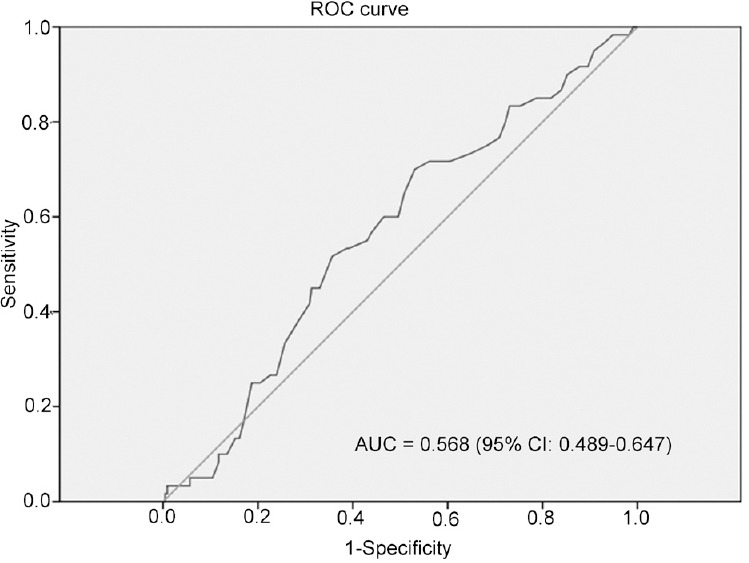
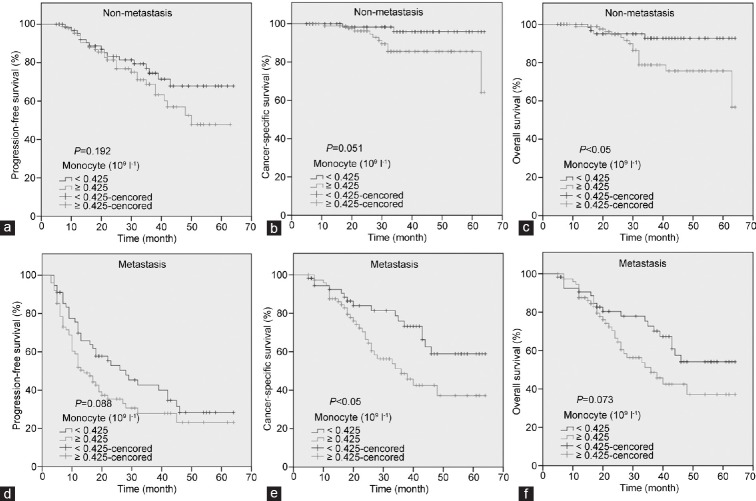
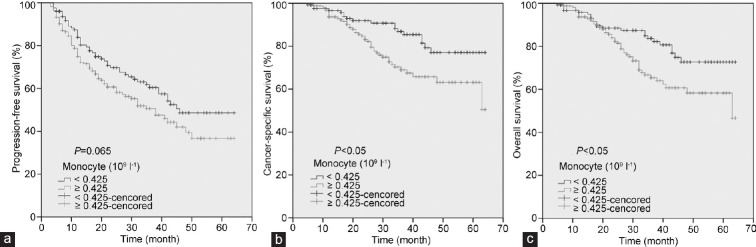
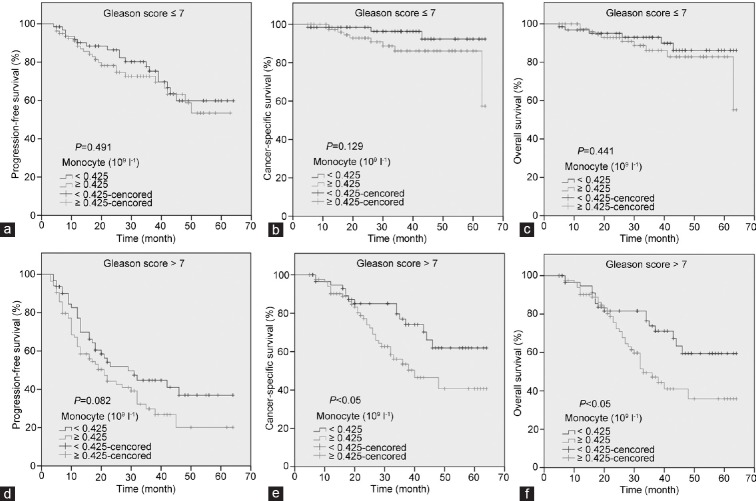
Increasing evidence indicates that inflammation may play important roles in tumorigenesis and progression, and an elevated peripheral monocyte count predicts a poor prognosis in various types of malignancies. Here, we evaluate the roles of peripheral monocyte count in the diagnosis and prognosis for prostate cancer in Chinese patients. A total of 1107 consecutive patients who had undergone prostate biopsy and 290 prostate cancer patients receiving androgen deprivation therapy as first-line therapy were retrospectively analyzed. The parameters were measured at the time of diagnosis. Univariate and multivariate logistic regression analyses were performed to identify the independent predictors of a positive biopsy. Patients were categorized in two groups using a cutoff point of 0.425 × 10⁹ l-1 as calculated by the receiver-operating curve analysis for prognosis. Univariate and multivariate Cox regression analyses were performed to determine the associations of monocyte count with progression-free survival, cancer-specific survival, and overall survival. Multivariate logistic regression analyses showed that monocyte count, age, prostate-specific antigen (PSA), free/total PSA, and prostate volume were independent predictors for prostate cancer. Multivariate Cox regression analyses identified an elevated monocyte count as an independent prognostic factor for worse cancer-specific survival (hazard ratio = 2.244, P < 0.05) and overall survival (hazard ratio = 1.995, P < 0.05), but not progression-free survival (P = 0.117). Our results indicated that an elevated monocyte count was an independent diagnostic biomarker for prostate cancer, and pretreatment peripheral monocyte count might play a significant role in the prognosis of prostate cancer patients treated with androgen deprivation therapy.
越来越多的证据表明,炎症可能在肿瘤发生和进展中发挥重要作用,外周单核细胞计数升高预示着各种类型恶性肿瘤的预后不良。在这里,我们评估了外周单核细胞计数在诊断和预测中国前列腺癌患者预后中的作用。回顾性分析了 1107 例连续接受前列腺活检的患者和 290 例接受雄激素剥夺治疗作为一线治疗的前列腺癌患者。在诊断时测量了这些参数。使用受试者工作特征曲线分析计算的 0.425×10⁹ l-1 作为截断值,对预后进行单因素和多因素逻辑回归分析,以确定阳性活检的独立预测因子。使用单因素和多因素 Cox 回归分析,确定单核细胞计数与无进展生存期、癌症特异性生存期和总生存期的关系。多因素逻辑回归分析表明,单核细胞计数、年龄、前列腺特异性抗原(PSA)、游离/总 PSA 和前列腺体积是前列腺癌的独立预测因子。多因素 Cox 回归分析确定升高的单核细胞计数是癌症特异性生存期(危险比=2.244,P<0.05)和总生存期(危险比=1.995,P<0.05)较差的独立预后因素,但与无进展生存期无关(P=0.117)。我们的结果表明,升高的单核细胞计数是前列腺癌的独立诊断生物标志物,治疗前外周单核细胞计数可能在接受雄激素剥夺治疗的前列腺癌患者的预后中发挥重要作用。