Jian Fang-Fang, Li Yun-Feng, Chen Yu-Fan, Jiang Hong, Chen Xiao, Zheng Li-Li, Zhao Yao, Wang Wei-Qing, Ning Guang, Bian Liu-Guan, Sun Qing-Fang
Department of Neurosurgery, Ruijin Hospital, Shanghai Jiao Tong University School of Medicine, Shanghai 200025, China.
Department of Neurosurgery, Changzheng Hospital, The Second Military Medical University, Shanghai 200003, China.
Chin Med J (Engl). 2016 Sep 5;129(17):2102-8. doi: 10.4103/0366-6999.189047.
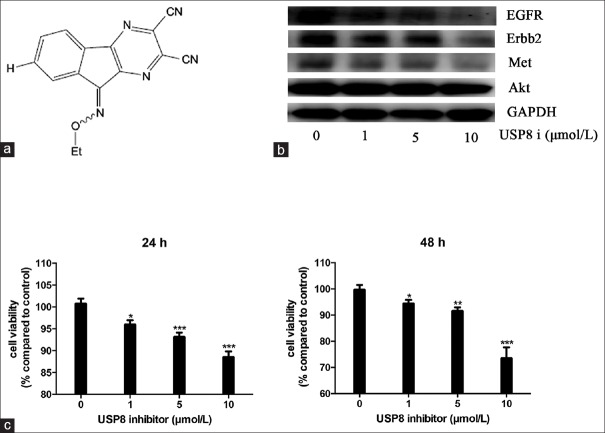
Two recent whole-exome sequencing researches identifying somatic mutations in the ubiquitin-specific protease 8 (USP8) gene in pituitary corticotroph adenomas provide exciting advances in this field. These mutations drive increased epidermal growth factor receptor (EGFR) signaling and promote adrenocorticotropic hormone (ACTH) production. This study was to investigate whether the inhibition of USP8 activity could be a strategy for the treatment of Cushing's disease (CD).
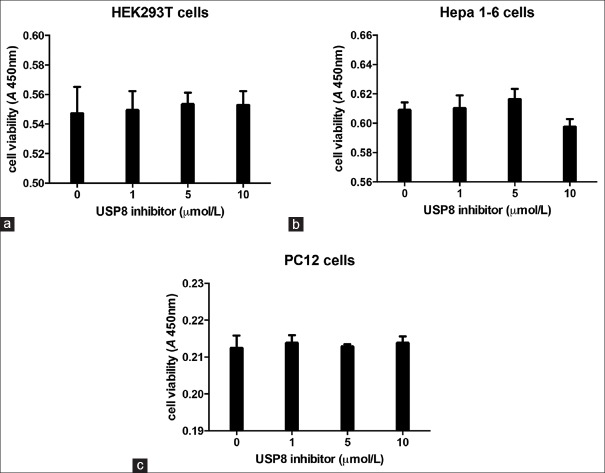
The anticancer effect of USP8 inhibitor was determined by testing cell viability, colony formation, apoptosis, and ACTH secretion. The immunoblotting and quantitative reverse transcription polymerase chain reaction were conducted to explore the signaling pathway by USP8 inhibition.
Inhibition of USP8-induced degradation of receptor tyrosine kinases including EGFR, EGFR-2 (ERBB2), and Met leading to a suppression of AtT20 cell growth and ACTH secretion. Moreover, treatment with USP8 inhibitor markedly induced AtT20 cells apoptosis.
Inhibition of USP8 activity could be an effective strategy for CD. It might provide a novel pharmacological approach for the treatment of CD.
最近两项全外显子测序研究发现垂体促肾上腺皮质激素腺瘤中泛素特异性蛋白酶8(USP8)基因存在体细胞突变,这为该领域带来了令人兴奋的进展。这些突变导致表皮生长因子受体(EGFR)信号增强并促进促肾上腺皮质激素(ACTH)的产生。本研究旨在探讨抑制USP8活性是否可作为治疗库欣病(CD)的一种策略。
通过检测细胞活力、集落形成、细胞凋亡和ACTH分泌来确定USP8抑制剂的抗癌作用。进行免疫印迹和定量逆转录聚合酶链反应以探索USP8抑制的信号通路。
抑制USP8可诱导包括EGFR、EGFR-2(ERBB2)和Met在内的受体酪氨酸激酶降解,从而抑制AtT20细胞生长和ACTH分泌。此外,用USP8抑制剂处理可显著诱导AtT20细胞凋亡。
抑制USP8活性可能是治疗CD的有效策略。它可能为CD的治疗提供一种新的药理学方法。