Yu Yu-Hsiang, Liao Pei-Ru, Guo Chien-Jung, Chen Che-Hong, Mochly-Rosen Daria, Chuang Lee-Ming
Department of Biotechnology and Animal Science, National Ilan University, Ilan, Taiwan.
Department of Internal Medicine, National Taiwan University Hospital, Taipei, Taiwan.
PLoS One. 2016 Aug 30;11(8):e0161993. doi: 10.1371/journal.pone.0161993. eCollection 2016.
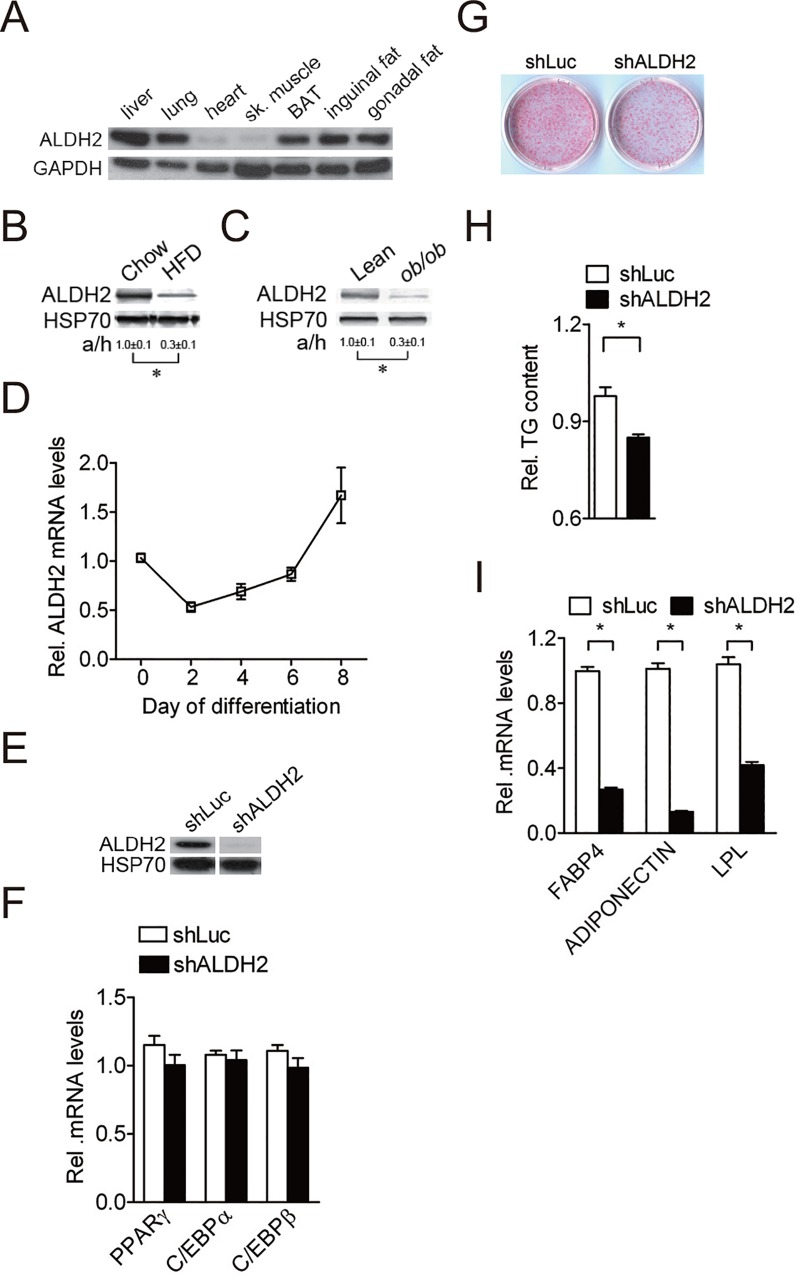
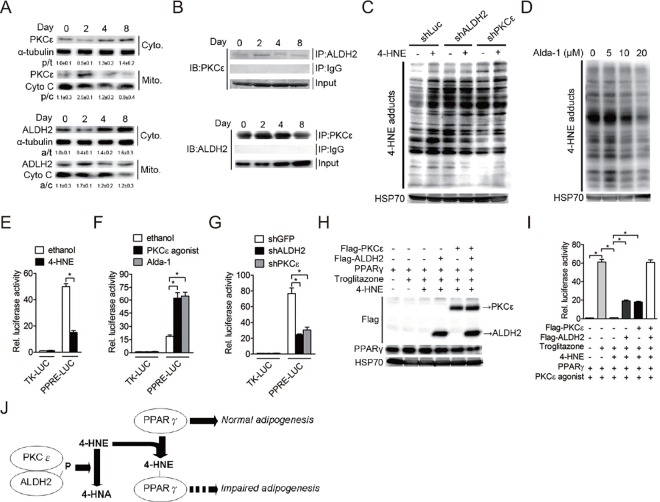
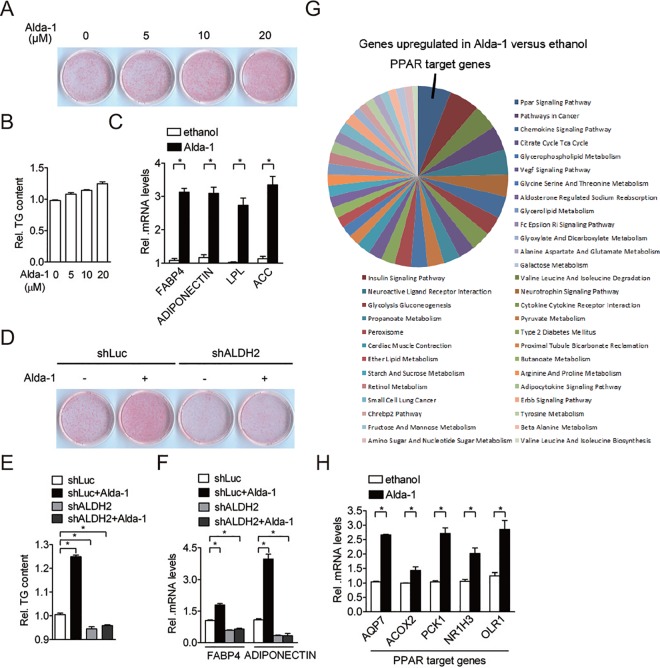
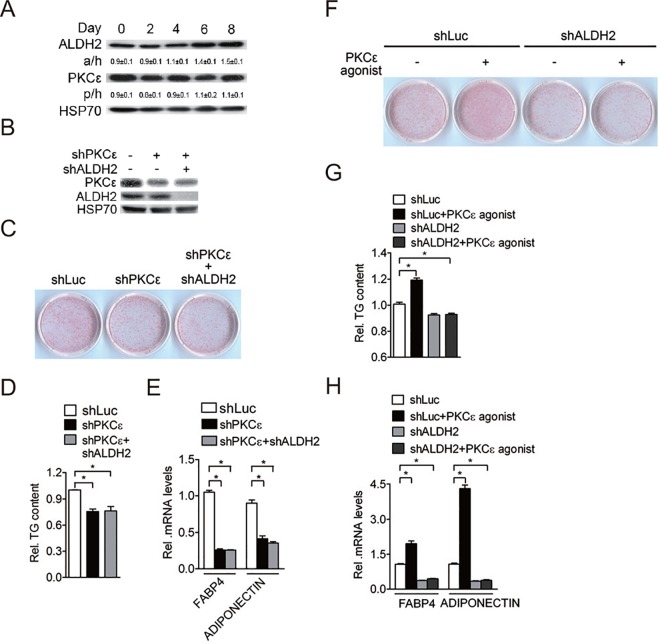
The ALDH2 gene encodes the mitochondrial aldehyde dehydrogenase 2 (ALDH2), a critical enzyme involved in ethanol clearance through acetaldehyde metabolism. ALDH2 also catalyzes the metabolism of other bioreactive aldehydes, including propionaldehyde, butyraldehyde, and 4-hydroxykenals (4-HNE). Increased levels of 4-HNE in adipose tissue positively correlate with obesity and insulin resistance. However, it remains unclear whether ALDH2 is involved in regulation of adipocyte differentiation. Here, we found that ALDH2 protein levels were lower in white adipose tissue of high-fat diet-fed mice and ob/ob mice relative to lean mice. Knockdown of ALDH2 expression in 3T3-L1 preadipocytes caused an increase in intracellular 4-HNE, thereby attenuated adipocyte differentiation. By contrast, an ALDH2 activator, Alda-1, significantly accelerated adipogenesis, which was accompanied by an increase in adipogenic gene expression. Consistently, adipogenesis was reduced when protein kinase C ε (PKCε), an ALDH2 phosphorylating activator, was silenced in 3T3-L1 preadipocytes, whereas treatment with a PKCε agonist in 3T3-L1 preadipocytes enhanced adipogenesis. Whole-genome microarray profiling of Alda-1-treated cells demonstrated several upregulated transcripts encoding proteins involved in metabolism and the majority of these transcripts are for proteins involved in PPAR signaling pathways. Furthermore, PKCε-ALDH2 interaction alleviates 4-HNE induced aberrant PPARγ regulation on adipogenesis. Taken together, these results demonstrate that ALDH2 activation enhances adipogenesis and signaling pathways involving PPARγ. Thus, activation of PKCε-ALDH2 regulatory axis may be a therapeutic target for treating obesity and type 2 diabetes.
醛脱氢酶2(ALDH2)基因编码线粒体醛脱氢酶2(ALDH2),这是一种通过乙醛代谢参与乙醇清除的关键酶。ALDH2还催化其他生物活性醛的代谢,包括丙醛、丁醛和4-羟基壬烯醛(4-HNE)。脂肪组织中4-HNE水平的升高与肥胖和胰岛素抵抗呈正相关。然而,尚不清楚ALDH2是否参与脂肪细胞分化的调控。在这里,我们发现,与瘦小鼠相比,高脂饮食喂养的小鼠和ob/ob小鼠白色脂肪组织中的ALDH2蛋白水平较低。在3T3-L1前脂肪细胞中敲低ALDH2表达会导致细胞内4-HNE增加,从而减弱脂肪细胞分化。相比之下,ALDH2激活剂Alda-1显著加速了脂肪生成,这伴随着脂肪生成基因表达的增加。同样,当蛋白激酶Cε(PKCε)(一种ALDH2磷酸化激活剂)在3T3-L1前脂肪细胞中沉默时,脂肪生成减少,而在3T3-L1前脂肪细胞中用PKCε激动剂处理则增强了脂肪生成。对Alda-1处理的细胞进行全基因组微阵列分析,发现几个上调的转录本编码参与代谢的蛋白质,其中大多数转录本是参与PPAR信号通路的蛋白质。此外,PKCε-ALDH2相互作用减轻了4-HNE诱导的PPARγ对脂肪生成的异常调控。综上所述,这些结果表明ALDH2激活增强了脂肪生成和涉及PPARγ的信号通路。因此,激活PKCε-ALDH2调节轴可能是治疗肥胖和2型糖尿病的治疗靶点。