Department of Kinesiology and Nutrition, University of Illinois at Chicago, Chicago, Illinois, United States of America ; Department of Histology and Embryology, Harbin Medical University, Harbin, Heilongjiang, China.
PLoS One. 2013 Aug 5;8(8):e70663. doi: 10.1371/journal.pone.0070663. Print 2013.
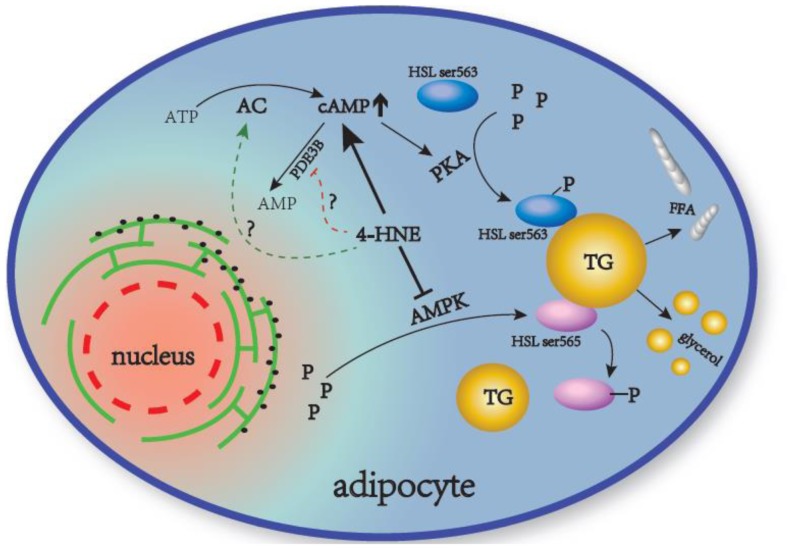
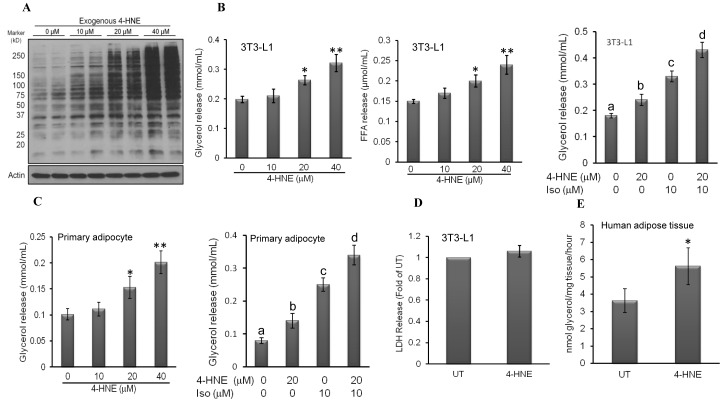
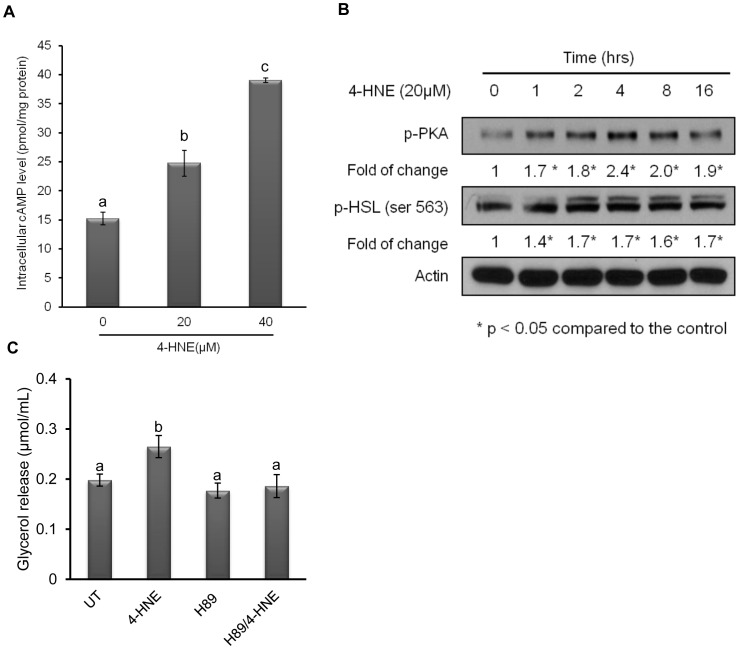
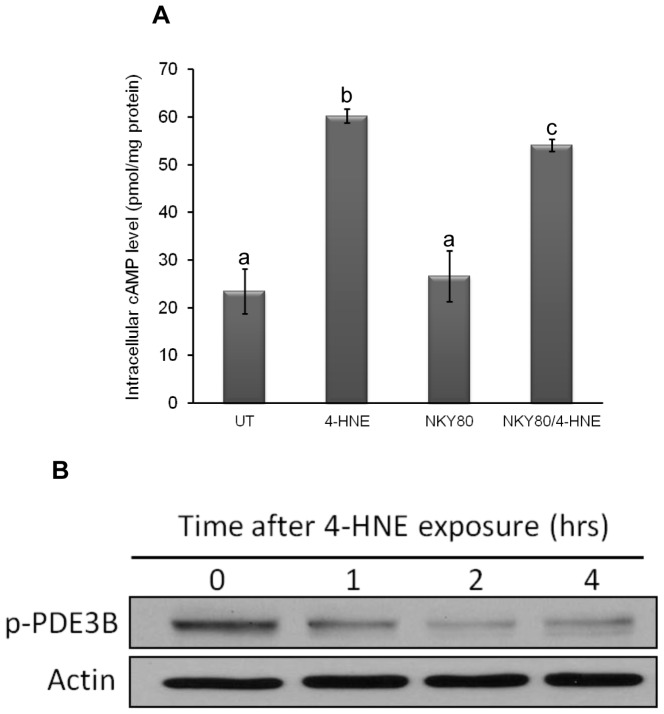
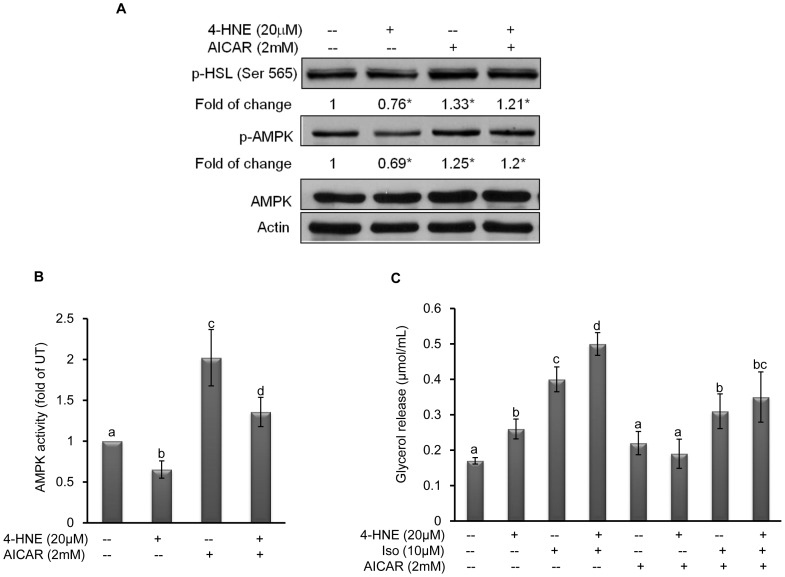
Oxidative stress in adipose tissue plays an etiological role in a variety of obesity-related metabolic disorders. We previously reported that increased adipose tissue 4-hydroxynonenal (4-HNE) contents contributed to obesity-related plasma adiponectin decline in mice. In the present study, we investigated the effects of intracellular 4-HNE accumulation on lipolytic response in adipocytes/adipose tissues and underlying mechanisms. In both fully-differentiated 3T3-L1 and primary adipocytes, a 5-hour 4-HNE exposure elevated lipolytic reaction in a dose-dependent manner at both basal and isoproterenol-stimulated conditions, evidenced by significantly increased glycerol and fatty acids releases. This conclusion was corroborated by the comparable observations when the minced human visceral adipose tissues were used. Mechanistic investigations revealed that 4-HNE-stimulated lipolytic activation is multifactorial. 4-HNE exposure quickly increased intracellular cyclic AMP (cAMP) level, which was concomitant with increased phosphorylations of protein kinase A (PKA) and its direct downstream target, hormone sensitive lipase (HSL). Pre-incubation with H89, a potent PKA inhibitor, prevented 4-HNE stimulated glycerol release, suggesting that enhanced lipolytic action in response to 4-HNE increase is mediated mainly by cAMP/PKA signal pathway in adipocytes. In addition to activating cAMP/PKA/HSL pathway, 4-HNE exposure also suppresses AMP-activated protein kinase (AMPK), a suppressive pathway for lipolysis, measured by both Western blotting for phosphorylated form of AMPK and ELISA for enzyme activity. Furthermore, 5-Aminoimidazole-4-carboxamide 1-beta-D-ribofuranoside (AICAR), a pharmacological AMPK activator, alleviated 4-HNE-induced lipolysis, suggesting that AMPK suppression also contributes to 4-HNE elicited lipolytic response. In conclusion, our findings indicate that increased intracellular 4-HNE accumulation in adipocytes/adipose tissues contributes to obesity-related lipolytic activation.
脂肪组织中的氧化应激在多种肥胖相关代谢紊乱中起着病因学作用。我们之前报道过,脂肪组织中 4-羟基壬烯醛(4-HNE)含量的增加导致肥胖相关血浆脂联素的下降。在本研究中,我们研究了细胞内 4-HNE 积累对脂肪细胞/脂肪组织中脂肪分解反应的影响及其潜在机制。在完全分化的 3T3-L1 和原代脂肪细胞中,4-HNE 暴露 5 小时可在基础和异丙肾上腺素刺激条件下呈剂量依赖性增加脂肪分解反应,这表现为甘油和脂肪酸的释放明显增加。当使用切碎的人类内脏脂肪组织时,观察到了类似的结论。机制研究表明,4-HNE 刺激的脂肪分解激活是多因素的。4-HNE 暴露可迅速增加细胞内环腺苷酸(cAMP)水平,同时增加蛋白激酶 A(PKA)及其直接下游靶标激素敏感脂肪酶(HSL)的磷酸化。用 H89(一种有效的 PKA 抑制剂)预先孵育可防止 4-HNE 刺激的甘油释放,这表明 4-HNE 刺激的脂肪分解作用主要通过 cAMP/PKA 信号通路在脂肪细胞中介导。除了激活 cAMP/PKA/HSL 通路外,4-HNE 暴露还抑制 AMP 激活的蛋白激酶(AMPK),这是脂肪分解的抑制通路,通过磷酸化形式的 AMPK 的 Western blot 和酶活性的 ELISA 进行测量。此外,5-氨基咪唑-4-羧酰胺 1-β-D-核糖呋喃核苷(AICAR),一种药理学 AMPK 激活剂,可减轻 4-HNE 诱导的脂肪分解,这表明 AMPK 抑制也有助于 4-HNE 引发的脂肪分解反应。总之,我们的发现表明,脂肪细胞/脂肪组织中细胞内 4-HNE 积累的增加导致肥胖相关的脂肪分解激活。