
用于局部血管测绘的阴极控制和近红外有机上转换。
Cathodic-controlled and near-infrared organic upconverter for local blood vessels mapping.
机构信息
Department of Electronic Engineering, National Taiwan University of Science and Technology, Taipei 10607, Taiwan.
Chang Gung University College of Medicine, Taoyuan City 33302, Taiwan.
出版信息
Sci Rep. 2016 Aug 31;6:32324. doi: 10.1038/srep32324.
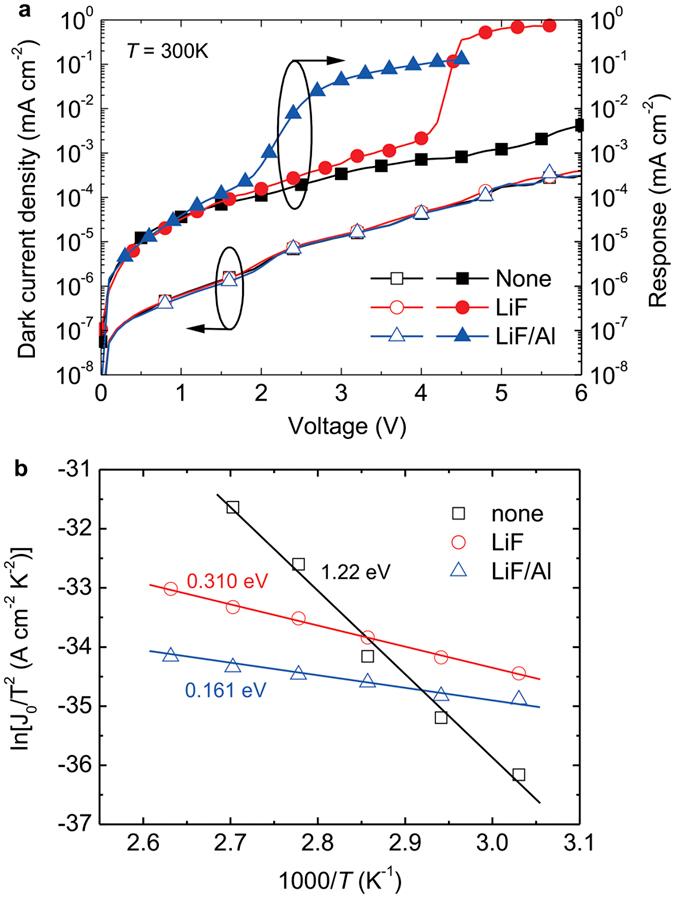
Organic materials are used in novel optoelectronic devices because of the ease and high compatibility of their fabrication processes. Here, we demonstrate a low-driving-voltage cathodic-controlled organic upconverter with a mapping application that converts near-infrared images to produce images of visible blood vessels. The proposed upconverter has a multilayer structure consisting of a photosensitive charge-generation layer (CGL) and a phosphorescent organic light-emitting diode (OLED) for producing clear images with a high resolution of 600 dots per inch. In this study, temperature-dependent electrical characterization was performed to analyze the interfacial modification of the cathodic-controlled upconverter. The result shows that the upconverter demonstrated a high conversion efficiency of 3.46% because of reduction in the injection barrier height at the interface between the CGL and the OLED.
有机材料因其制备工艺的简单性和高兼容性而被用于新型光电设备。在这里,我们展示了一种低驱动电压的阴极控制有机上转换器件,该器件具有映射应用,可以将近红外图像转换为可见血管图像。所提出的上转换器具有多层结构,包括光敏电荷产生层(CGL)和磷光有机发光二极管(OLED),可产生高分辨率为 600dpi 的清晰图像。在这项研究中,进行了温度相关的电特性分析,以研究阴极控制上转换器的界面修饰。结果表明,由于 CGL 和 OLED 之间界面处的注入势垒高度降低,上转换器表现出 3.46%的高转换效率。


 Zotero 插件