Graduate School of Life Sciences, Ritsumeikan University, Kusatsu, Shiga 525-8577, Japan.
College of Life Sciences, Ritsumeikan University, Kusatsu, Shiga 525-8577, Japan.
Sci Rep. 2016 Sep 1;6:32443. doi: 10.1038/srep32443.
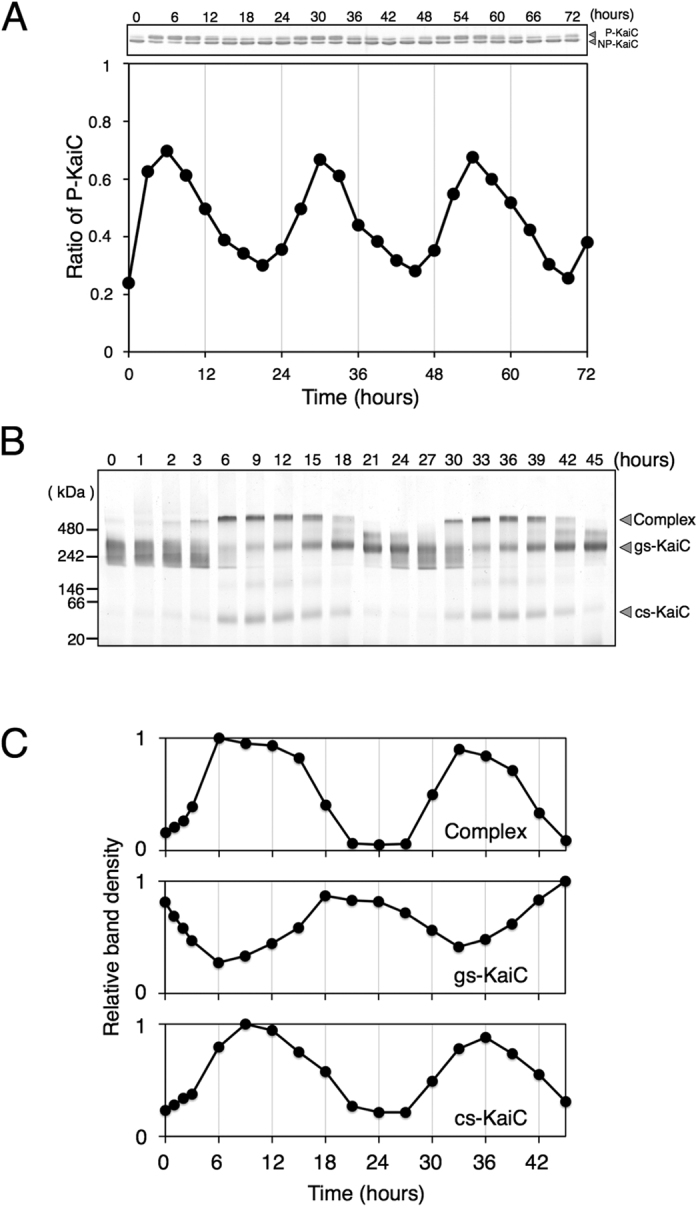
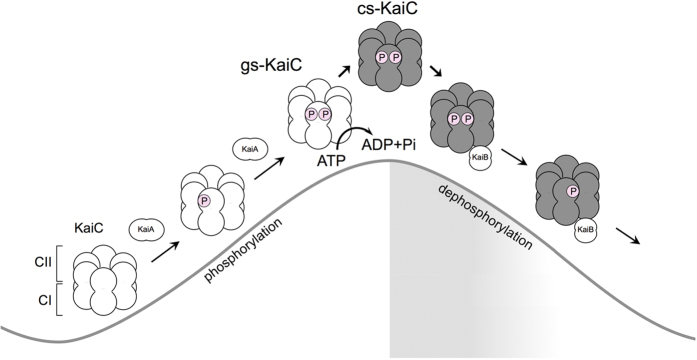
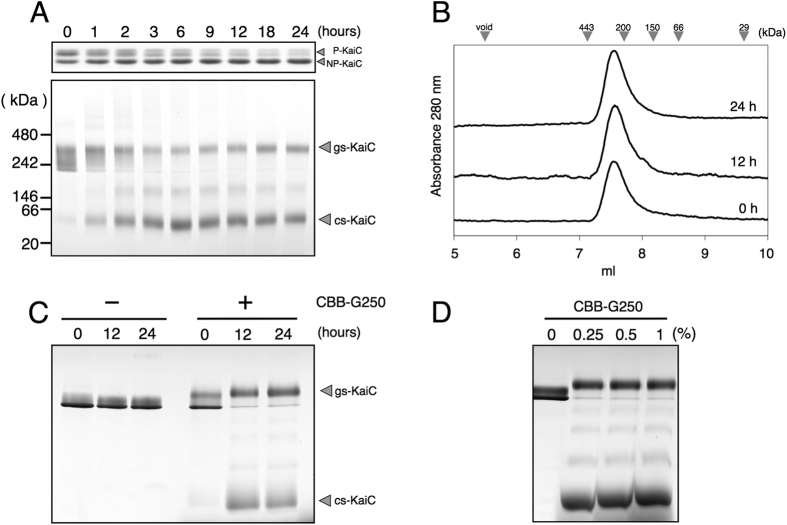
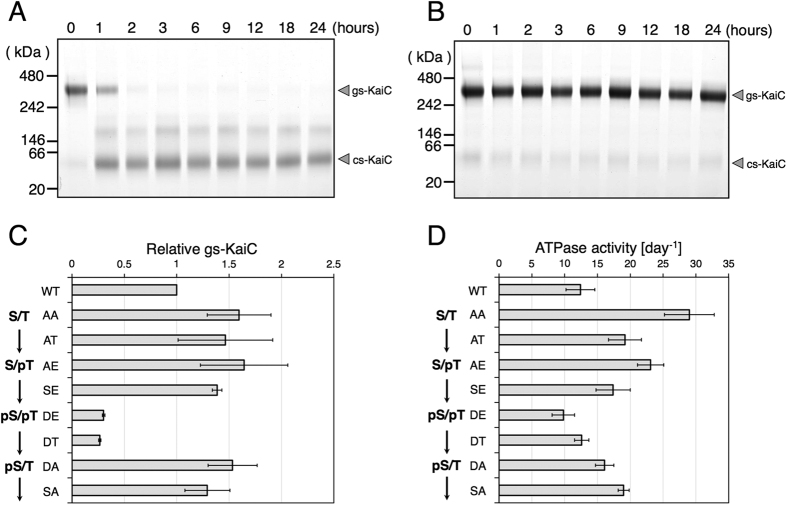
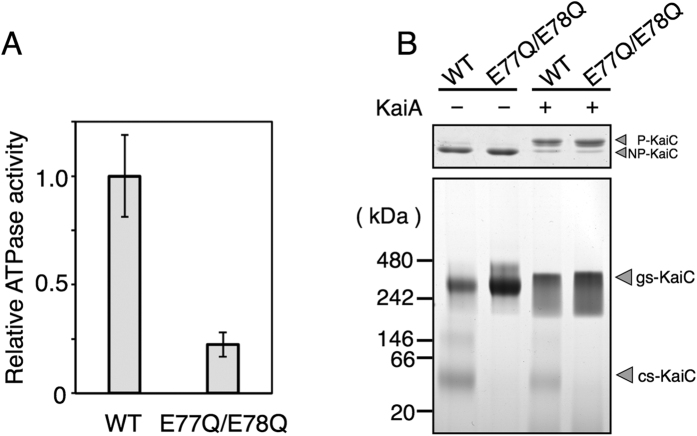
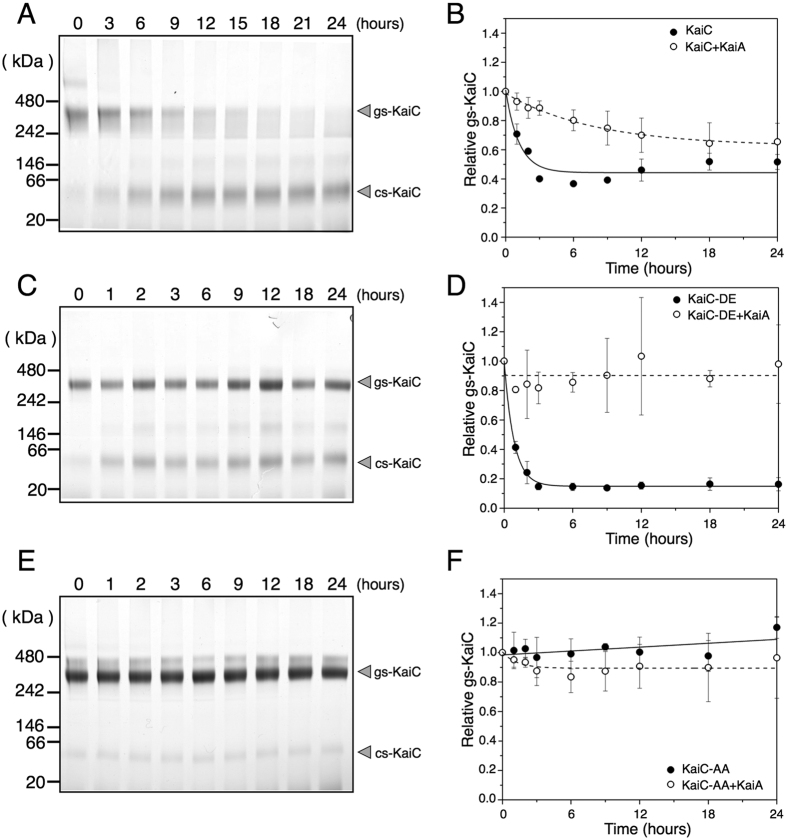
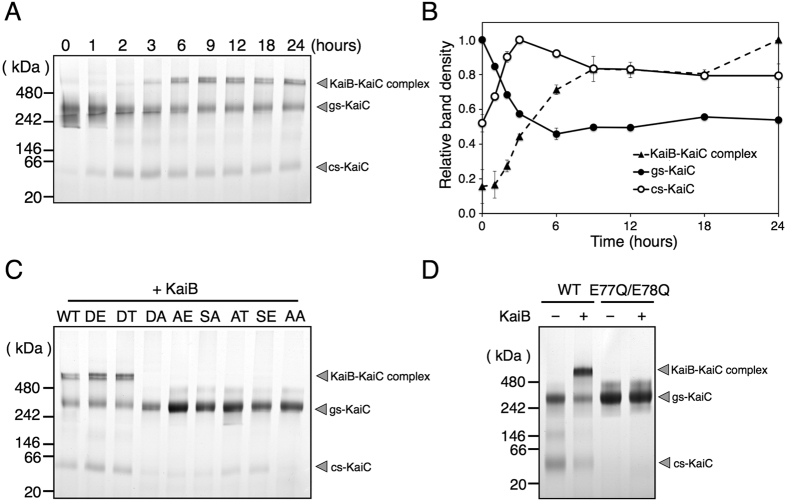
The cyanobacterial circadian oscillator can be reconstituted in vitro by mixing three clock proteins, KaiA, KaiB and KaiC, with ATP. KaiC is the only protein with circadian rhythmic activities. In the present study, we tracked the complex formation of the three Kai proteins over time using blue native (BN) polyacrylamide gel electrophoresis (PAGE), in which proteins are charged with the anionic dye Coomassie brilliant blue (CBB). KaiC was separated as three bands: the KaiABC complex, KaiC hexamer and KaiC monomer. However, no KaiC monomer was observed using gel filtration chromatography and CBB-free native PAGE. These data indicate two conformational states of KaiC hexamer and show that the ground-state KaiC (gs-KaiC) is stable and competent-state KaiC (cs-KaiC) is labile and degraded into monomers by the binding of CBB. Repeated conversions from gs-KaiC to cs-KaiC were observed over 24 h using an in vitro reconstitution system. Phosphorylation of KaiC promoted the conversion from gs-KaiC to cs-KaiC. KaiA sustained the gs-KaiC state, and KaiB bound only cs-KaiC. An E77Q/E78Q-KaiC variant that lacked N-terminal ATPase activity remained in the gs-KaiC state. Taken together, ATP hydrolysis induces the formation of cs-KaiC and promotes the binding of KaiB, which is a trigger for circadian oscillations.
蓝藻生物钟振荡器可以通过混合三种时钟蛋白 KaiA、KaiB 和 KaiC 与 ATP 在体外重建。KaiC 是唯一具有昼夜节律活性的蛋白质。在本研究中,我们使用蓝色 native (BN) 聚丙烯酰胺凝胶电泳 (PAGE) 随时间追踪三种 Kai 蛋白的复合物形成,其中蛋白质用阴离子染料考马斯亮蓝 (CBB) 带电。KaiC 被分离为三条带:KaiABC 复合物、KaiC 六聚体和 KaiC 单体。然而,使用凝胶过滤色谱和无 CBB 的天然 PAGE 未观察到 KaiC 单体。这些数据表明 KaiC 六聚体有两种构象状态,并表明基础态 KaiC (gs-KaiC) 是稳定的,竞争态 KaiC (cs-KaiC) 是不稳定的,并且通过与 CBB 结合降解成单体。在体外重建系统中,在 24 小时内观察到 gs-KaiC 到 cs-KaiC 的反复转换。KaiC 的磷酸化促进了从 gs-KaiC 到 cs-KaiC 的转换。KaiA 维持 gs-KaiC 状态,KaiB 仅结合 cs-KaiC。缺乏 N 端 ATP 酶活性的 E77Q/E78Q-KaiC 变体仍处于 gs-KaiC 状态。总之,ATP 水解诱导 cs-KaiC 的形成并促进 KaiB 的结合,这是昼夜节律振荡的触发因素。