Lv Qiao-Li, Hu Lei, Chen Shu-Hui, Sun Bao, Fu Meng-Long, Qin Chong-Zhen, Qu Qiang, Wang Gui-Hua, He Chen-Jie, Zhou Hong-Hao
Department of Clinical Pharmacology, Xiangya Hospital, Central South University, Changsha 410008, China.
Institute of Clinical Pharmacology, Hunan Key Laboratory of Pharmacogenetics, Central South University, Changsha 410078, China.
Int J Mol Sci. 2016 Aug 30;17(9):1431. doi: 10.3390/ijms17091431.
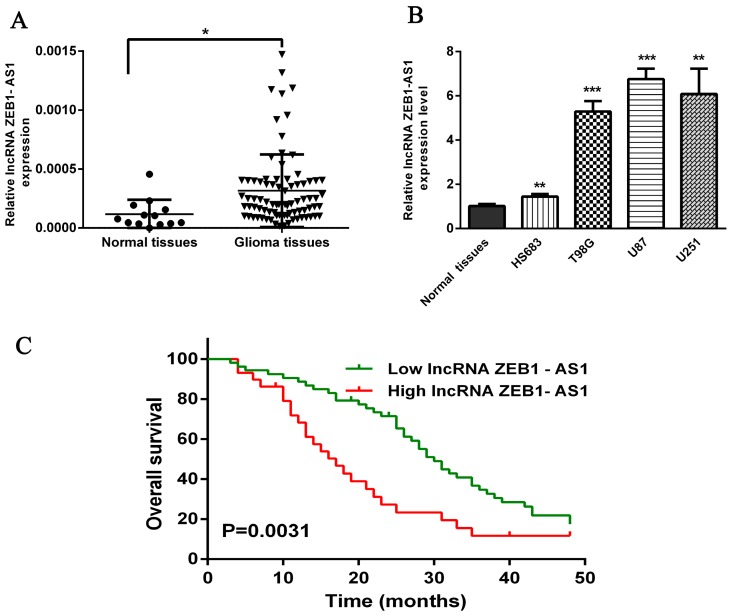
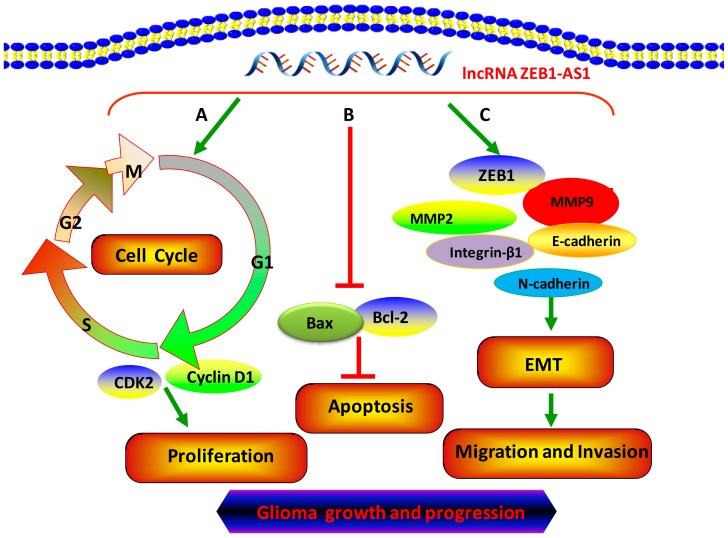
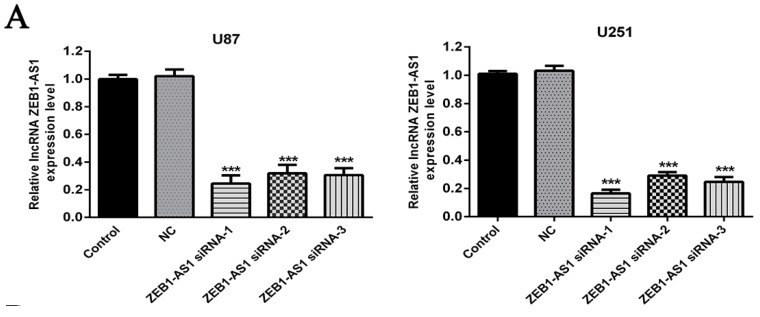
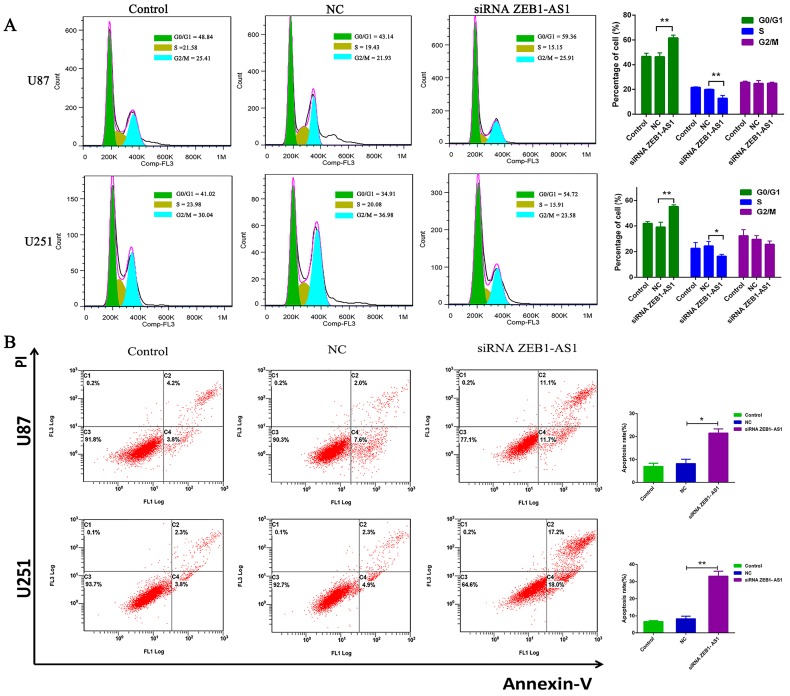
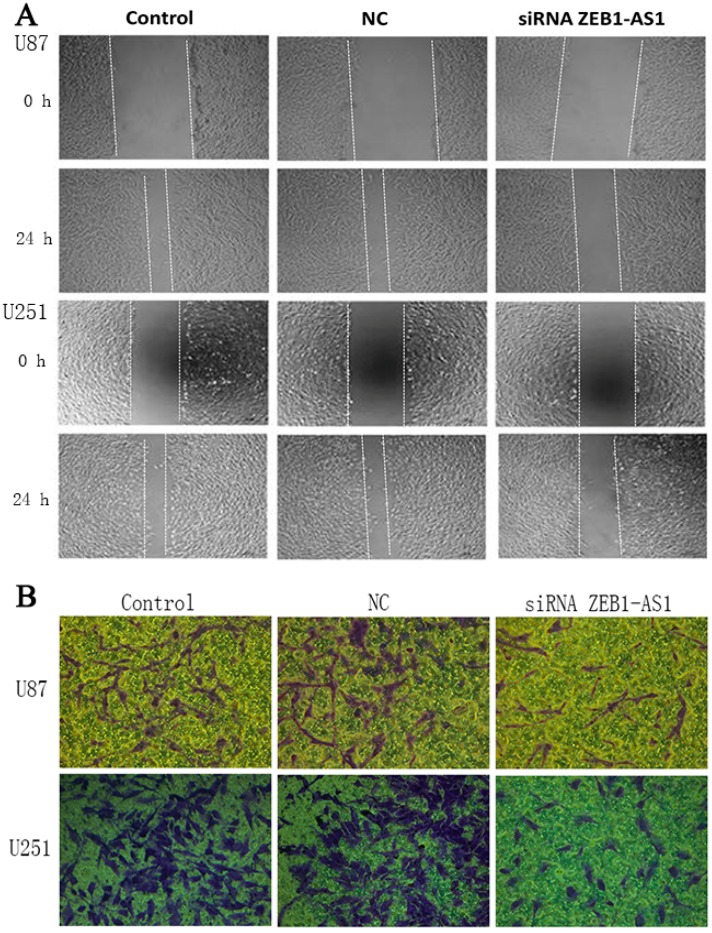
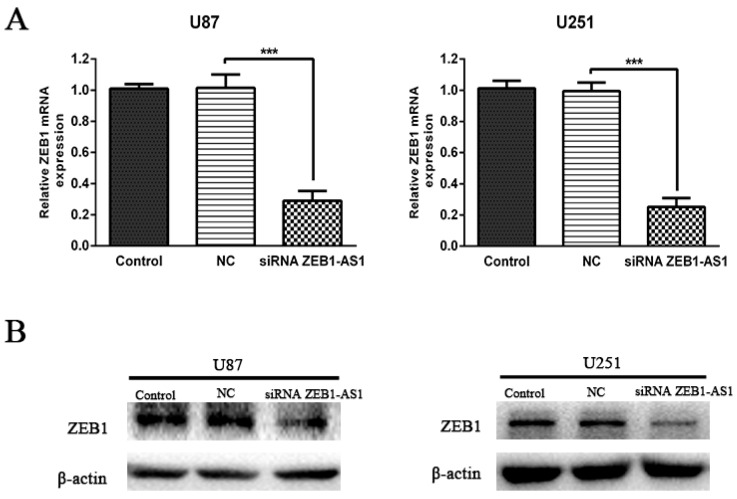
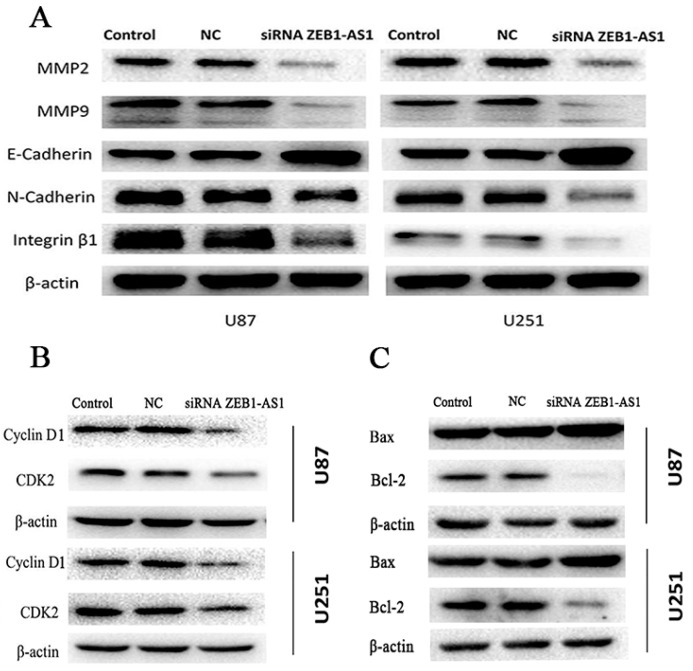
Emerging studies show that long noncoding RNAs (lncRNAs) have important roles in carcinogenesis. lncRNA ZEB1 antisense 1 (ZEB1-AS1) is a novel lncRNA, whose clinical significance, biological function, and underlying mechanism remains unclear in glioma. Here, we found that ZEB1-AS1 was highly expressed in glioma tissues, being closely related to clinical stage of glioma. Moreover, patients with high ZEB1-AS1 levels had poor prognoses, with the evidence provided by multivariate Cox regression analysis indicating that ZEB1-AS1 expression could serve as an independent prognostic factor in glioma patients. Functionally, silencing of ZEB1-AS1 could significantly inhibit cell proliferation, migration, and invasion, as well as promote apoptosis. Knockdown of ZEB1-AS1 significantly induced the G0/G1 phase arrest and correspondingly decreased the percentage of S phase cells. Further analysis indicated that ZEB1-AS1 could regulate the cell cycle by inhibiting the expression of G1/S transition key regulators, such as Cyclin D1 and CDK2. Furthermore, ZEB1-AS1 functioned as an important regulator of migration and invasion via activating epithelial to mesenchymal transition (EMT) through up-regulating the expression of ZEB1, MMP2, MMP9, N-cadherin, and Integrin-β1 as well as decreasing E-cadherin levels in the metastatic progression of glioma. Additionally, forced down-regulation of ZEB1-AS1 could dramatically promote apoptosis by increasing the expression level of Bax and reducing Bcl-2 expression in glioma. Taken together, our data suggest that ZEB1-AS1 may serve as a new prognostic biomarker and therapeutic target of glioma.
新兴研究表明,长链非编码RNA(lncRNA)在肿瘤发生中发挥重要作用。lncRNA ZEB1反义RNA1(ZEB1-AS1)是一种新型lncRNA,其在胶质瘤中的临床意义、生物学功能及潜在机制尚不清楚。在此,我们发现ZEB1-AS1在胶质瘤组织中高表达,与胶质瘤的临床分期密切相关。此外,ZEB1-AS1水平高的患者预后较差,多因素Cox回归分析表明ZEB1-AS1表达可作为胶质瘤患者的独立预后因素。在功能上,沉默ZEB1-AS1可显著抑制细胞增殖、迁移和侵袭,并促进细胞凋亡。敲低ZEB1-AS1可显著诱导G0/G1期阻滞,并相应降低S期细胞百分比。进一步分析表明,ZEB1-AS1可通过抑制G1/S转换关键调节因子如细胞周期蛋白D1和细胞周期蛋白依赖性激酶2的表达来调节细胞周期。此外,在胶质瘤转移过程中,ZEB1-AS1通过上调ZEB1、基质金属蛋白酶2、基质金属蛋白酶9、N-钙黏蛋白和整合素-β1的表达以及降低E-钙黏蛋白水平,激活上皮-间质转化(EMT),从而作为迁移和侵袭的重要调节因子。此外,强制下调ZEB1-AS1可通过增加胶质瘤中Bax的表达水平和降低Bcl-2的表达来显著促进细胞凋亡。综上所述,我们的数据表明ZEB1-AS1可能作为胶质瘤的一种新的预后生物标志物和治疗靶点。