Diz-Muñoz Alba, Romanczuk Pawel, Yu Weimiao, Bergert Martin, Ivanovitch Kenzo, Salbreux Guillaume, Heisenberg Carl-Philipp, Paluch Ewa K
Max Planck Institute of Molecular Cell Biology and Genetics, Dresden, 01307, Germany.
International Institute of Molecular and Cell Biology, Warsaw, 02-109, Poland.
BMC Biol. 2016 Sep 2;14(1):74. doi: 10.1186/s12915-016-0294-x.
High directional persistence is often assumed to enhance the efficiency of chemotactic migration. Yet, cells in vivo usually display meandering trajectories with relatively low directional persistence, and the control and function of directional persistence during cell migration in three-dimensional environments are poorly understood.
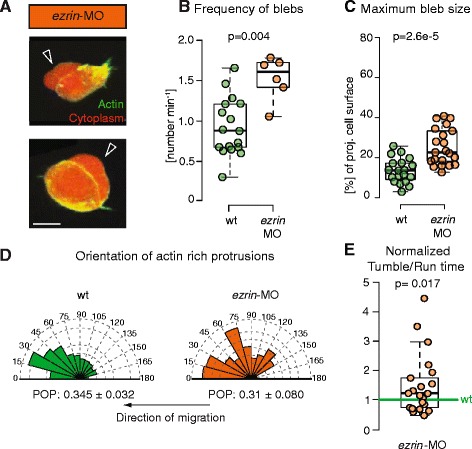
Here, we use mesendoderm progenitors migrating during zebrafish gastrulation as a model system to investigate the control of directional persistence during migration in vivo. We show that progenitor cells alternate persistent run phases with tumble phases that result in cell reorientation. Runs are characterized by the formation of directed actin-rich protrusions and tumbles by enhanced blebbing. Increasing the proportion of actin-rich protrusions or blebs leads to longer or shorter run phases, respectively. Importantly, both reducing and increasing run phases result in larger spatial dispersion of the cells, indicative of reduced migration precision. A physical model quantitatively recapitulating the migratory behavior of mesendoderm progenitors indicates that the ratio of tumbling to run times, and thus the specific degree of directional persistence of migration, are critical for optimizing migration precision.
Together, our experiments and model provide mechanistic insight into the control of migration directionality for cells moving in three-dimensional environments that combine different protrusion types, whereby the proportion of blebs to actin-rich protrusions determines the directional persistence and precision of movement by regulating the ratio of tumbling to run times.
人们通常认为高定向持续性可提高趋化性迁移的效率。然而,体内细胞通常表现出曲折的轨迹,定向持续性相对较低,而且在三维环境中细胞迁移过程中定向持续性的控制和功能尚不清楚。
在这里,我们以斑马鱼原肠胚形成过程中迁移的中内胚层祖细胞为模型系统,研究体内迁移过程中定向持续性的控制。我们发现祖细胞在持续的奔跑阶段和翻滚阶段之间交替,翻滚阶段会导致细胞重新定向。奔跑阶段的特征是形成富含肌动蛋白的定向突起,翻滚阶段的特征是泡状化增强。增加富含肌动蛋白的突起或泡状化的比例分别导致更长或更短的奔跑阶段。重要的是,减少和增加奔跑阶段都会导致细胞更大的空间分散,这表明迁移精度降低。一个定量概括中内胚层祖细胞迁移行为的物理模型表明,翻滚与奔跑时间的比率,即迁移的特定定向持续程度,对于优化迁移精度至关重要。
总之,我们的实验和模型为在结合不同突起类型的三维环境中移动的细胞的迁移方向性控制提供了机制性见解,其中泡状化与富含肌动蛋白的突起的比例通过调节翻滚与奔跑时间的比率来决定运动的定向持续性和精度。