Craven Dylan, Thakur Madhav P, Cameron Erin K, Frelich Lee E, Beauséjour Robin, Blair Robert B, Blossey Bernd, Burtis James, Choi Amy, Dávalos Andrea, Fahey Timothy J, Fisichelli Nicholas A, Gibson Kevin, Handa I Tanya, Hopfensperger Kristine, Loss Scott R, Nuzzo Victoria, Maerz John C, Sackett Tara, Scharenbroch Bryant C, Smith Sandy M, Vellend Mark, Umek Lauren G, Eisenhauer Nico
German Centre for Integrative Biodiversity Research (iDiv) Halle-Jena-Leipzig, Deutscher Platz 5e, 04103, Leipzig, Germany.
Institute of Biology, Leipzig University, Johannisallee 21, 04103, Leipzig, Germany.
Glob Chang Biol. 2017 Mar;23(3):1065-1074. doi: 10.1111/gcb.13446. Epub 2016 Sep 3.
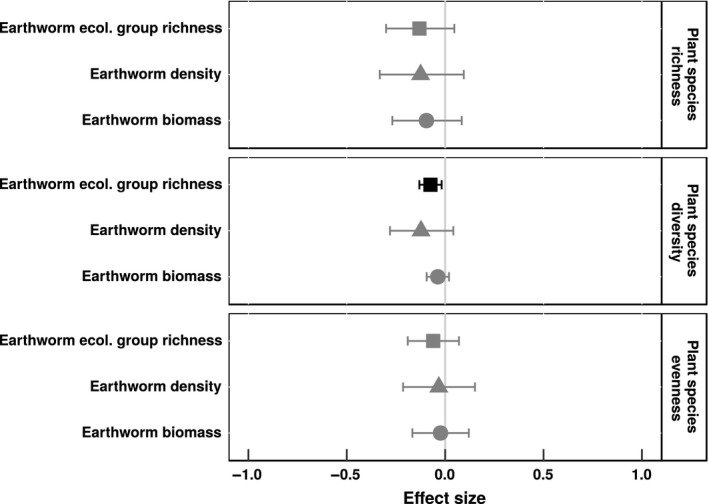
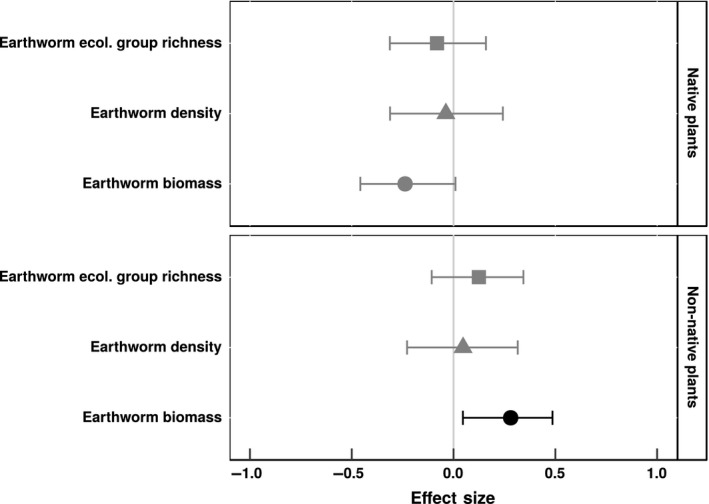
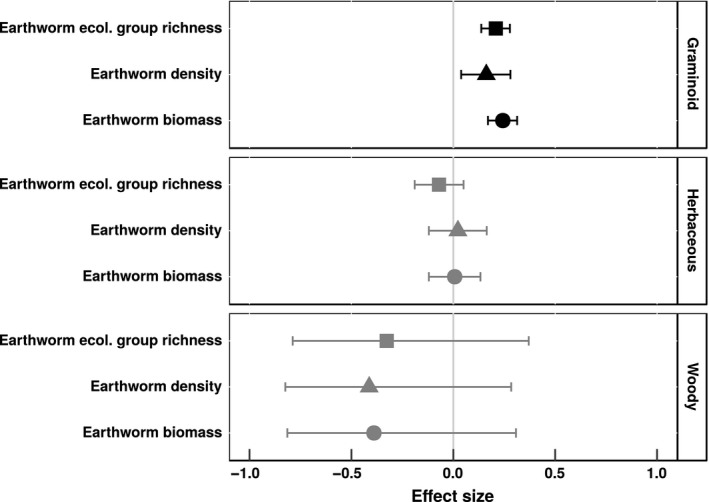
Globally, biological invasions can have strong impacts on biodiversity as well as ecosystem functioning. While less conspicuous than introduced aboveground organisms, introduced belowground organisms may have similarly strong effects. Here, we synthesize for the first time the impacts of introduced earthworms on plant diversity and community composition in North American forests. We conducted a meta-analysis using a total of 645 observations to quantify mean effect sizes of associations between introduced earthworm communities and plant diversity, cover of plant functional groups, and cover of native and non-native plants. We found that plant diversity significantly declined with increasing richness of introduced earthworm ecological groups. While plant species richness or evenness did not change with earthworm invasion, our results indicate clear changes in plant community composition: cover of graminoids and non-native plant species significantly increased, and cover of native plant species (of all functional groups) tended to decrease, with increasing earthworm biomass. Overall, these findings support the hypothesis that introduced earthworms facilitate particular plant species adapted to the abiotic conditions of earthworm-invaded forests. Further, our study provides evidence that introduced earthworms are associated with declines in plant diversity in North American forests. Changing plant functional composition in these forests may have long-lasting effects on ecosystem functioning.
在全球范围内,生物入侵会对生物多样性以及生态系统功能产生重大影响。虽然与引入的地上生物相比不太明显,但引入的地下生物可能具有同样强烈的影响。在此,我们首次综合分析了引入蚯蚓对北美森林植物多样性和群落组成的影响。我们进行了一项荟萃分析,共使用了645个观测数据,以量化引入蚯蚓群落与植物多样性、植物功能群覆盖度以及本地和非本地植物覆盖度之间关联的平均效应大小。我们发现,随着引入蚯蚓生态类群丰富度的增加,植物多样性显著下降。虽然植物物种丰富度或均匀度并未因蚯蚓入侵而改变,但我们的结果表明植物群落组成发生了明显变化:随着蚯蚓生物量的增加,禾本科植物和非本地植物物种的覆盖度显著增加,而本地植物物种(所有功能群)的覆盖度则趋于下降。总体而言,这些发现支持了这样一种假设,即引入的蚯蚓促进了特定适应蚯蚓入侵森林非生物条件的植物物种的生长。此外,我们的研究提供了证据,表明引入的蚯蚓与北美森林植物多样性的下降有关。这些森林中植物功能组成的变化可能会对生态系统功能产生长期影响。