Calvo-Gutiérrez J, Garrido-Castro J L, González-Navas C, Castro-Villegas M C, Ortega-Castro R, López-Medina C, Font-Ugalde P, Escudero-Contreras A, Collantes-Estévez E
Rheumatology Department, Reina Sofía University Hospital, Maimonides Institute for Biomedical Research of Cordoba (IMIBIC), University of Cordoba, Av/ Menedez Pidal SN, 14001, Cordoba, Spain.
BMC Musculoskelet Disord. 2016 Sep 5;17(1):382. doi: 10.1186/s12891-016-1242-1.
Several measurements are often used in daily clinical practice in the assessment of Ankylosing Spondylitis (AS) patients. The Assessment in SpondyloArthiritis International Society (ASAS) recommend in its core set: chest expansion modified Schöber test, Occiput to wall distance, lateral lumbar flexion, cervical rotation and The Bath Ankylosing Spondylitis Metrology Index (BASMI). BASMI also includes five measurements, some of them recommended by ASAS. Three versions of BASMI have been published with different scales and intervals for each component of the index. Though studies about reliability of these measurements are needed. The aim of this study was to analyze inter-rater reliability of recommended spinal mobility measures in AS.
We examined reproducibility of spinal mobility measurements on 33 AS patients performed by two experienced rheumatologists in the same day. Descriptive statistics, Intraclass Correlation Coefficients (ICC), and Smallest Detectable Difference (SDD) using the Bland-Altman criteria were obtained for all the measurements.
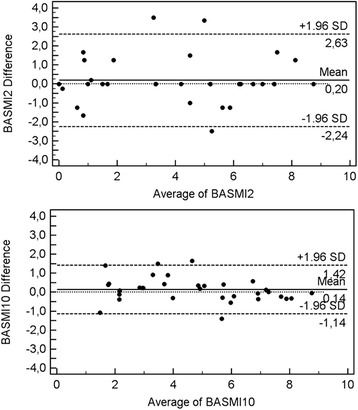
Chest expansion showed the lowest value of ICC (0.66) and occiput-wall the highest (0.97). SDD was 2.43 units for BASMI2 and 1.27 units for BASMI10.
Reliability according to ICC was moderate to high in all measurements. BASMI10, instead BASMI2, must be used: measurements used to calculate are the same but there is better reliability. Inter-rater variation, expressed as SDD, must be taken in account: smaller improvements do not demonstrate the efficacy of treatment because they can be due to experimental error and not to the treatment itself.
在强直性脊柱炎(AS)患者的日常临床评估中,常使用多种测量方法。国际脊柱关节炎评估协会(ASAS)在其核心指标集中推荐了:改良Schöber试验测量胸廓活动度、枕墙距、腰椎侧屈、颈椎旋转以及巴斯强直性脊柱炎测量指数(BASMI)。BASMI也包含五项测量指标,其中一些是ASAS推荐的。已发布了三个版本的BASMI,该指数的每个组成部分都有不同的量表和区间。尽管需要对这些测量的可靠性进行研究。本研究的目的是分析AS中推荐的脊柱活动度测量指标的评分者间信度。
我们检查了由两位经验丰富的风湿病学家在同一天对33例AS患者进行的脊柱活动度测量的可重复性。对所有测量指标进行描述性统计、组内相关系数(ICC)以及使用Bland-Altman标准的最小可检测差异(SDD)分析。
胸廓活动度的ICC值最低(0.66),枕墙距的ICC值最高(0.97)。BASMI2的SDD为2.43个单位,BASMI10的SDD为1.27个单位。
所有测量指标的ICC信度为中到高。应使用BASMI10而非BASMI2:用于计算的测量指标相同,但BASMI10的信度更高。必须考虑以SDD表示的评分者间差异:较小的改善并不表明治疗有效,因为这可能是由于实验误差而非治疗本身所致。