
作为磁阻线性刻度传感器编码器集成电路的前端读出电路。
The Front-End Readout as an Encoder IC for Magneto-Resistive Linear Scale Sensors.
作者信息
Tran Trong-Hieu, Chao Paul Chang-Po, Chien Ping-Chieh
机构信息
Department of Electrical Engineering, National Chiao Tung University, Hsinchu 200, Taiwan.
出版信息
Sensors (Basel). 2016 Sep 2;16(9):1416. doi: 10.3390/s16091416.
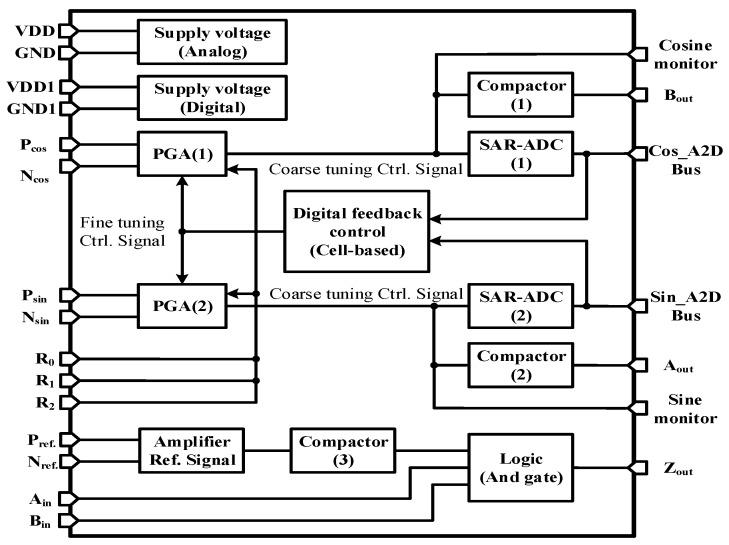
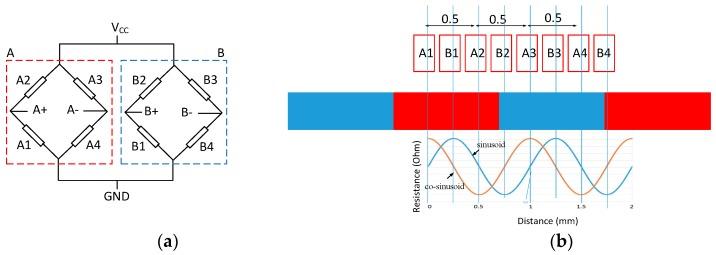
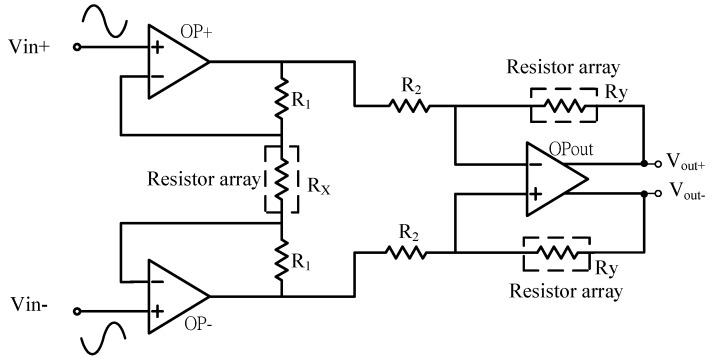
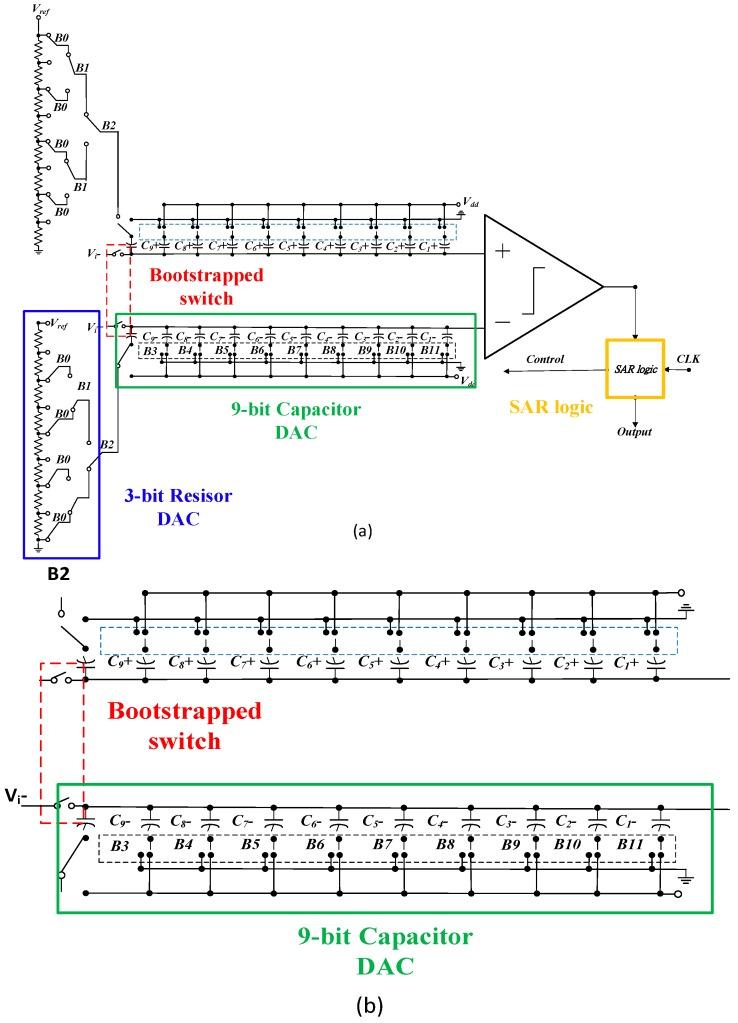
This study proposes a front-end readout circuit as an encoder chip for magneto-resistance (MR) linear scales. A typical MR sensor consists of two major parts: one is its base structure, also called the magnetic scale, which is embedded with multiple grid MR electrodes, while another is an "MR reader" stage with magnets inside and moving on the rails of the base. As the stage is in motion, the magnetic interaction between the moving stage and the base causes the variation of the magneto-resistances of the grid electrodes. In this study, a front-end readout IC chip is successfully designed and realized to acquire temporally-varying resistances in electrical signals as the stage is in motions. The acquired signals are in fact sinusoids and co-sinusoids, which are further deciphered by the front-end readout circuit via newly-designed programmable gain amplifiers (PGAs) and analog-to-digital converters (ADCs). The PGA is particularly designed to amplify the signals up to full dynamic ranges and up to 1 MHz. A 12-bit successive approximation register (SAR) ADC for analog-to-digital conversion is designed with linearity performance of ±1 in the least significant bit (LSB) over the input range of 0.5-2.5 V from peak to peak. The chip was fabricated by the Taiwan Semiconductor Manufacturing Company (TSMC) 0.35-micron complementary metal oxide semiconductor (CMOS) technology for verification with a chip size of 6.61 mm², while the power consumption is 56 mW from a 5-V power supply. The measured integral non-linearity (INL) is -0.79-0.95 LSB while the differential non-linearity (DNL) is -0.68-0.72 LSB. The effective number of bits (ENOB) of the designed ADC is validated as 10.86 for converting the input analog signal to digital counterparts. Experimental validation was conducted. A digital decoder is orchestrated to decipher the harmonic outputs from the ADC via interpolation to the position of the moving stage. It was found that the displacement measurement error is within ±15 µm for a measuring range of 10 mm.
本研究提出了一种前端读出电路作为磁阻(MR)线性标尺的编码器芯片。典型的MR传感器由两个主要部分组成:一个是其基础结构,也称为磁标尺,其中嵌入了多个网格MR电极,另一个是“MR读取器”阶段,内部有磁铁并在基础结构的轨道上移动。当该阶段移动时,移动阶段与基础结构之间的磁相互作用会导致网格电极的磁阻发生变化。在本研究中,成功设计并实现了一种前端读出IC芯片,以在该阶段移动时获取电信号中随时间变化的电阻。所获取的信号实际上是正弦波和余弦波,前端读出电路通过新设计的可编程增益放大器(PGA)和模数转换器(ADC)对其进行进一步解码。PGA经过专门设计,可将信号放大至全动态范围,最高可达1 MHz。设计了一个12位逐次逼近寄存器(SAR)ADC用于模数转换,在0.5 - 2.5 V峰峰值的输入范围内,其线性性能在最低有效位(LSB)上为±1。该芯片由台湾积体电路制造股份有限公司(TSMC)的0.35微米互补金属氧化物半导体(CMOS)技术制造,用于验证,芯片尺寸为6.61 mm²,从5 V电源获取的功耗为56 mW。测得的积分非线性(INL)为 - 0.79 - 0.95 LSB,而微分非线性(DNL)为 - 0.68 - 0.72 LSB。所设计ADC的有效位数(ENOB)经验证为10.86,用于将输入模拟信号转换为数字信号。进行了实验验证。精心设计了一个数字解码器,通过对ADC的谐波输出进行插值来确定移动阶段的位置。结果发现,在10 mm的测量范围内,位移测量误差在±15 µm以内。



 Zotero 插件