Lu Benjamin, Green Brooke A, Farr Jacqueline M, Lopes Flávia C M, Van Raay Terence J
Department of Molecular and Cellular Biology, University of Guelph, Guelph, ON N1G 2W1, Canada.
Cancers (Basel). 2016 Sep 1;8(9):82. doi: 10.3390/cancers8090082.
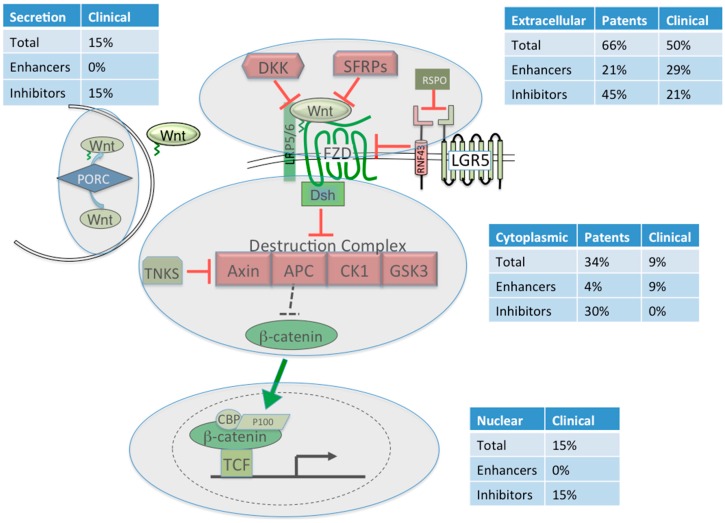
The Wnt signaling pathway is intricately involved in many aspects of development and is the root cause of an increasing number of diseases. For example, colorectal cancer is the second leading cause of death in the industrialized world and aberration of Wnt signaling within the colonic stem cell is the cause of more than 90% of these cancers. Despite our advances in successfully targeting other pathways, such as Human Epidermal Growth Factor Receptor 2 (HER2), there are no clinically relevant therapies available for Wnt-related diseases. Here, we investigated where research activities are focused with respect to Wnt signaling modulators by searching the United States Patent and Trade Office (USPTO) for patents and patent applications related to Wnt modulators and compared this to clinical trials focusing on Wnt modulation. We found that while the transition of intellectual property surrounding the Wnt ligand-receptor interface to clinical trials is robust, this is not true for specific inhibitors of β-catenin, which is constitutively active in many cancers. Considering the ubiquitous use of the synthetic T-cell Factor/Lymphoid Enhancer Factor (TCF/Lef) reporter system and its success in identifying novel modulators in vitro, we speculate that this model of drug discovery does not capture the complexity of in vivo Wnt signaling that may be required if we are to successfully target the Wnt pathway in the clinic. Notwithstanding, increasingly more complex models are being developed, which may not be high throughput, but more pragmatic in our pursuit to control Wnt signaling.
Wnt信号通路复杂地参与了发育的许多方面,并且是越来越多疾病的根本原因。例如,结直肠癌是工业化国家中第二大死因,结肠干细胞内Wnt信号的异常是超过90%这类癌症的病因。尽管我们在成功靶向其他通路(如人表皮生长因子受体2(HER2))方面取得了进展,但对于与Wnt相关的疾病,尚无临床相关的治疗方法。在此,我们通过在美国专利商标局(USPTO)搜索与Wnt调节剂相关的专利和专利申请,研究了Wnt信号调节剂的研究活动重点,并将其与专注于Wnt调节的临床试验进行了比较。我们发现,虽然围绕Wnt配体-受体界面的知识产权向临床试验的转化很顺利,但对于β-连环蛋白的特异性抑制剂并非如此,β-连环蛋白在许多癌症中具有组成性活性。考虑到合成的T细胞因子/淋巴细胞增强因子(TCF/Lef)报告系统的广泛使用及其在体外鉴定新型调节剂方面的成功,我们推测这种药物发现模型没有捕捉到体内Wnt信号的复杂性,而如果我们要在临床上成功靶向Wnt通路,可能需要这种复杂性。尽管如此,越来越复杂的模型正在被开发出来,这些模型可能不是高通量的,但在我们控制Wnt信号的追求中更具实用性。