Meneton Pierre, Lemogne Cédric, Herquelot Eléonore, Bonenfant Sébastien, Larson Martin G, Vasan Ramachandran S, Ménard Joël, Goldberg Marcel, Zins Marie
INSERM U1142 LIMICS, UMR_S 1142 Sorbonne Université, UPMC Université Paris 06, Université Paris 13, Paris, France.
Centre Psychiatrie et Neurosciences, INSERM U894, Université Paris Descartes, AP-HP Hôpitaux Universitaires Paris Ouest, Paris, France.
PLoS One. 2016 Sep 6;11(9):e0162386. doi: 10.1371/journal.pone.0162386. eCollection 2016.
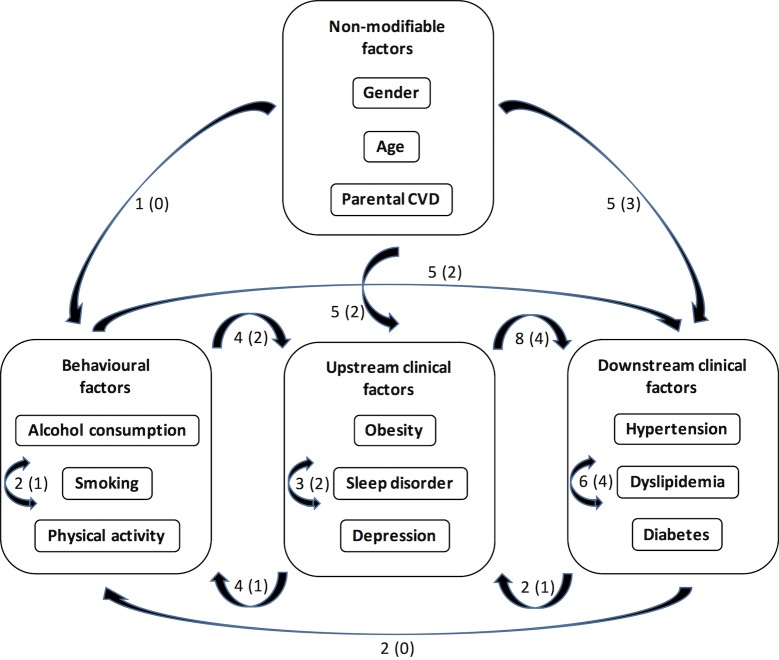
Although it has been recognized for a long time that the predisposition to cardiovascular diseases (CVD) is determined by many risk factors and despite the common use of algorithms incorporating several of these factors to predict the overall risk, there has yet been no global description of the complex way in which CVD risk factors interact with each other. This is the aim of the present study which investigated all existing relationships between the main CVD risk factors in a well-characterized occupational cohort. Prospective associations between 12 behavioural and clinical risk factors (gender, age, parental history of CVD, non-moderate alcohol consumption, smoking, physical inactivity, obesity, hypertension, dyslipidemia, diabetes, sleep disorder, depression) were systematically tested using Cox regression in 10,736 middle-aged individuals free of CVD at baseline and followed over 20 years. In addition to independently predicting CVD risk (HRs from 1.18 to 1.97 in multivariable models), these factors form a vast network of associations where each factor predicts, and/or is predicted by, several other factors (n = 47 with p<0.05, n = 37 with p<0.01, n = 28 with p<0.001, n = 22 with p<0.0001). Both the number of factors associated with a given factor (1 to 9) and the strength of the associations (HRs from 1.10 to 6.12 in multivariable models) are very variable, suggesting that all the factors do not have the same influence within this network. These results show that there is a remarkably extensive network of relationships between the main CVD risk factors which may have not been sufficiently taken into account, notably in preventive strategies aiming to lower CVD risk.
尽管长期以来人们已经认识到心血管疾病(CVD)的易感性由多种风险因素决定,并且尽管通常使用纳入其中若干因素的算法来预测总体风险,但尚未对CVD风险因素相互作用的复杂方式进行全面描述。本研究的目的即在于此,该研究调查了一个特征明确的职业队列中主要CVD风险因素之间所有现存的关系。在10736名基线时无CVD的中年个体中,使用Cox回归系统地测试了12种行为和临床风险因素(性别、年龄、CVD家族史、非适度饮酒、吸烟、缺乏身体活动、肥胖、高血压、血脂异常、糖尿病、睡眠障碍、抑郁症)之间的前瞻性关联,并对其进行了20多年的随访。除了独立预测CVD风险(多变量模型中的HR为1.18至1.97)外,这些因素还形成了一个庞大的关联网络,其中每个因素都可预测和/或被其他几个因素所预测(p<0.05时有47个,p<0.01时有37个,p<0.001时有28个,p<0.0001时有22个)。与给定因素相关的因素数量(1至9个)以及关联强度(多变量模型中的HR为1.10至6.12)都非常多变,这表明在这个网络中所有因素的影响并不相同。这些结果表明,主要CVD风险因素之间存在着非常广泛的关系网络,而这一点可能尚未得到充分考虑,尤其是在旨在降低CVD风险的预防策略中。