Equils Ozlem, da Costa Christopher, Wible Michele, Lipsky Benjamin A
Pfizer Inc., Collegeville, PA, USA.
University of Oxford, Oxford, UK.
BMC Infect Dis. 2016 Sep 6;16(1):476. doi: 10.1186/s12879-016-1779-5.
The presence of diabetes mellitus increases the risk of several severe infections, but data on its effect on treatment outcomes in patients with nosocomial pneumonia (NP) caused by methicillin-resistant Staphylococcus aureus (MRSA) are limited.
We retrospectively analyzed data from a double-blind, randomized, multi-center, international clinical trial of culture-confirmed MRSA NP that compared treatment with linezolid to vancomycin. Specifically, we evaluated the clinical and microbiologic outcomes of patients with and without diabetes in the modified intent to treat population at end-of-treatment (EOT) and end-of-study (EOS, 7-30 days post-EOT).
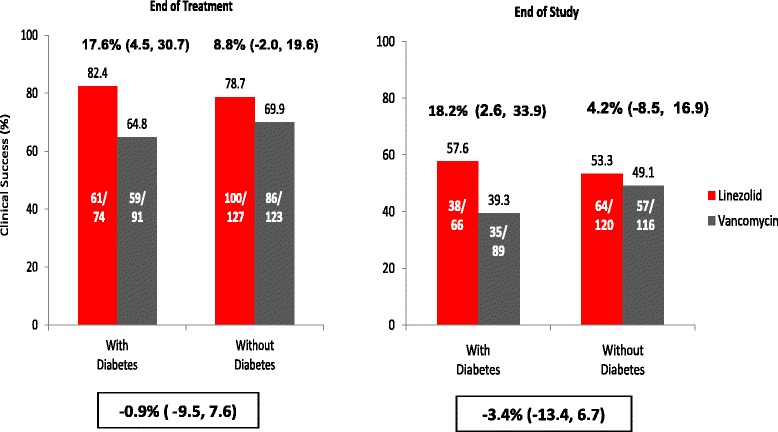
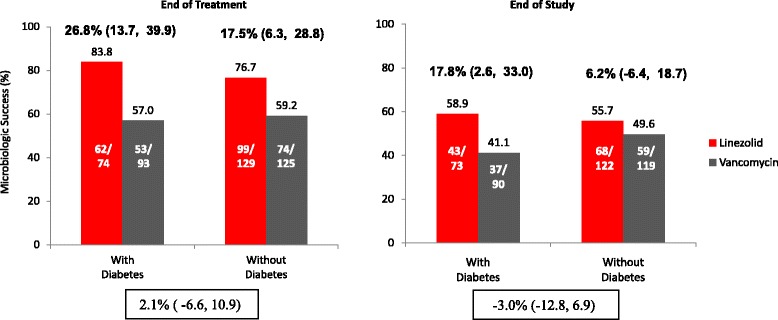
Among 448 enrolled patients 183 (40.8 %) had diabetes mellitus, 87 (47.5 %) of whom received linezolid and 96 (52.5 %) vancomycin. Baseline demographic and clinical characteristics were similar for the two treatment groups. Clinical success rates at EOS were 57.6 % with linezolid and 39.3 % with vancomycin, while microbiological success rates were 58.9 % with linezolid and 41.1 % with vancomycin. Among diabetic patients, rates of mortality and study drug-related adverse effects were similar between the treatment groups. Overall day 28 mortality rates were higher among diabetic patients compared to non-diabetic patients (23.5 vs 14.7 %, respectively: RD = 8.8 %, 95 % CI [1.4, 16.3]).
Among diabetic patients with MRSA NP, treatment with linezolid, compared to vancomycin, was associated with higher clinical and microbiologic success rates, and comparable adverse event rates.
NCT00084266 .
糖尿病的存在会增加多种严重感染的风险,但关于其对耐甲氧西林金黄色葡萄球菌(MRSA)所致医院获得性肺炎(NP)患者治疗结局影响的数据有限。
我们回顾性分析了一项关于确诊为MRSA NP的双盲、随机、多中心、国际临床试验的数据,该试验比较了利奈唑胺与万古霉素的治疗效果。具体而言,我们评估了改良意向性治疗人群中治疗结束时(EOT)和研究结束时(EOS,EOT后7 - 30天)有糖尿病和无糖尿病患者的临床和微生物学结局。
在448名入组患者中,183名(40.8%)患有糖尿病,其中87名(47.5%)接受利奈唑胺治疗,96名(52.5%)接受万古霉素治疗。两个治疗组的基线人口统计学和临床特征相似。EOS时利奈唑胺的临床成功率为57.6%,万古霉素为39.3%,而利奈唑胺的微生物学成功率为58.9%,万古霉素为41.1%。在糖尿病患者中,治疗组之间的死亡率和研究药物相关不良反应发生率相似。糖尿病患者的总体28天死亡率高于非糖尿病患者(分别为23.5%和14.7%:风险差 = 8.8%,95%可信区间[1.4, 16.3])。
在患有MRSA NP的糖尿病患者中,与万古霉素相比,利奈唑胺治疗的临床和微生物学成功率更高,不良事件发生率相当。
NCT00084266 。