Temereva Elena N, Kosevich Igor A
Department Invertebrate Zoology, Biological Faculty, Moscow State University, Moscow, Russia.
BMC Evol Biol. 2016 Sep 6;16(1):181. doi: 10.1186/s12862-016-0744-7.
The Bryozoa (=Ectoprocta) is a large group of bilaterians that exhibit great variability in the innervation of tentacles and in the organization of the cerebral ganglion. Investigations of bryozoans from different groups may contribute to the reconstruction of the bryozoan nervous system bauplan. A detailed investigation of the polypide nervous system of the ctenostome bryozoan Amathia gracilis is reported here.
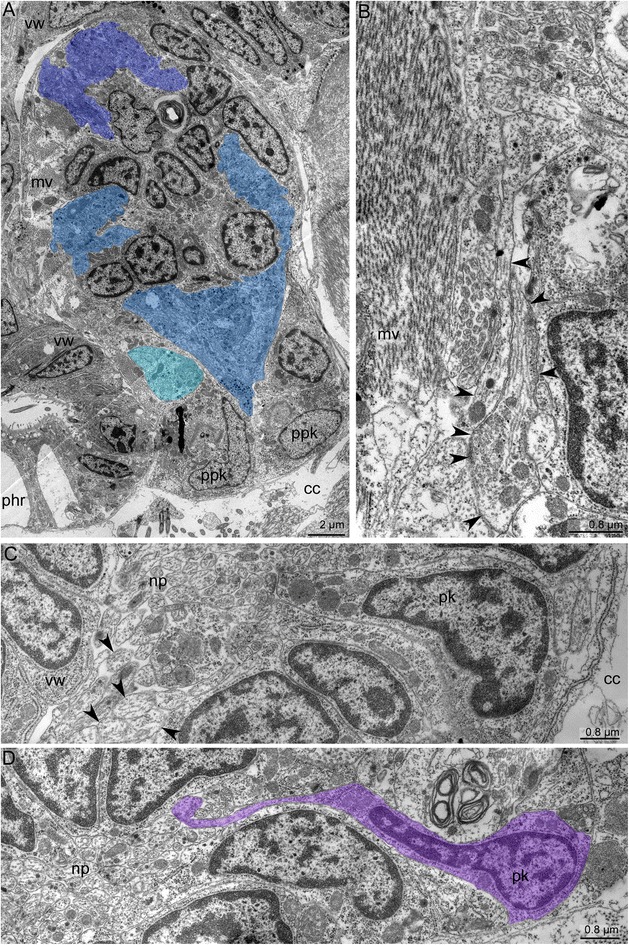
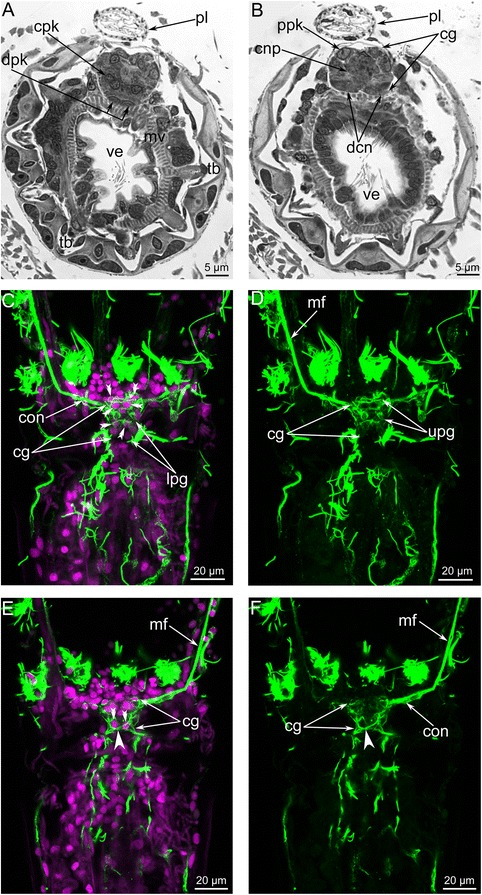
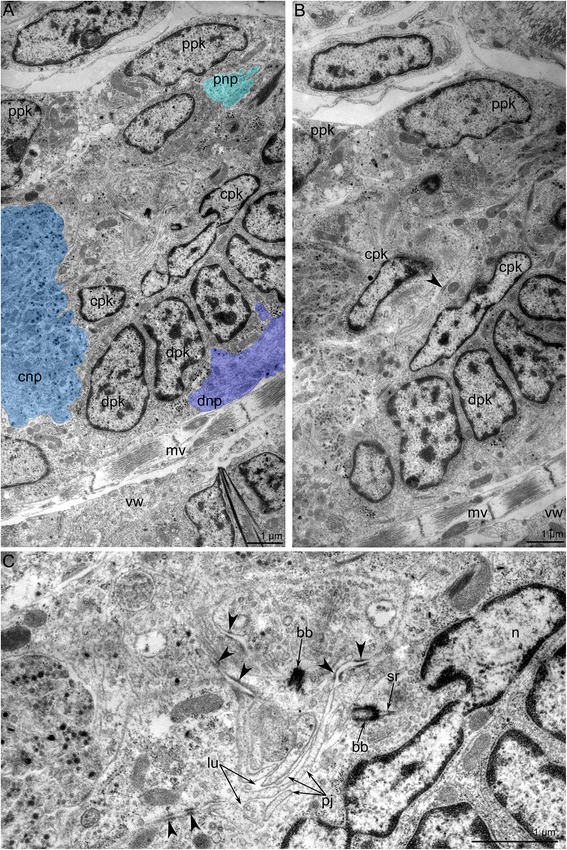
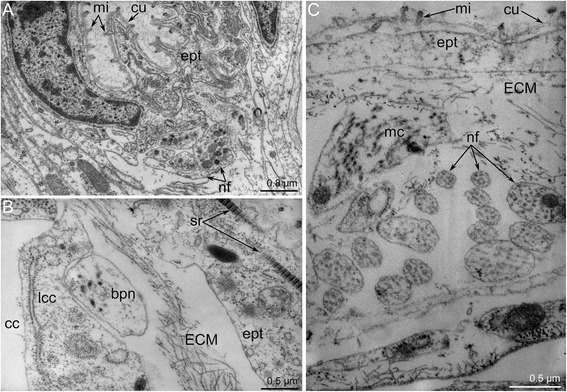
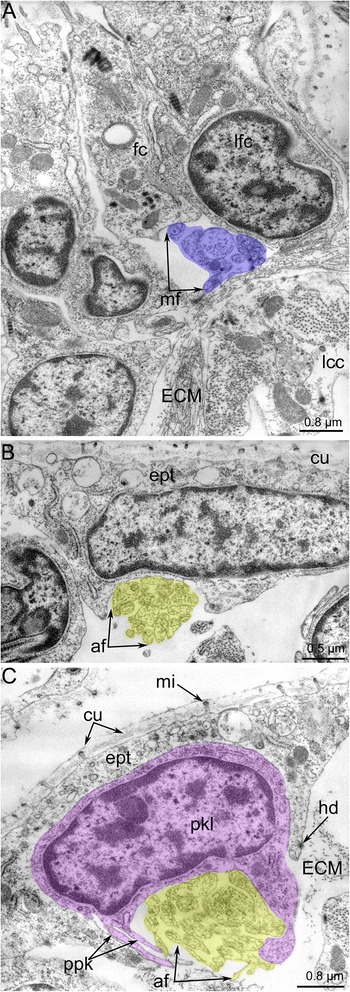
The cerebral ganglion displays prominent zonality and has at least three zones: proximal, central, and distal. The proximal zone is the most developed and contains two large perikarya giving rise to the tentacle sheath nerves. The neuroepithelial organization of the cerebral ganglion is revealed. The tiny lumen of the cerebral ganglion is represented by narrow spaces between the apical projections of the perikarya of the central zone. The cerebral ganglion gives rise to five groups of main neurite bundles of the lophophore and the tentacle sheath: the circum-oral nerve ring, the lophophoral dorso-lateral nerves, the pharyngeal and visceral neurite bundles, the outer nerve ring, and the tentacle sheath nerves. Serotonin-like immunoreactive nerve system of polypide includes eight large perikarya located between tentacles bases. There are two analmost and six oralmost perikarya with prominent serotonergic "gap" between them. Based on the characteristics of their innervations, the tentacles can be subdivided into two groups: four that are near the anus and six that are near the mouth. Two longitudinal neurite bundles - medio-frontal and abfrontal - extend along each tentacle.
The zonality of the cerebral ganglion, the presence of three commissures, and location of the main nerves emanating from each zone might have caused by directive innervation of the various parts of the body: the tentacles sheath, the lophohpore, and the digestive tract. Two alternative scenarios of bryozoan lophophore evolution are discussed. The arrangement of large serotonin-like immunoreactive perikarya differs from the pattern previously described in ctenostome bryozoans. In accordance with its position relative to the same organs (tentacles, anus, and mouth), the lophophore outer nerve ring corresponds to the brachiopod lower brachial nerve and to the phoronid tentacular nerve ring. The presence of the outer nerve ring makes the lophophore innervation within the group (clade) of lophophorates similar and provides additional morphological evidence of the lophophore homology and monophyly of the lophophorates.
苔藓虫纲(=外肛动物门)是一大类两侧对称动物,其触手的神经支配和脑神经节的组织结构具有很大的变异性。对不同类群苔藓虫的研究可能有助于重建苔藓虫神经系统的基本构造。本文报道了对栉口目苔藓虫纤细艾氏苔藓虫虫体神经系统的详细研究。
脑神经节呈现出明显的分区性,至少有三个区域:近端区、中央区和远端区。近端区最为发达,包含两个大型神经核,发出触手鞘神经。揭示了脑神经节的神经上皮组织。脑神经节的微小管腔由中央区神经核顶端突起之间的狭窄间隙表示。脑神经节发出五组触手冠和触手鞘的主要神经纤维束:围口神经环、触手冠背外侧神经、咽和内脏神经纤维束、外神经环和触手鞘神经。虫体的5-羟色胺样免疫反应性神经系统包括位于触手基部之间的八个大型神经核。有两个最靠近肛门的和六个最靠近口的神经核,它们之间有明显的5-羟色胺能“间隙”。根据其神经支配的特点,触手可分为两组:四个靠近肛门的和六个靠近口的。两条纵向神经纤维束——中额叶束和额前束——沿着每条触手延伸。
脑神经节的分区性、三个连合的存在以及每个区域发出的主要神经的位置可能是由身体各部分的定向神经支配引起的:触手鞘、触手冠和消化道。讨论了苔藓虫触手冠进化的两种替代方案。大型5-羟色胺样免疫反应性神经核的排列与先前在栉口目苔藓虫中描述的模式不同。根据其相对于相同器官(触手、肛门和口)的位置,触手冠外神经环对应于腕足动物的下腕臂神经和帚虫动物的触手神经环。外神经环的存在使触手冠类群(分支)内的神经支配相似,并为触手冠的同源性和触手冠类群的单系性提供了额外的形态学证据。