Yao Jie, Qin Li, Miao Sen, Wang Xiangshan, Wu Xuejian
Orthopedics Department, The First Affiliated Hospital of Zhengzhou University, Zhengzhou, Henan 450052, P.R. China; Spine Department 3, Zhengzhou Orthopedics Hospital, Zhengzhou, Henan 450052, P.R. China.
Orthopedics Department 3,The First Affiliated Hospital of Zhengzhou University, Zhengzhou, Henan 450052, P.R. China.
Oncol Lett. 2016 Sep;12(3):1840-1848. doi: 10.3892/ol.2016.4827. Epub 2016 Jul 8.
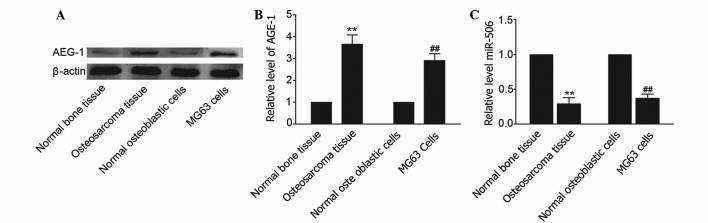
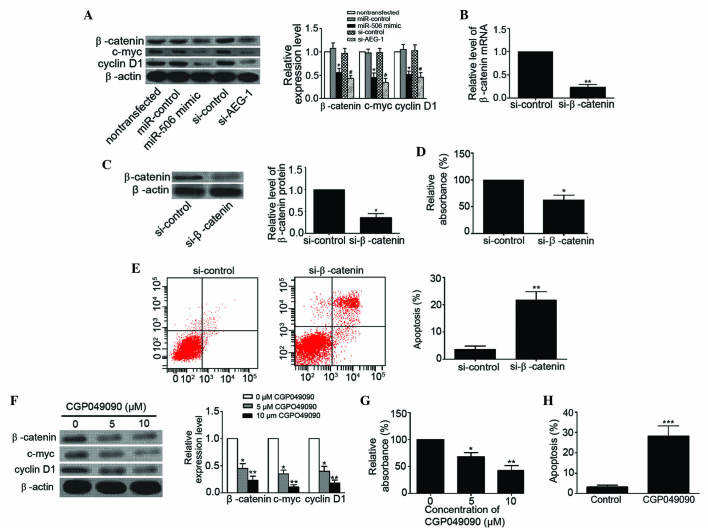
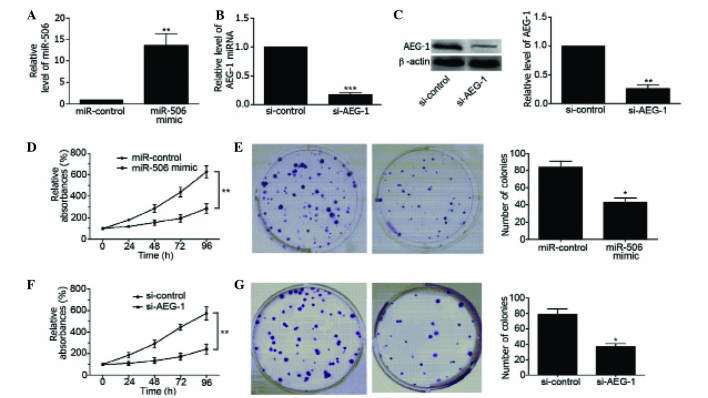
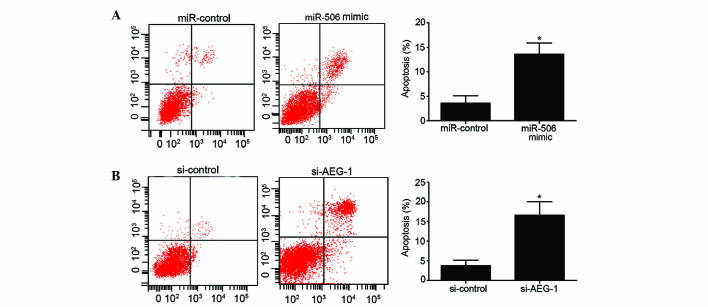
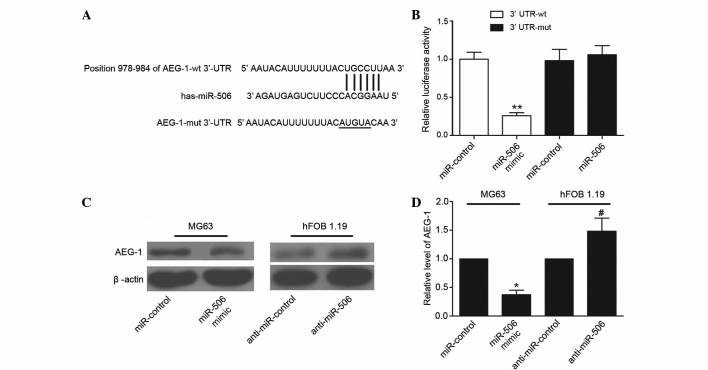
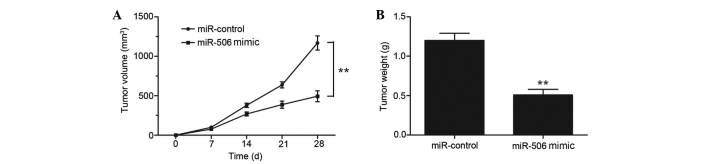
There is increasing evidence that microRNAs (miRs) are implicated in tumor development and progression; however, their specific roles in osteosarcoma are not well understood. The aim of the present study was to investigate the role of miR-506 in the pathogenesis of osteosarcoma. The expression levels of miR-506 and astrocyte elevated gene-1 (AEG-1) mRNA were detected using quantitative polymerase chain reaction, and the protein levels of AEG-1, β-catenin, c-myc and cyclin D1 were determined using western blot analysis. The effects of miR-506 and AEG-1 on cell viability, colony forming ability and apoptosis were assessed using MTT assay, colony formation assay, and flow cytometry, respectively. Lucifer reporter assays were used to demonstrate whether AEG-1 is a direct target of miR-506. The present study identified that miR-506 was downregulated in osteosarcoma tissues and cells. Overexpression of miR-506 suppressed the proliferation and induced apoptosis in osteosarcoma cells and inhibited tumor formation . Overexpression of miR-506 significantly inhibited the luciferase activity of AEG-1 with a wild-type 3'-untranslated region, providing clear evidence that AEG-1 was a direct and functional downstream target of miR-506. Similar to the overexpression of miR-506, downregulation of AEG-1 lead to an inhibitory effect on osteosarcoma . Furthermore, overexpression of miR-506 or downregulation of AEG-1 inhibited the Wnt/β-catenin signaling pathway, and inhibition of this pathway by β-catenin small interfering RNA or CGP049090, a small molecule inhibitor, suppressed cell proliferation and induced apoptosis . Overall, the present data indicated that miR-506 functions as a tumor suppressor by targeting AEG-1 in osteosarcoma via the regulation of the Wnt/β-catenin signaling pathway.
越来越多的证据表明,微小RNA(miR)与肿瘤的发生和发展有关;然而,它们在骨肉瘤中的具体作用尚不清楚。本研究的目的是探讨miR-506在骨肉瘤发病机制中的作用。采用定量聚合酶链反应检测miR-506和星形胶质细胞上调基因1(AEG-1)mRNA的表达水平,并用蛋白质印迹分析测定AEG-1、β-连环蛋白、c-myc和细胞周期蛋白D1的蛋白质水平。分别采用MTT法、集落形成试验和流式细胞术评估miR-506和AEG-1对细胞活力、集落形成能力和凋亡的影响。荧光素酶报告基因试验用于证明AEG-1是否为miR-506的直接靶点。本研究发现,miR-506在骨肉瘤组织和细胞中表达下调。miR-506的过表达抑制了骨肉瘤细胞的增殖并诱导其凋亡,同时抑制了肿瘤形成。miR-506的过表达显著抑制了具有野生型3'-非翻译区的AEG-1的荧光素酶活性,这清楚地证明AEG-1是miR-506直接的功能性下游靶点。与miR-506过表达相似,AEG-1的下调对骨肉瘤也有抑制作用。此外,miR-506的过表达或AEG-1的下调抑制了Wnt/β-连环蛋白信号通路,而β-连环蛋白小干扰RNA或小分子抑制剂CGP049090对该通路的抑制作用则抑制了细胞增殖并诱导了凋亡。总体而言,目前的数据表明,miR-506在骨肉瘤中通过靶向AEG-1调控Wnt/β-连环蛋白信号通路发挥肿瘤抑制作用。