Vigotsky Andrew D, Lehman Gregory J, Beardsley Chris, Contreras Bret, Chung Bryan, Feser Erin H
Kinesiology Program, Arizona State University , Phoenix , AZ , United States.
Private Practice , Toronto , Ontario , Canada.
PeerJ. 2016 Aug 11;4:e2325. doi: 10.7717/peerj.2325. eCollection 2016.
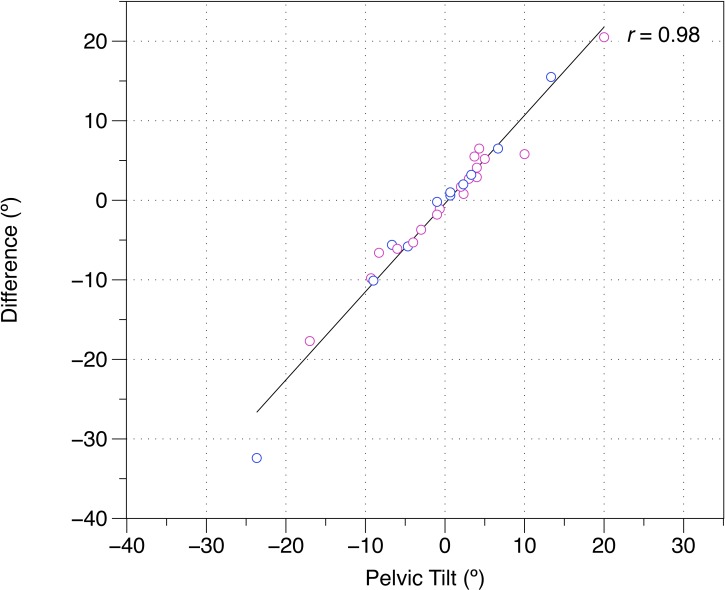
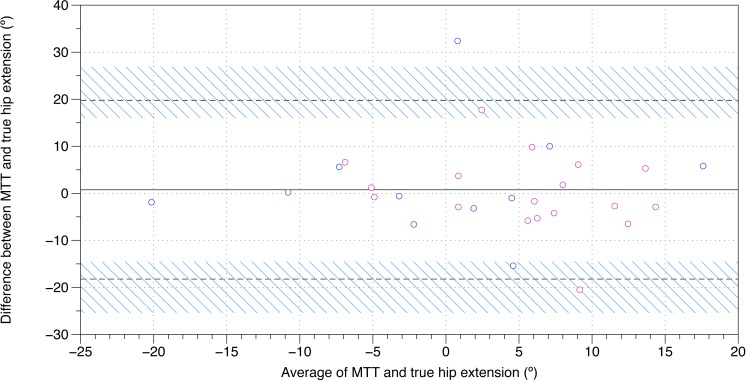
The modified Thomas test was developed to assess the presence of hip flexion contracture and to measure hip extensibility. Despite its widespread use, to the authors' knowledge, its criterion reference validity has not yet been investigated. The purpose of this study was to assess the criterion reference validity of the modified Thomas test for measuring peak hip extension angle and hip extension deficits, as defined by the hip not being able to extend to 0º, or neutral. Twenty-nine healthy college students (age = 22.00 ± 3.80 years; height = 1.71 ± 0.09 m; body mass = 70.00 ± 15.60 kg) were recruited for this study. Bland-Altman plots revealed poor validity for the modified Thomas test's ability to measure hip extension, which could not be explained by differences in hip flexion ability alone. The modified Thomas test displayed a sensitivity of 31.82% (95% CI [13.86-54.87]) and a specificity of 57.14% (95% CI [18.41-90.10]) for testing hip extension deficits. It appears, however, that by controlling pelvic tilt, much of this variance can be accounted for (r = 0.98). When pelvic tilt is not controlled, the modified Thomas test displays poor criterion reference validity and, as per previous studies, poor reliability. However, when pelvic tilt is controlled, the modified Thomas test appears to be a valid test for evaluating peak hip extension angle.
改良托马斯试验旨在评估髋关节屈曲挛缩的存在情况并测量髋关节的伸展性。尽管该试验被广泛应用,但据作者所知,其标准参照效度尚未得到研究。本研究的目的是评估改良托马斯试验在测量髋关节最大伸展角度和髋关节伸展不足方面的标准参照效度,髋关节伸展不足定义为髋关节无法伸展至0°(即中立位)。本研究招募了29名健康大学生(年龄=22.00±3.80岁;身高=1.71±0.09米;体重=70.00±15.60千克)。布兰德-奥特曼图显示改良托马斯试验测量髋关节伸展的效度较差,这不能仅用髋关节屈曲能力的差异来解释。改良托马斯试验检测髋关节伸展不足的灵敏度为31.82%(95%置信区间[13.86 - 54.87]),特异度为57.14%(95%置信区间[18.41 - 90.10])。然而,似乎通过控制骨盆倾斜,大部分这种差异是可以解释的(r = 0.98)。当不控制骨盆倾斜时,改良托马斯试验显示出较差的标准参照效度,并且如先前研究所示,可靠性也较差。然而,当控制骨盆倾斜时,改良托马斯试验似乎是评估髋关节最大伸展角度的有效试验。