Leem Inhwan, Lee Gyu Bin, Wang Ji Won, Pyun Sang Woo, Kum Chang-Jun, Lee Jin Hyuck, Kim Hyeong-Dong
Department of Physical Therapy, School of Health and Environmental Science, College of Health Science, Korea University, Seoul 02841, Republic of Korea.
365 Maeil Korean Medicine Hospital, Seoul 02582, Republic of Korea.
Diagnostics (Basel). 2025 May 13;15(10):1229. doi: 10.3390/diagnostics15101229.
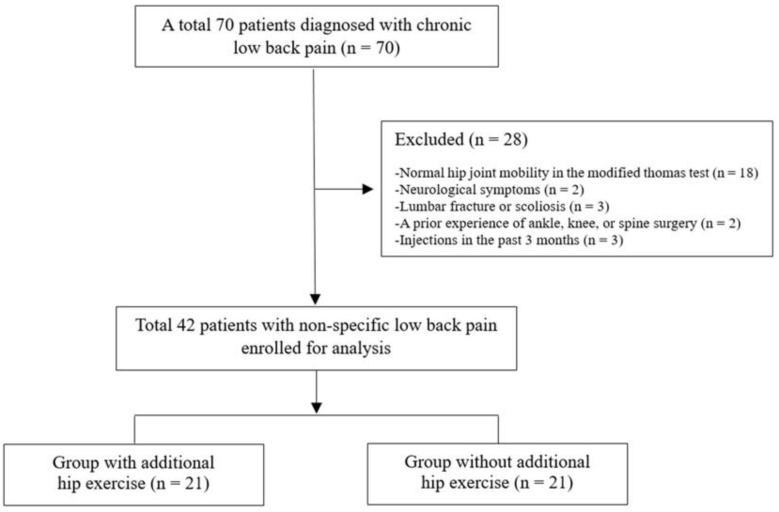
This study aimed to compare functional and clinical outcomes between patients with chronic non-specific lower back pain (NSLBP) with restricted hip extension mobility who performed spinal stabilization exercises with hip mobilization either with or without additional hip exercises. A total of 42 patients with chronic NSLBP with restricted hip extension mobility were enrolled (21 with and 21 without additional hip exercises). Functional and clinical outcomes were assessed based on hip joint mobility, back extensor endurance, postural stability, and patient-reported outcomes, including visual analog scale (VAS) and Oswestry disability index (ODI) scores. A significant group-time interaction was identified for postural stability (Rt: < 0.001, Lt: = 0.002) and the ODI ( = 0.004). After the intervention, the group with additional hip exercises demonstrated significantly greater improvements in postural stability (Rt: < 0.001; Lt: = 0.01) and ODI scores ( < 0.001) compared with the group without additional hip exercises. However, no significant main group effect or group-time interaction was observed for the hip joint mobility, back extensor endurance, or VAS scores (all > 0.05). Furthermore, the ODI score (r = 0.123, = 0.023) was an independent predictor of hip joint mobility but not the VAS score ( > 0.05). Hip exercises may improve postural stability and function in patients with chronic NSLBP with restricted hip extension mobility. Notably, clinicians and therapists must recognize the importance of hip exercises during rehabilitation of patients with chronic NSLBP with restricted hip extension mobility.
本研究旨在比较慢性非特异性下背痛(NSLBP)且髋关节伸展活动受限的患者,在进行脊柱稳定训练时,加或不加额外髋关节训练的功能和临床结果。共纳入42例慢性NSLBP且髋关节伸展活动受限的患者(21例进行额外髋关节训练,21例未进行)。基于髋关节活动度、背伸肌耐力、姿势稳定性以及患者报告的结果,包括视觉模拟量表(VAS)和Oswestry功能障碍指数(ODI)评分,对功能和临床结果进行评估。在姿势稳定性(右侧:<0.001,左侧:=0.002)和ODI(=0.004)方面,发现了显著的组间-时间交互作用。干预后,与未进行额外髋关节训练的组相比,进行额外髋关节训练的组在姿势稳定性(右侧:<0.001;左侧:=0.01)和ODI评分(<0.001)方面有显著更大的改善。然而,在髋关节活动度、背伸肌耐力或VAS评分方面,未观察到显著 的主要组效应或组间-时间交互作用(均>0.05)。此外,ODI评分(r = 0.123,= 0.023)是髋关节活动度的独立预测因子,但不是VAS评分的独立预测因子(>0.05)。髋关节训练可能会改善慢性NSLBP且髋关节伸展活动受限患者的姿势稳定性和功能。值得注意的是,临床医生和治疗师必须认识到在慢性NSLBP且髋关节伸展活动受限患者的康复过程中,髋关节训练的重要性。