Daneshjoo Abdolhamid, Hosseini Elham, Heshmati Safoura, Sahebozamani Mansour, Behm David George
Department of Sports Injuries and Corrective Exercises, Faculty of Sports Sciences, Shahid Bahonar University of Kerman, Kerman, 7616913439, (ad), Iran.
School of Human Kinetics and Recreation, Memorial University of Newfoundland, St. John's, NL, A1C 5S7, Canada.
BMC Sports Sci Med Rehabil. 2024 Aug 9;16(1):167. doi: 10.1186/s13102-024-00841-5.
Considering the effects of fatigue on athletic performance and the subsequent increase in the probability of injury, the purpose of this study was to compare the effects of slow dynamic, fast dynamic, and static stretching on the recovery of performance, range of motion (ROM), balance, and joint position sense.
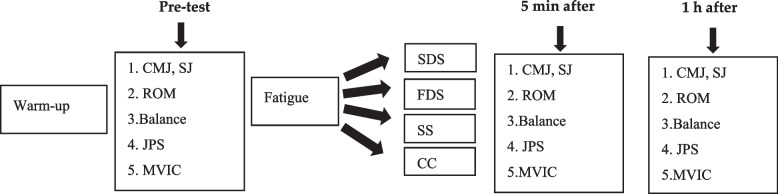
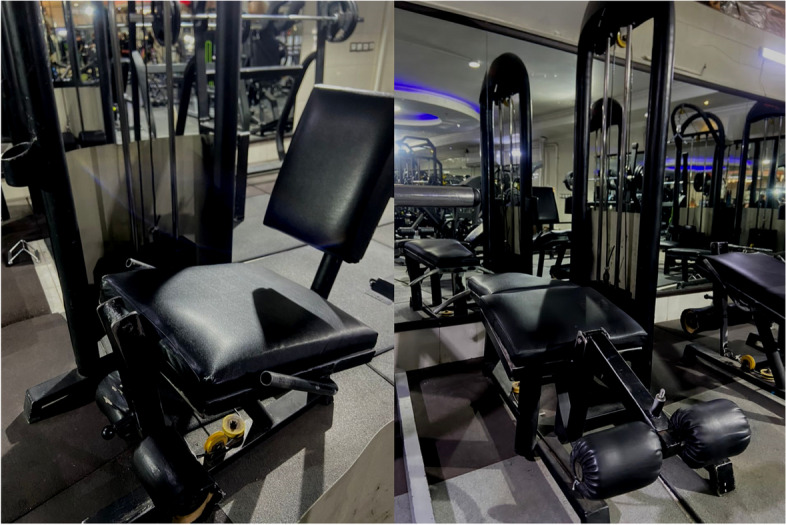
Fifteen collegiate healthy females were involved in four separate sessions of slow dynamic stretching (SDS), fast dynamic stretching (FDS), static stretching (SS), and control condition (CC; without stretching), in a random order with at least 48 h of rest between sessions. After warming up, the individuals performed ROM, balance, joint position sense (JPS) maximum voluntary isometric contraction (MVIC) force as well as countermovement (CMJ) and squat jump (SJ) as pre-tests. After performing the knee fatigue protocol of 4 sets of knee extension and flexion at 60% of 1 repetition maximum (RM) to exhaustion (CC; without stretching) or stretching programs (SDS or FDS or SS), the subjects repeated all the tests at post-test 1 (after 5 min) and post-test 2 (after 60 min).
A significantly lower JPS error was detected with SDS while JPS error increased in the SS and control conditions (p < 0.0001). MVIC force significantly increased with SDS and FDS but decreased in control and SS conditions (p < 0.0001). Moreover, a significant decrease in CMJ and SJ height in SS and control conditions was revealed (p < 0.0001). Also, a significant decrease in balance with the control condition was revealed. But only SDS minimized fatigue-induced balance decrements (p < 0.0001). Additionally, the control condition experienced a significant decrease in knee extensor ROM, which contrasted with the significant increase in the quadriceps flexibility with the stretching conditions.
The present results support the idea that SDS may increase quadriceps MVIC force, knee extensor ROM and knee JPS. So according to the present results, it is suggested that the SDS could be implemented and incorporated into a regular recovery program.
考虑到疲劳对运动表现的影响以及随后受伤概率的增加,本研究的目的是比较慢速动态拉伸、快速动态拉伸和静态拉伸对运动表现恢复、关节活动范围(ROM)、平衡和关节位置觉的影响。
15名大学健康女性参与了四个独立的实验环节,分别为慢速动态拉伸(SDS)、快速动态拉伸(FDS)、静态拉伸(SS)和对照条件(CC;不进行拉伸),实验顺序随机,各环节之间至少休息48小时。热身之后,个体进行ROM、平衡、关节位置觉(JPS)、最大自主等长收缩(MVIC)力量以及反向运动跳(CMJ)和深蹲跳(SJ)作为预测试。在进行4组膝关节伸展和屈曲(每组重复次数最大值的60%,即60%RM)直至力竭的膝关节疲劳方案(CC;不进行拉伸)或拉伸方案(SDS或FDS或SS)后,受试者在测试后1(5分钟后)和测试后2(60分钟后)重复所有测试。
SDS组检测到的JPS误差显著更低,而SS组和对照条件下JPS误差增加(p < 0.0001)。MVIC力量在SDS组和FDS组显著增加,但在对照组和SS组降低(p < 0.0001)。此外,SS组和对照条件下CMJ和SJ高度显著降低(p < 0.0001)。同时,对照条件下平衡显著降低。但只有SDS能将疲劳引起的平衡下降降至最低(p < 0.0001)。此外,对照条件下膝关节伸肌ROM显著降低,这与拉伸条件下股四头肌柔韧性显著增加形成对比。
目前的结果支持这样的观点,即SDS可能会增加股四头肌MVIC力量、膝关节伸肌ROM和膝关节JPS。因此,根据目前的结果,建议实施SDS并将其纳入常规恢复计划。