
关于陆地生态学的内在空间知识有利于高个子判断距离。
Intrinsic spatial knowledge about terrestrial ecology favors the tall for judging distance.
机构信息
Key Laboratory of Brain Functional Genomics (Ministry of Education and Science and Technology Commission of Shanghai Municipality), Institute of Cognitive Neurosciences, School of Psychology and Cognitive Science, East China Normal University, Shanghai 200062, China.
College of Optometry, Ohio State University, Columbus, OH 43210, USA.
出版信息
Sci Adv. 2016 Aug 31;2(8):e1501070. doi: 10.1126/sciadv.1501070. eCollection 2016 Aug.
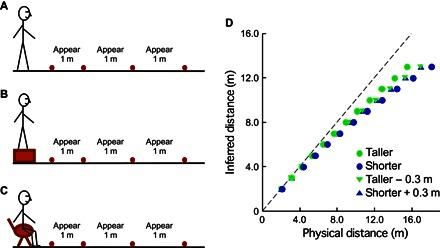
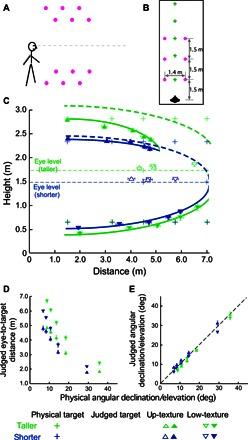
Our sense of vision reliably directs and guides our everyday actions, such as reaching and walking. This ability is especially fascinating because the optical images of natural scenes that project into our eyes are insufficient to adequately form a perceptual space. It has been proposed that the brain makes up for this inadequacy by using its intrinsic spatial knowledge. However, it is unclear what constitutes intrinsic spatial knowledge and how it is acquired. We investigated this question and showed evidence of an ecological basis, which uses the statistical spatial relationship between the observer and the terrestrial environment, namely, the ground surface. We found that in dark and reduced-cue environments where intrinsic knowledge has a greater contribution, perceived target location is more accurate when referenced to the ground than to the ceiling. Furthermore, taller observers more accurately localized the target. Superior performance was also observed in the full-cue environment, even when we compensated for the observers' heights by having the taller observer sit on a chair and the shorter observers stand on a box. Although fascinating, this finding dovetails with the prediction of the ecological hypothesis for intrinsic spatial knowledge. It suggests that an individual's accumulated lifetime experiences of being tall and his or her constant interactions with ground-based objects not only determine intrinsic spatial knowledge but also endow him or her with an advantage in spatial ability in the intermediate distance range.
我们的视觉可靠地引导和指导我们的日常行动,例如伸手和行走。这种能力特别令人着迷,因为投射到我们眼睛中的自然场景的光学图像不足以充分形成感知空间。有人提出,大脑通过利用其内在的空间知识来弥补这种不足。然而,目前尚不清楚内在空间知识的构成以及它是如何获得的。我们研究了这个问题,并证明了它具有生态基础,该基础利用了观察者与地面环境(即地面)之间的统计空间关系。我们发现,在内在知识贡献更大的黑暗和提示减少的环境中,相对于天花板,参照地面时目标位置的感知更为准确。此外,较高的观察者更准确地定位了目标。即使我们通过让较高的观察者坐在椅子上而让较矮的观察者站在盒子上来补偿观察者的身高,在全提示环境中也观察到了更高的性能。尽管令人着迷,但这一发现与内在空间知识的生态假说的预测相一致。它表明,个体一生中积累的高个子经验以及他或她与基于地面的物体的不断互动不仅决定了内在空间知识,而且还赋予了他或她在中等距离范围内的空间能力优势。


 Zotero 插件