Heo Bong Ha, Lee Hyeon Jung, Lee Hyung Gon, Kim Man Young, Park Keun Suk, Choi Jeong Il, Yoon Myung Ha, Kim Woong Mo
Department of Anesthesiology and Pain Medicine, Chonnam National University, Medical School, Gwangju, Republic of Korea.
Medicine (Baltimore). 2016 Sep;95(36):e4771. doi: 10.1097/MD.0000000000004771.
The existence of peripheral opioid receptors and its effectiveness in peripheral nerve block remain controversial. The aim of this prospective, randomized, double-blinded study was to examine the analgesic effects of adding fentanyl to ropivacaine for continuous femoral nerve block (CFNB) using patient-controlled analgesia after total knee arthroplasty (TKA).
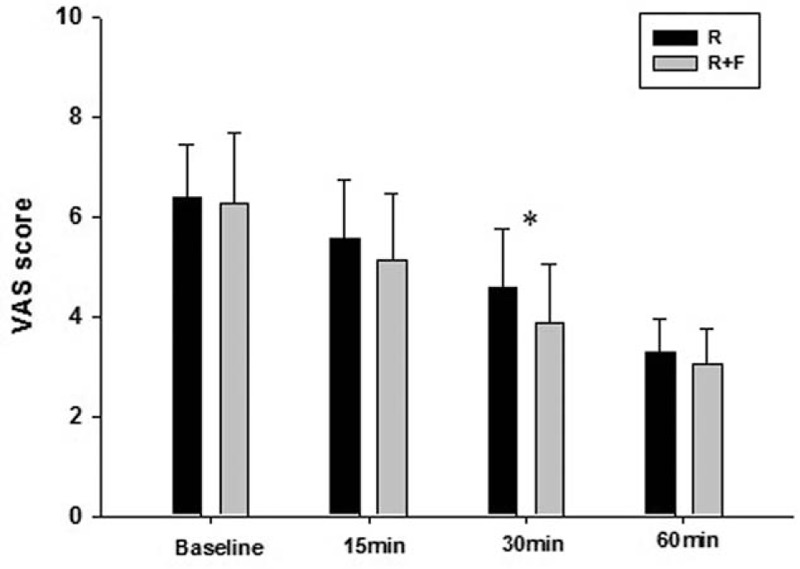
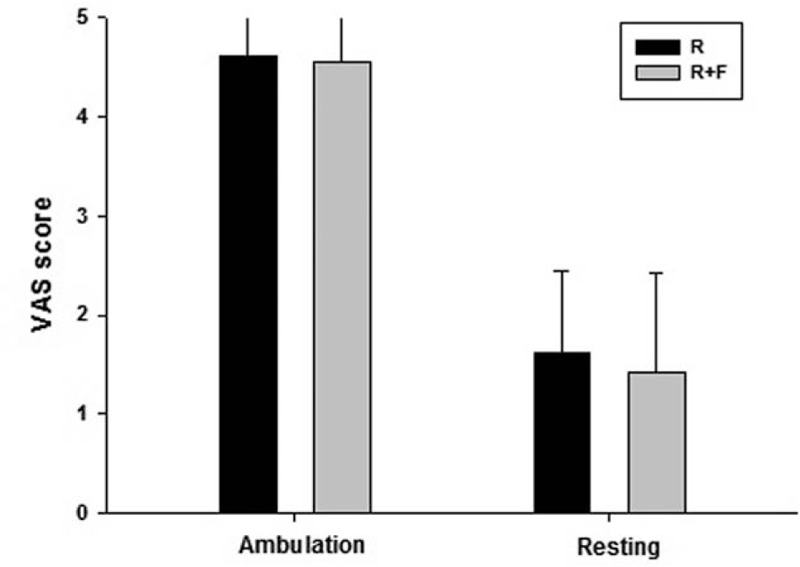
The patients were divided into 2 groups, each with n = 40 in ropivacaine (R) group and n = 42 in R with fentanyl (R + F) group. After operation, the patients in each group received R + F and R alone via a femoral nerve catheter, respectively. We assessed the visual analog scale (VAS) pain immediately before administration (baseline) and at 15, 30, and 60 minutes on postanesthesia care unit (PACU), and resting and ambulatory VAS score up to 24 hours.
Overall, the average VAS scores in the R + F group were slightly lower than those of the R group. However, the VAS score differences between groups were not statistically significant, except for 30 minutes (P = 0.009) in PACU. R group showed higher supplemental analgesics consumption in average compared with R + F group, but not significant.
Additional fentanyl did not show prominent enhancement of analgesic effect in the field of CFNB after TKA.
外周阿片受体的存在及其在周围神经阻滞中的有效性仍存在争议。这项前瞻性、随机、双盲研究的目的是探讨在全膝关节置换术(TKA)后使用患者自控镇痛的连续股神经阻滞(CFNB)中,向罗哌卡因中添加芬太尼的镇痛效果。
将患者分为2组,罗哌卡因(R)组n = 40例,罗哌卡因加芬太尼(R+F)组n = 42例。术后,每组患者分别通过股神经导管单独接受R+F和R。我们在给药前(基线)以及在麻醉后护理单元(PACU)的15、30和60分钟时评估视觉模拟量表(VAS)疼痛,以及直至24小时的静息和活动VAS评分。
总体而言,R+F组的平均VAS评分略低于R组。然而,除了在PACU中的30分钟(P = 0.009)外,两组之间的VAS评分差异无统计学意义。与R+F组相比,R组平均补充镇痛药的消耗量更高,但差异不显著。
在TKA后的CFNB领域,额外添加芬太尼并未显示出显著增强的镇痛效果。