Université Paris-Est (F.L., M.L.), INSERM U955, Laboratoire Psychiatrie Translationnelle, et AP-HP, DHU Pe-PSY, Pole de Psychiatrie et d'Addictologie des Hôpitaux Universitaires Henri Mondor, et Fondation FondaMental, Créteil; French Reference Center on Paraneoplastic Neurological Syndrome (L.T., G.P., V.D., F.D., V.R., D.P., J.-C.A., J.-Y.D., J.H.), Hospices Civils de Lyon, Hôpital Neurologique, Bron; Institut NeuroMyoGene (INMG) INSERM U1217/CNRS UMR 5310 (L.T., V.D., F.D., V.R., J.-C.A., J.H.), Lyon; Université de Lyon-Université Claude Bernard Lyon 1 (L.T., V.D., F.D., J.H.); AP-HP (D.P., J.-Y.D.), Groupe Hospitalier Pitié-Salpêtrière, Service de Neurologie 2-Mazarin, Paris; Service de Neurologie (J.-C.A.), CHU de Saint-Etienne et Université de Lyon, Saint-Etienne; Inserm (J.-Y.D.), U 1127, CNRS, UMR 7225, ICM, Sorbonne Universités, UPMC Univ Paris 06, UM 75 Paris; and Université de Bordeaux (L.G.), Interdisciplinary Institute for Neuroscience, UMR 5297, France.
Neurol Neuroimmunol Neuroinflamm. 2016 Aug 29;3(5):e280. doi: 10.1212/NXI.0000000000000280. eCollection 2016 Oct.
To precisely describe the initial psychiatric presentation of patients with anti-NMDA receptor (NMDAR) antibodies encephalitis (anti-NMDAR encephalitis) to identify potential clues enhancing its early diagnosis.
We retrospectively studied the French Reference Centre medical records of every adult patient with anti-NMDAR encephalitis to specify the patients' initial psychiatric symptoms leading to hospitalization in a psychiatric department and the reasons underlying the diagnosis of anti-NMDAR encephalitis.
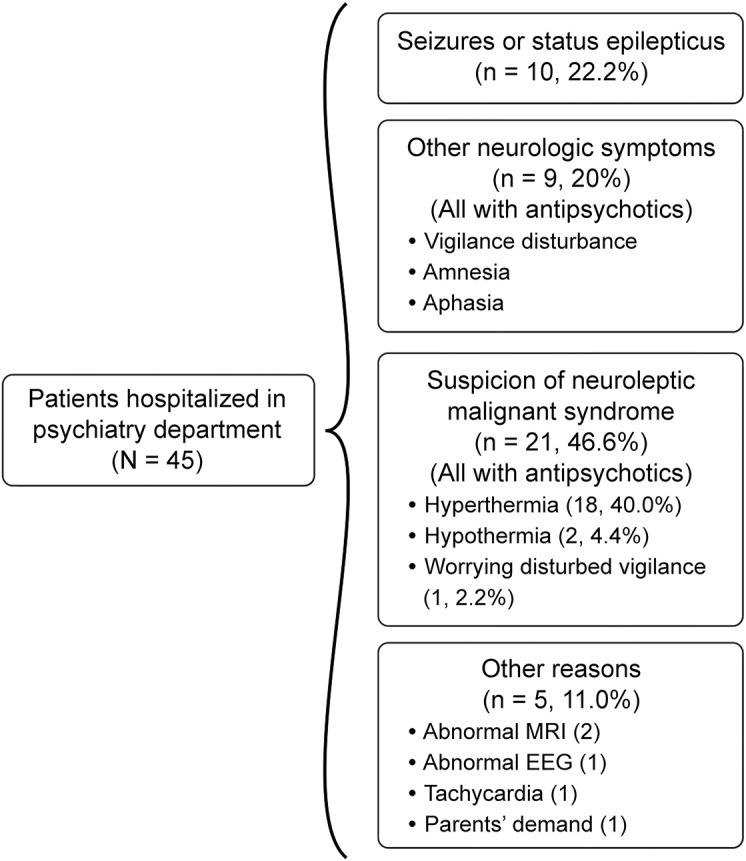
The medical records of 111 adult patients were reviewed. Psychiatric features were the initial presentation in 65 patients (59%). Among them, several psychiatric manifestations were observed, including visual and auditory hallucinations (n = 26, 40%), depression (n = 15, 23%), mania (n = 5, 8%), acute schizoaffective episode (n = 15, 23%), and eating disorder or addiction (n = 4; 6%). Forty-five patients (40% of total cohort) were first hospitalized in a psychiatric institution (91% women), with a median duration of stay of 9 days (range 0.25-239 days). Among them, 24 patients (53%) had associated discreet neurologic signs at the first evaluation, while 17 additional patients (38%) developed neurologic signs within a few days. Twenty-one patients (47%) were transferred to a medical unit for a suspicion of antipsychotic intolerance characterized by high temperature, muscle rigidity, mutism or coma, and biological results suggesting rhabdomyolysis.
Several psychiatric presentations were observed in patients with anti-NMDAR encephalitis, although none was specific; however, patients, mostly women, also had discreet neurologic signs that should be carefully assessed as well as signs of antipsychotic intolerance that should raise suspicion for anti-NMDAR encephalitis.
准确描述抗 N- 甲基-D- 天冬氨酸受体(NMDAR)抗体脑炎(抗 NMDAR 脑炎)患者的初始精神表现,以确定潜在的线索,提高其早期诊断率。
我们回顾性研究了法国参考中心每一位成年抗 NMDAR 脑炎患者的病历,以明确导致患者因精神科就诊并住院的初始精神症状以及诊断抗 NMDAR 脑炎的原因。
共回顾了 111 例成年患者的病历。精神症状是 65 例患者(59%)的首发症状。其中,观察到多种精神表现,包括幻视和幻听(26 例,40%)、抑郁(15 例,23%)、躁狂(5 例,8%)、急性精神分裂样发作(15 例,23%)和饮食障碍或成瘾(4 例,6%)。45 例患者(总队列的 40%)首次在精神科住院(91%为女性),平均住院时间为 9 天(0.25-239 天)。其中,24 例患者(53%)在首次评估时存在轻微的神经系统体征,而另外 17 例患者(38%)在几天内出现神经系统体征。21 例患者(47%)因怀疑抗精神病药物不耐受而转入内科,表现为高热、肌肉僵硬、缄默或昏迷,且生物学结果提示横纹肌溶解。
抗 NMDAR 脑炎患者存在多种精神表现,尽管没有一种是特异性的;但是,患者,主要为女性,也存在轻微的神经系统体征,需要仔细评估,以及抗精神病药物不耐受的体征,这应引起对抗 NMDAR 脑炎的怀疑。