Savino Elisabetta, Soavi Cecilia, Capatti Eleonora, Borrelli Massimo, Vigna Giovanni B, Passaro Angelina, Zuliani Giovanni
Department of Medical Sciences, Section of Internal and Cardiopulmonary Medicine, University of Ferrara, Via Savonarola n°9, 44100, Ferrara, Italy.
Azienda Ospedaliero-Universitaria S. Anna Ferrara, Ferrara, Italy.
BMC Neurol. 2016 Sep 8;16(1):165. doi: 10.1186/s12883-016-0693-1.
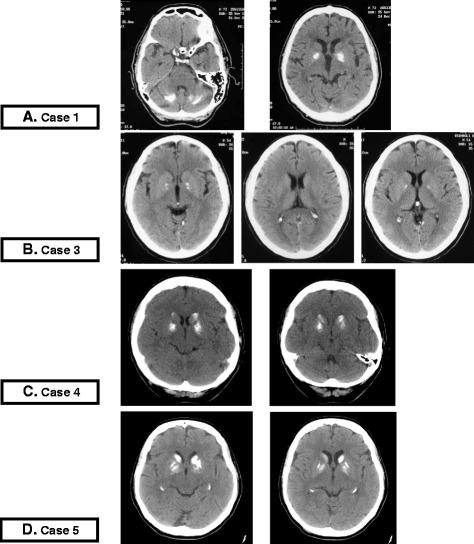
Fahr's disease is rare a neurodegenerative idiopathic condition characterized by symmetric and bilateral calcifications of basal ganglia, usually associated with progressive neuropsychiatric dysfunctions and movement disorders. The term "Fahr's syndrome" is used in presence of calcifications secondary to a specific cause, but the variability of etiology, pathogenesis, and clinical picture underlying this condition have raised the question of the real existence of a syndrome. Several classifications based on the etiology, the location of brain calcifications and the clinical presentation have been proposed. Here we describe seven clinical cases of basal ganglia calcifications, in order to search for pathognomonic features and correlations between clinical picture and imaging findings.
The patients came to our attention for different reasons (most of them for memory/behavior disturbances); all underwent neuro-psychologic evaluation and neuro-imaging. All patients showed variable degrees of deterioration in cognitive function; anxiety and depression were frequent too, and resistant to treatment in all cases. Less frequent, but severe if present, were psychotic symptoms, with different grade of structure and emotional involvement, and always resistant to treatment. We observed only few cases of extrapyramidal disorders related to the disease itself; anyway, mild extrapyramidal syndrome occurred quite frequently after treatment with antipsychotics.
Based on these findings we discourage the use of the term "Fahr's syndrome", and suggest to refer to Idiopathic or Secondary basal ganglia calcification. Unlike early onset forms (idiopathic or inherited), the clinical presentation of late onset form and Secondary basal ganglia calcification seems to be really heterogeneous. Case-control studies are necessary to determine the actual significance of basal ganglia calcification in the adult population and in the elderly, in cognitive, physical and emotional terms.
法尔病是一种罕见的神经退行性特发性疾病,其特征为基底节区对称性双侧钙化,通常伴有进行性神经精神功能障碍和运动障碍。“法尔综合征”一词用于存在继发于特定原因的钙化情况,但这种疾病潜在的病因、发病机制和临床表现的多样性引发了是否真的存在一种综合征的问题。已经提出了几种基于病因、脑钙化位置和临床表现的分类方法。在此,我们描述7例基底节区钙化的临床病例,以寻找其特征性表现以及临床表现与影像学检查结果之间的相关性。
这些患者因不同原因引起我们的关注(大多数是因为记忆/行为障碍);均接受了神经心理学评估和神经影像学检查。所有患者均表现出不同程度的认知功能减退;焦虑和抑郁也很常见,且在所有病例中对治疗均有抵抗。精神病性症状较少见,但一旦出现则较为严重,具有不同程度的结构和情感方面的表现,且对治疗始终有抵抗。我们仅观察到少数与疾病本身相关的锥体外系疾病病例;无论如何,使用抗精神病药物治疗后轻度锥体外系综合征相当常见。
基于这些发现,我们不鼓励使用“法尔综合征”这一术语,建议使用特发性或继发性基底节区钙化。与早发型(特发性或遗传性)不同,晚发型和继发性基底节区钙化的临床表现似乎确实具有异质性。有必要进行病例对照研究,以确定基底节区钙化在成年人群和老年人中的认知、身体和情感方面的实际意义。