• 文献检索
  • 文档翻译
  • 深度研究
  • 学术资讯
  • Suppr Zotero 插件Zotero 插件
  • 邀请有礼
  • 套餐&价格
  • 历史记录
应用&插件
Suppr Zotero 插件Zotero 插件浏览器插件Mac 客户端Windows 客户端微信小程序
定价
高级版会员购买积分包购买API积分包
服务
文献检索文档翻译深度研究API 文档MCP 服务
关于我们
关于 Suppr公司介绍联系我们用户协议隐私条款
关注我们

Suppr 超能文献

核心技术专利:CN118964589B侵权必究
粤ICP备2023148730 号-1Suppr @ 2026

文献检索

告别复杂PubMed语法,用中文像聊天一样搜索,搜遍4000万医学文献。AI智能推荐,让科研检索更轻松。

立即免费搜索

文件翻译

保留排版,准确专业,支持PDF/Word/PPT等文件格式,支持 12+语言互译。

免费翻译文档

深度研究

AI帮你快速写综述,25分钟生成高质量综述,智能提取关键信息,辅助科研写作。

立即免费体验

肺动脉高压的声学诊断:自动化语音识别启发式分类算法优于医生。

Acoustic diagnosis of pulmonary hypertension: automated speech- recognition-inspired classification algorithm outperforms physicians.

机构信息

Department of Electrical and Computer Engineering, University of Alberta, Edmonton, Canada.

Pediatric Pulmonary Hypertension Service, Pediatric Cardiac Critical Care Unit, Stollery Children's Hospital, Mazankowski Alberta Heart Institute, University of Alberta, Edmonton, Canada.

出版信息

Sci Rep. 2016 Sep 9;6:33182. doi: 10.1038/srep33182.

DOI:10.1038/srep33182
PMID:27609672
原文链接:https://pmc.ncbi.nlm.nih.gov/articles/PMC5016849/
Abstract

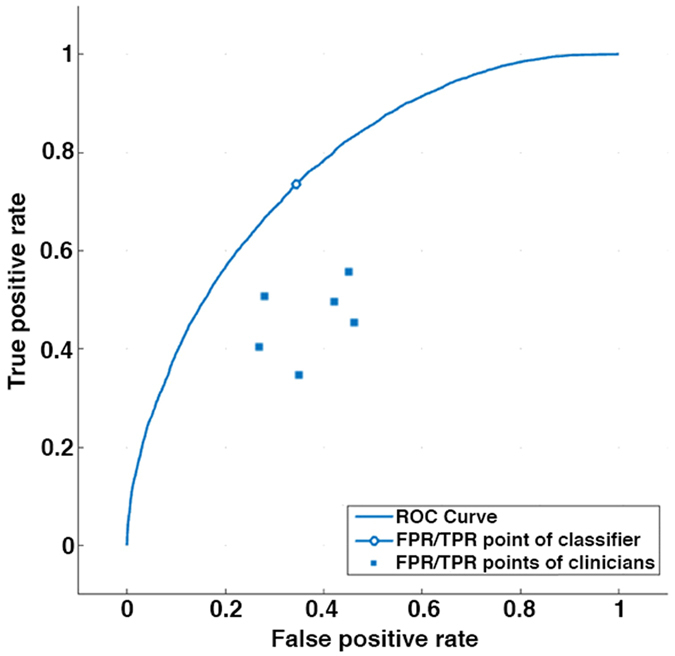
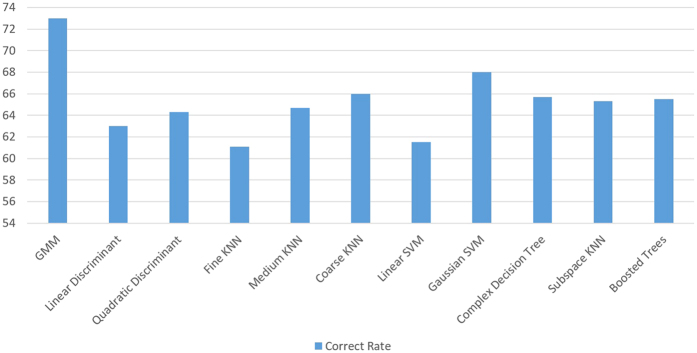
We hypothesized that an automated speech- recognition-inspired classification algorithm could differentiate between the heart sounds in subjects with and without pulmonary hypertension (PH) and outperform physicians. Heart sounds, electrocardiograms, and mean pulmonary artery pressures (mPAp) were recorded simultaneously. Heart sound recordings were digitized to train and test speech-recognition-inspired classification algorithms. We used mel-frequency cepstral coefficients to extract features from the heart sounds. Gaussian-mixture models classified the features as PH (mPAp ≥ 25 mmHg) or normal (mPAp < 25 mmHg). Physicians blinded to patient data listened to the same heart sound recordings and attempted a diagnosis. We studied 164 subjects: 86 with mPAp ≥ 25 mmHg (mPAp 41 ± 12 mmHg) and 78 with mPAp < 25 mmHg (mPAp 17 ± 5 mmHg) (p  < 0.005). The correct diagnostic rate of the automated speech-recognition-inspired algorithm was 74% compared to 56% by physicians (p = 0.005). The false positive rate for the algorithm was 34% versus 50% (p = 0.04) for clinicians. The false negative rate for the algorithm was 23% and 68% (p = 0.0002) for physicians. We developed an automated speech-recognition-inspired classification algorithm for the acoustic diagnosis of PH that outperforms physicians that could be used to screen for PH and encourage earlier specialist referral.

摘要

我们假设,一种受自动语音识别启发的分类算法,可以区分肺动脉高压(PH)患者和非 PH 患者的心音,并优于医生。同时记录心音、心电图和平均肺动脉压(mPAp)。将心音记录数字化,以训练和测试受语音识别启发的分类算法。我们使用梅尔频率倒谱系数从心音中提取特征。高斯混合模型将特征分类为 PH(mPAp≥25mmHg)或正常(mPAp<25mmHg)。对患者数据不知情的医生听取相同的心音记录并尝试诊断。我们研究了 164 名受试者:86 名 mPAp≥25mmHg(mPAp 41±12mmHg),78 名 mPAp<25mmHg(mPAp 17±5mmHg)(p<0.005)。与医生的 56%相比,自动语音识别启发算法的正确诊断率为 74%(p=0.005)。算法的假阳性率为 34%,而医生为 50%(p=0.04)。算法的假阴性率为 23%,而医生为 68%(p=0.0002)。我们开发了一种受自动语音识别启发的分类算法,用于 PH 的声学诊断,优于医生,可用于 PH 的筛查,并鼓励更早地转介给专科医生。
https://cdn.ncbi.nlm.nih.gov/pmc/blobs/b29c/5016849/489999b4b50d/srep33182-f6.jpg
https://cdn.ncbi.nlm.nih.gov/pmc/blobs/b29c/5016849/e3acbd6bf569/srep33182-f1.jpg
https://cdn.ncbi.nlm.nih.gov/pmc/blobs/b29c/5016849/1cdde61fefa1/srep33182-f2.jpg
https://cdn.ncbi.nlm.nih.gov/pmc/blobs/b29c/5016849/579d658d4adf/srep33182-f3.jpg
https://cdn.ncbi.nlm.nih.gov/pmc/blobs/b29c/5016849/1f837d0c770a/srep33182-f4.jpg
https://cdn.ncbi.nlm.nih.gov/pmc/blobs/b29c/5016849/6f7ab31d2f81/srep33182-f5.jpg
https://cdn.ncbi.nlm.nih.gov/pmc/blobs/b29c/5016849/489999b4b50d/srep33182-f6.jpg
https://cdn.ncbi.nlm.nih.gov/pmc/blobs/b29c/5016849/e3acbd6bf569/srep33182-f1.jpg
https://cdn.ncbi.nlm.nih.gov/pmc/blobs/b29c/5016849/1cdde61fefa1/srep33182-f2.jpg
https://cdn.ncbi.nlm.nih.gov/pmc/blobs/b29c/5016849/579d658d4adf/srep33182-f3.jpg
https://cdn.ncbi.nlm.nih.gov/pmc/blobs/b29c/5016849/1f837d0c770a/srep33182-f4.jpg
https://cdn.ncbi.nlm.nih.gov/pmc/blobs/b29c/5016849/6f7ab31d2f81/srep33182-f5.jpg
https://cdn.ncbi.nlm.nih.gov/pmc/blobs/b29c/5016849/489999b4b50d/srep33182-f6.jpg

相似文献

1
Acoustic diagnosis of pulmonary hypertension: automated speech- recognition-inspired classification algorithm outperforms physicians.肺动脉高压的声学诊断:自动化语音识别启发式分类算法优于医生。
Sci Rep. 2016 Sep 9;6:33182. doi: 10.1038/srep33182.
2
Spectral analysis of the heart sounds in children with and without pulmonary artery hypertension.有和无肺动脉高压儿童的心音频谱分析。
Int J Cardiol. 2014 Apr 15;173(1):92-9. doi: 10.1016/j.ijcard.2014.02.025. Epub 2014 Feb 24.
3
Criteria for diagnosis of exercise pulmonary hypertension.运动性肺动脉高压的诊断标准。
Eur Respir J. 2015 Sep;46(3):728-37. doi: 10.1183/09031936.00021915. Epub 2015 May 28.
4
Detection of Heart Sounds in Children with and without Pulmonary Arterial Hypertension--Daubechies Wavelets Approach.有和无肺动脉高压儿童心音的检测——多贝西小波方法
PLoS One. 2015 Dec 2;10(12):e0143146. doi: 10.1371/journal.pone.0143146. eCollection 2015.
5
Using voice-recognition technology to eliminate cardiac cycle segmentation in automated heart sound diagnosis.在自动心音诊断中使用语音识别技术消除心动周期分割
Biomed Instrum Technol. 2007 Mar-Apr;41(2):157-66. doi: 10.2345/0899-8205(2007)41[157:UVTTEC]2.0.CO;2.
6
The unique heart sound signature of children with pulmonary artery hypertension.肺动脉高压患儿独特的心音特征。
Pulm Circ. 2015 Dec;5(4):631-9. doi: 10.1086/683694.
7
High sensitivity and negative predictive value of the DETECT algorithm for an early diagnosis of pulmonary arterial hypertension in systemic sclerosis: application in a single center.DETECT算法在系统性硬化症肺动脉高压早期诊断中的高敏感性和阴性预测值:单中心应用
Arthritis Res Ther. 2017 Jun 14;19(1):135. doi: 10.1186/s13075-017-1327-8.
8
Utility of the physical examination in detecting pulmonary hypertension. A mixed methods study.
PLoS One. 2014 Oct 24;9(10):e108499. doi: 10.1371/journal.pone.0108499. eCollection 2014.
9
Resting pulmonary artery pressure of 21-24 mmHg predicts abnormal exercise haemodynamics.静息肺动脉压 21-24mmHg 预示运动血液动力学异常。
Eur Respir J. 2016 May;47(5):1436-44. doi: 10.1183/13993003.01684-2015. Epub 2016 Mar 10.
10
Blood flow vortices along the main pulmonary artery measured with MR imaging for diagnosis of pulmonary hypertension.磁共振成像测量主肺动脉血流涡旋诊断肺动脉高压
Radiology. 2015 Apr;275(1):71-9. doi: 10.1148/radiol.14140849. Epub 2014 Nov 5.

引用本文的文献

1
Ethical guidance for reporting and evaluating claims of AI outperforming human doctors.关于报告和评估人工智能表现优于人类医生的声明的伦理指南。
NPJ Digit Med. 2024 Oct 2;7(1):271. doi: 10.1038/s41746-024-01255-w.
2
Deep Learning Based Prediction of Pulmonary Hypertension in Newborns Using Echocardiograms.基于深度学习利用超声心动图预测新生儿肺动脉高压
Int J Comput Vis. 2024;132(7):2567-2584. doi: 10.1007/s11263-024-01996-x. Epub 2024 Feb 6.
3
[Diagnosis of pulmonary hypertension associated with congenital heart disease based on statistical features of the second heart sound].

本文引用的文献

1
The unique heart sound signature of children with pulmonary artery hypertension.肺动脉高压患儿独特的心音特征。
Pulm Circ. 2015 Dec;5(4):631-9. doi: 10.1086/683694.
2
Pediatric Pulmonary Hypertension: Guidelines From the American Heart Association and American Thoracic Society.儿童肺动脉高压:美国心脏协会和美国胸科学会指南。
Circulation. 2015 Nov 24;132(21):2037-99. doi: 10.1161/CIR.0000000000000329. Epub 2015 Nov 3.
3
Predictors of Catastrophic Adverse Outcomes in Children With Pulmonary Hypertension Undergoing Cardiac Catheterization: A Multi-Institutional Analysis From the Pediatric Health Information Systems Database.
基于第二心音统计特征的先天性心脏病相关性肺动脉高压诊断
Sheng Wu Yi Xue Gong Cheng Xue Za Zhi. 2024 Feb 25;41(1):41-50. doi: 10.7507/1001-5515.202304037.
4
Explanatory deep learning to predict elevated pulmonary artery pressure in children with ventricular septal defects using standard chest x-rays: a novel approach.使用标准胸部X光片通过解释性深度学习预测室间隔缺损患儿肺动脉压力升高:一种新方法。
Front Cardiovasc Med. 2024 Jan 12;11:1330685. doi: 10.3389/fcvm.2024.1330685. eCollection 2024.
5
21st century (clinical) decision support in nursing and allied healthcare. Developing a learning health system: a reasoned design of a theoretical framework.21 世纪护理及相关医疗保健领域的(临床)决策支持。开发学习型卫生系统:理论框架的合理设计。
BMC Med Inform Decis Mak. 2023 Dec 5;23(1):279. doi: 10.1186/s12911-023-02372-4.
6
Audio Recording Patient-Nurse Verbal Communications in Home Health Care Settings: Pilot Feasibility and Usability Study.家庭医疗环境中患者-护士言语交流的音频记录:初步可行性和可用性研究
JMIR Hum Factors. 2022 May 11;9(2):e35325. doi: 10.2196/35325.
7
Deep learning to predict elevated pulmonary artery pressure in patients with suspected pulmonary hypertension using standard chest X ray.深度学习利用标准胸部 X 光片预测疑似肺动脉高压患者的肺动脉高压。
Sci Rep. 2020 Nov 17;10(1):19311. doi: 10.1038/s41598-020-76359-w.
8
Digital stethoscope: technology update.数字听诊器:技术更新
Med Devices (Auckl). 2018 Jan 4;11:29-36. doi: 10.2147/MDER.S135882. eCollection 2018.
接受心导管检查的肺动脉高压患儿灾难性不良结局的预测因素:来自儿科健康信息系统数据库的多机构分析
J Am Coll Cardiol. 2015 Sep 15;66(11):1261-1269. doi: 10.1016/j.jacc.2015.07.032.
4
Initial Use of Ambrisentan plus Tadalafil in Pulmonary Arterial Hypertension.初始使用安贝生坦联合他达拉非治疗肺动脉高压。
N Engl J Med. 2015 Aug 27;373(9):834-44. doi: 10.1056/NEJMoa1413687.
5
Time-domain analysis of heart sound intensity in children with and without pulmonary artery hypertension: a pilot study using a digital stethoscope.有和无肺动脉高压儿童心音强度的时域分析:一项使用数字听诊器的初步研究
Pulm Circ. 2014 Dec;4(4):685-95. doi: 10.1086/678513.
6
Cardiac catheterization in children with pulmonary hypertensive vascular disease.患有肺动脉高压性血管疾病儿童的心脏导管插入术。
Pediatr Cardiol. 2015 Apr;36(4):873-9. doi: 10.1007/s00246-015-1100-1. Epub 2015 Jan 11.
7
Early detection of pulmonary arterial hypertension.肺动脉高压的早期检测。
Nat Rev Cardiol. 2015 Mar;12(3):143-55. doi: 10.1038/nrcardio.2014.191. Epub 2014 Nov 25.
8
Spectral analysis of the heart sounds in children with and without pulmonary artery hypertension.有和无肺动脉高压儿童的心音频谱分析。
Int J Cardiol. 2014 Apr 15;173(1):92-9. doi: 10.1016/j.ijcard.2014.02.025. Epub 2014 Feb 24.
9
Updated clinical classification of pulmonary hypertension.肺动脉高压的最新临床分类。
J Am Coll Cardiol. 2013 Dec 24;62(25 Suppl):D34-41. doi: 10.1016/j.jacc.2013.10.029.
10
Pediatric pulmonary hypertension.小儿肺动脉高压。
J Am Coll Cardiol. 2013 Dec 24;62(25 Suppl):D117-26. doi: 10.1016/j.jacc.2013.10.028.