Parker K A, Bond U
Department of Molecular Biophysics and Biochemistry, Yale University School of Medicine, New Haven, Connecticut 06510.
Mol Cell Biol. 1989 Jun;9(6):2500-12. doi: 10.1128/mcb.9.6.2500-2512.1989.
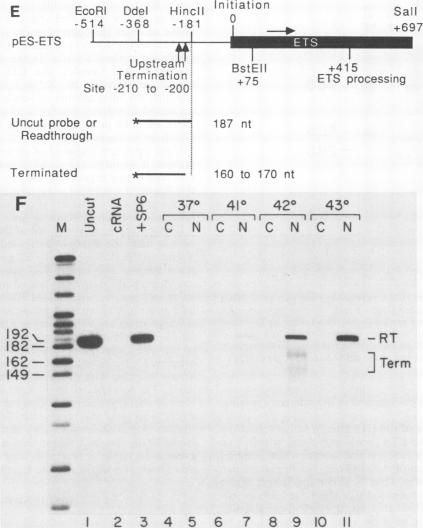
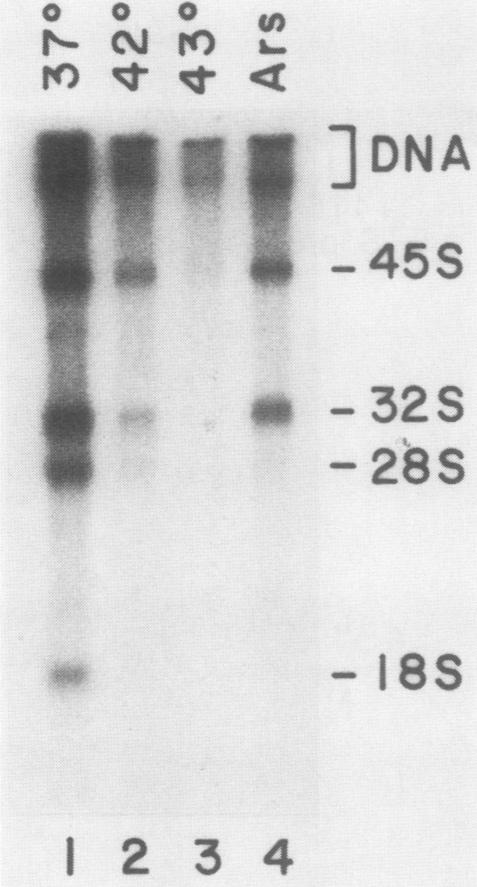
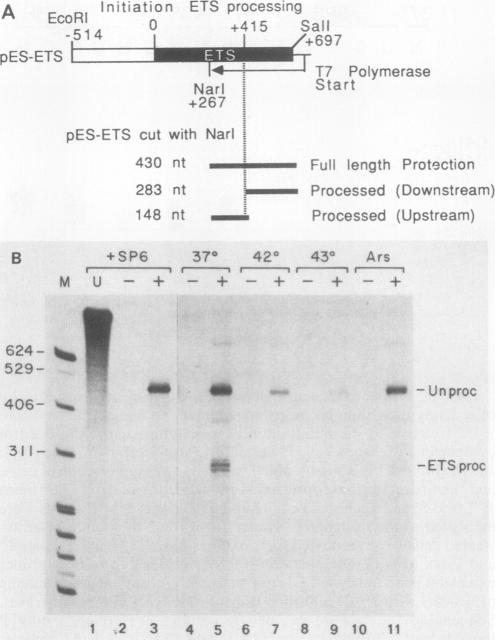
Human rRNA precursor from normal or stressed HeLa cells were studied by S1 nuclease mapping of unlabeled RNA and by antisense RNase mapping of RNA from cells that had been labeled in vivo with [32P]PO4. Heating cells to 43 degrees C decreased the amount of newly synthesized rRNA to less than 5% of the control level and led to greater than 95% inhibition of transcription termination at a region 355 to 362 nucleotides downstream of the 3' end of 28S rRNA, with readthrough continuing into the next transcription unit. Heating of cells to 42 degrees C led to 60% inhibition of termination at this site; 50% of transcripts that extended into the nontranscribed spacer ended in a region 200 to 210 nucleotides upstream of the polymerase I (Pol I) initiation site. This is presumed to be the human upstream transcription termination site because of the absence of RNAs with a 5' end corresponding to this region, the location relative to the Pol I initiation site (which is similar to the location of upstream terminators in other species), and the fact that it is 15 to 25 nucleotides upstream of the sequence GGGTTGACC, which has an 8-of-9 base identity with the sequence 3' of the downstream termination site. Surprisingly, treatment of cells with sodium arsenite, which also leads to the induction of a stress response, did not inhibit termination. Pol I initiation was decreased to the same extent as termination, which lends support to the hypothesis that termination and initiation are coupled. Although termination was almost completely inhibited at 43 degrees C, the majority of the recently synthesized rRNAs were processed to have the correct 3' end of 28S. This finding suggests that 3'-end formation can involve an endonucleolytic cut and is not solely dependent on exonucleolytic trimming of correctly terminated rRNAs.
通过对未标记RNA进行S1核酸酶图谱分析以及对体内用[32P]PO4标记的细胞RNA进行反义RNA酶图谱分析,研究了来自正常或应激HeLa细胞的人rRNA前体。将细胞加热至43℃可使新合成的rRNA量降至对照水平的5%以下,并导致在28S rRNA 3'端下游355至362个核苷酸区域的转录终止受到大于95%的抑制,通读延伸至下一个转录单元。将细胞加热至42℃导致该位点的终止受到60%的抑制;延伸至非转录间隔区的转录本中有50%在聚合酶I(Pol I)起始位点上游200至210个核苷酸的区域结束。由于不存在5'端对应于该区域的RNA,其相对于Pol I起始位点的位置(与其他物种上游终止子的位置相似),以及它位于序列GGGTTGACC上游15至25个核苷酸处这一事实(该序列与下游终止位点3'端的序列具有9个碱基中的8个相同),推测这是人类上游转录终止位点。令人惊讶的是,用亚砷酸钠处理细胞,亚砷酸钠也会导致应激反应的诱导,但并未抑制终止。Pol I起始减少到与终止相同的程度,这支持了终止和起始是偶联的这一假说。尽管在43℃时终止几乎完全被抑制,但大多数最近合成的rRNA被加工成具有正确的28S 3'端。这一发现表明3'端形成可能涉及内切核酸酶切割,并不完全依赖于正确终止的rRNA的外切核酸酶修剪。