de Beer Z W, Duong T A, Wingfield M J
Department of Microbiology and Plant Pathology, Forestry and Agricultural Research Institute (FABI), University of Pretoria, Pretoria 0002, South Africa.
Department of Genetics, Forestry and Agricultural Research Institute (FABI), University of Pretoria, Pretoria 0002, South Africa.
Stud Mycol. 2016;83:165-91. doi: 10.1016/j.simyco.2016.07.001. Epub 2016 Jul 27.
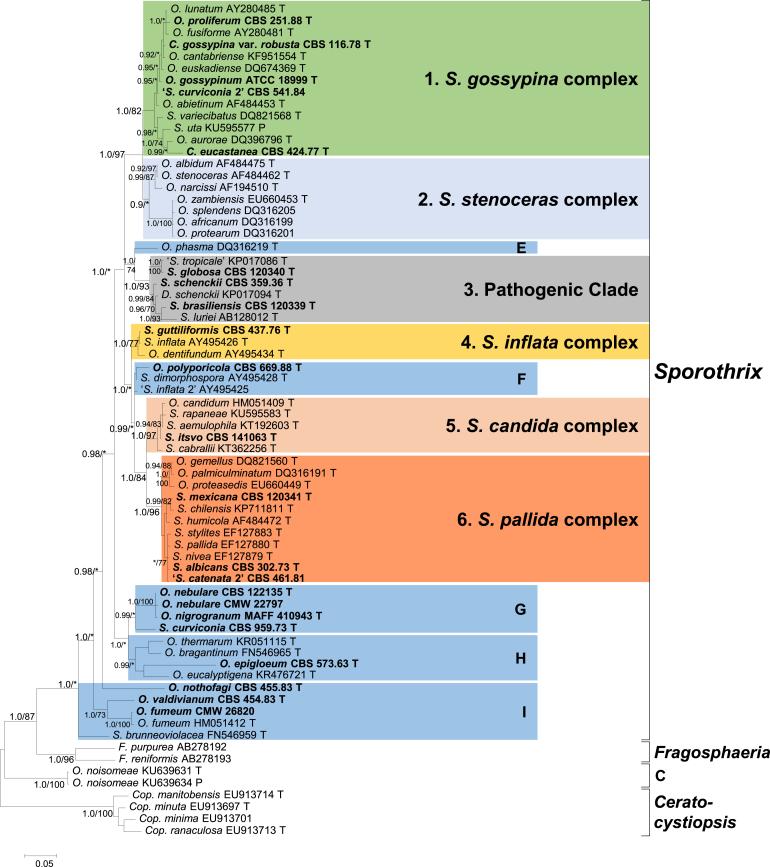
One of the causal agents of human sporotrichosis, Sporothrix schenckii, is the type species of the genus Sporothrix. During the course of the last century the asexual morphs of many Ophiostoma spp. have also been treated in Sporothrix. More recently several DNA-based studies have suggested that species of Sporothrix and Ophiostoma converge in what has become known as Ophiostoma s. lat. Were the one fungus one name principles adopted in the Melbourne Code to be applied to Ophiostoma s. lat., Sporothrix would have priority over Ophiostoma, resulting in more than 100 new combinations. The consequence would be name changes for several economically important tree pathogens including O. novo-ulmi. Alternatively, Ophiostoma could be conserved against Sporothrix, but this would necessitate changing the names of the important human pathogens in the group. In this study, we sought to resolve the phylogenetic relationship between Ophiostoma and Sporothrix. DNA sequences were determined for the ribosomal large subunit and internal transcribed spacer regions, as well as the beta-tubulin and calmodulin genes in 65 isolates. The results revealed Sporothrix as a well-supported monophyletic lineage including 51 taxa, distinct from Ophiostoma s. str. To facilitate future studies exploring species level resolution within Sporothrix, we defined six species complexes in the genus. These include the Pathogenic Clade containing the four human pathogens, together with the S. pallida-, S. candida-, S. inflata-, S. gossypina- and S. stenoceras complexes, which include environmental species mostly from soil, hardwoods and Protea infructescences. The description of Sporothrix is emended to include sexual morphs, and 26 new combinations. Two new names are also provided for species previously treated as Ophiostoma.
引起人类孢子丝菌病的病原体之一申克孢子丝菌(Sporothrix schenckii)是孢子丝菌属的模式种。在上个世纪的进程中,许多长喙壳属(Ophiostoma spp.)的无性型也被归入孢子丝菌属。最近,一些基于DNA的研究表明,孢子丝菌属和长喙壳属的物种在所谓的广义长喙壳属(Ophiostoma s. lat.)中趋同。如果《墨尔本法规》中采用的“一个真菌一个名称”原则应用于广义长喙壳属,那么孢子丝菌属将比长喙壳属具有优先权,这将导致100多个新组合。其结果将是几种经济上重要的树木病原体的名称发生变化,包括新榆长喙壳菌(O. novo-ulmi)。或者,可以将长喙壳属保留而不采用孢子丝菌属的名称,但这将需要更改该类群中重要人类病原体的名称。在本研究中,我们试图解决长喙壳属和孢子丝菌属之间的系统发育关系。测定了65个分离株的核糖体大亚基和内部转录间隔区以及β-微管蛋白和钙调蛋白基因的DNA序列。结果表明,孢子丝菌属是一个得到充分支持的单系谱系,包括51个分类单元,与狭义长喙壳属(Ophiostoma s. str.)不同。为便于今后在孢子丝菌属内进行物种水平分辨率的研究,我们在该属中定义了六个物种复合体。其中包括包含四种人类病原体的致病分支,以及苍白孢子丝菌、念珠状孢子丝菌、膨胀孢子丝菌、棉籽壳孢子丝菌和窄顶孢子丝菌复合体,其中包括主要来自土壤、硬木和山龙眼科果实的环境物种。对孢子丝菌属的描述进行了修订,以包括有性型以及26个新组合。还为以前被视为长喙壳属的物种提供了两个新名称。