Klumpp Lukas, Sezgin Efe C, Eckert Franziska, Huber Stephan M
Department of Radiation Oncology, University of Tübingen, 72076 Tübingen, Germany.
Dr. Margarete Fischer-Bosch-Institute of Clinical Pharmacology, 70376 Stuttgart, Germany.
Int J Mol Sci. 2016 Sep 8;17(9):1513. doi: 10.3390/ijms17091513.
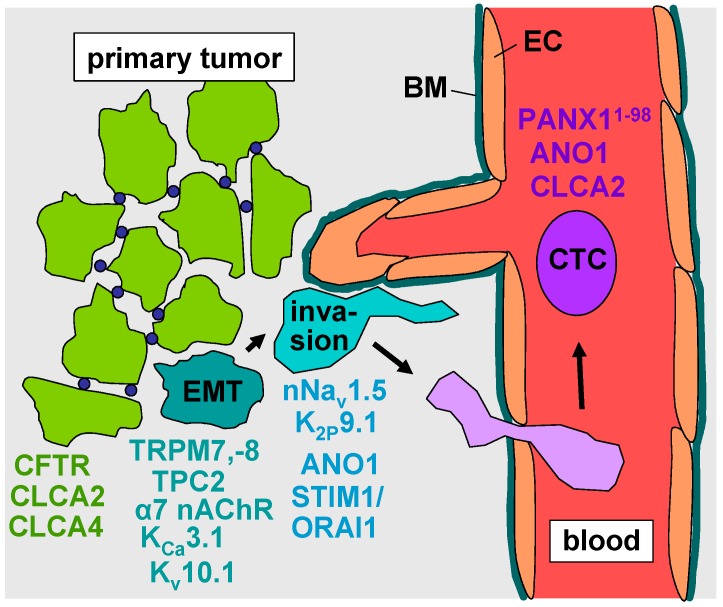
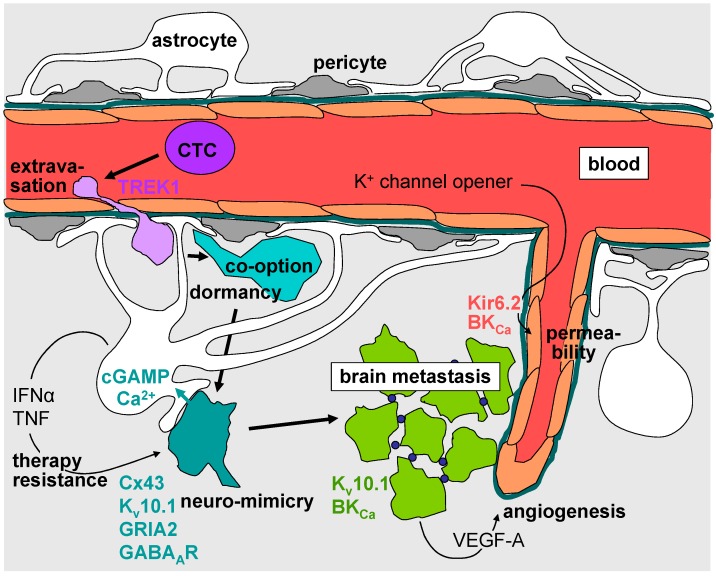
Breast cancer, lung cancer and melanoma exhibit a high metastatic tropism to the brain. Development of brain metastases severely worsens the prognosis of cancer patients and constrains curative treatment options. Metastasizing to the brain by cancer cells can be dissected in consecutive processes including epithelial-mesenchymal transition, evasion from the primary tumor, intravasation and circulation in the blood, extravasation across the blood-brain barrier, formation of metastatic niches, and colonization in the brain. Ion channels have been demonstrated to be aberrantly expressed in tumor cells where they regulate neoplastic transformation, malignant progression or therapy resistance. Moreover, many ion channel modulators are FDA-approved drugs and in clinical use proposing ion channels as druggable targets for future anti-cancer therapy. The present review article aims to summarize the current knowledge on the function of ion channels in the different processes of brain metastasis. The data suggest that certain channel types involving voltage-gated sodium channels, ATP-release channels, ionotropic neurotransmitter receptors and gap junction-generating connexins interfere with distinct processes of brain metastazation.
乳腺癌、肺癌和黑色素瘤对脑表现出高度的转移嗜性。脑转移瘤的发生严重恶化癌症患者的预后,并限制了治愈性治疗选择。癌细胞转移至脑可分为连续的过程,包括上皮-间质转化、逃离原发肿瘤、进入血液并在血液中循环、穿越血脑屏障外渗、形成转移龛以及在脑中定植。已证明离子通道在肿瘤细胞中异常表达,它们在肿瘤细胞中调节肿瘤转化、恶性进展或治疗抗性。此外,许多离子通道调节剂是美国食品药品监督管理局(FDA)批准的药物并在临床使用,这表明离子通道可作为未来抗癌治疗的可成药靶点。本综述文章旨在总结目前关于离子通道在脑转移不同过程中功能的知识。数据表明,某些通道类型,包括电压门控钠通道、ATP释放通道、离子型神经递质受体和形成间隙连接的连接蛋白,会干扰脑转移的不同过程。