Gao Nannan, Yu Yong, Zhang Bingchang, Yuan Zhongshang, Zhang Haiqing, Song Yongfeng, Zhao Meng, Ji Jiadong, Liu Lu, Xu Chao, Zhao Jiajun
Department of Endocrinology, Shandong Provincial Hospital affiliated to Shandong University, Jinan, 250021, Shandong, China.
Institute of Endocrinology and Metabolism, Shandong Academy of Clinical Medicine, Jinan, Shandong, 250021, China.
Lipids Health Dis. 2016 Sep 13;15(1):154. doi: 10.1186/s12944-016-0328-y.
The prevalence of cardiovascular disease has been increasing worldwide. As a common pathogenic risk factor, dyslipidemia played a great role in the incidence and progress of these diseases. We investigated to achieve accurate and up-to-date information on the prevalence of dyslipidemia and its associations with other lipid-related diseases in rural North China.
Using a complex, multistage, probability sampling design, we conducted a large-scale cross-sectional study of 8528 rural participants aged over 18 years in Shandong Province. Prevalence and characteristics of dyslipidemia were demonstrated. The odds ratios between dyslipidemia types and lipid-related diseases were further analyzed by logistic regression.
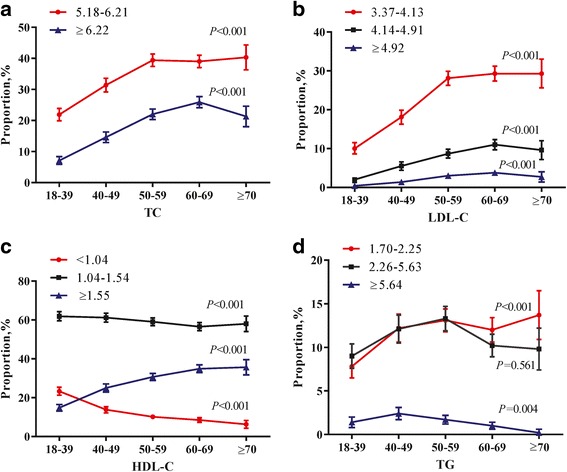
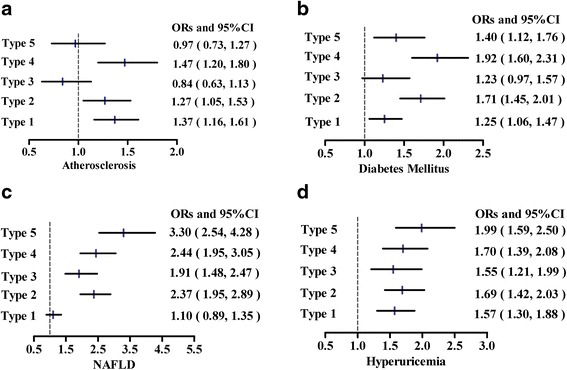
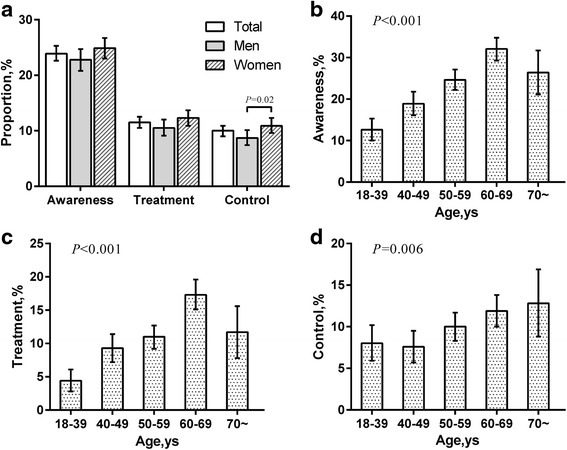
Among the overall population, 45.8 % suffered from dyslipidemia. The prevalence of lipid abnormality (including high and very high levels) was 18.6, 12.7, 9.8 and 12.7 % for total cholesterol (TC), high-density lipoprotein (HDL), and low-density lipoprotein (LDL) cholesterol and triglycerides (TG), respectively. Among all participants with dyslipidemia, 23.9 % were aware, only 11.5 % were treated, 10.0 % were controlled. For subjects with dyslipidemia, the risk for non-alcoholic fatty liver disease (NAFLD) was highest with a 3.3-fold over that of non-dyslipidmia (OR = 3.30, P < 0.001); followed by hyperuricemia and diabetes mellitus (DM), while with 2-fold increase (OR = 1.99, P < 0.001; OR = 1.92, P < 0.001); with only 1.5-fold risk for atherosclerosis (AS) (OR = 1.47, P < 0.001). The presence of high cholesterol was mainly associated with AS, while abnormal TG was correlated with NAFLD and DM.
Dyslipidemia has become a serious public health issue in rural North China. The rapid increase of high TC and incremental risk of high TG may contribute to the epidemic of AS, NAFLD and DM. It is imperative to develop individualized prevention and treatment guidelines according to dyslipidemia phenotypes.
心血管疾病在全球范围内的患病率一直在上升。作为一种常见的致病风险因素,血脂异常在这些疾病的发生和发展中起着重要作用。我们进行调查以获取有关中国北方农村地区血脂异常患病率及其与其他脂质相关疾病关联的准确和最新信息。
采用复杂的多阶段概率抽样设计,我们对山东省8528名18岁以上的农村参与者进行了大规模横断面研究。展示了血脂异常的患病率和特征。通过逻辑回归进一步分析血脂异常类型与脂质相关疾病之间的比值比。
在总体人群中,45.8%患有血脂异常。总胆固醇(TC)、高密度脂蛋白(HDL)、低密度脂蛋白(LDL)胆固醇和甘油三酯(TG)的脂质异常(包括高水平和非常高水平)患病率分别为18.6%、12.7%、9.8%和12.7%。在所有血脂异常参与者中,23.9%知晓自己的病情,仅11.5%接受治疗,10.0%得到控制。对于血脂异常患者,非酒精性脂肪性肝病(NAFLD)的风险最高,是血脂正常者的3.3倍(比值比=3.30,P<0.001);其次是高尿酸血症和糖尿病(DM),风险增加2倍(比值比=1.99,P<0.001;比值比=1.92,P<0.001);动脉粥样硬化(AS)的风险仅增加1.5倍(比值比=1.47,P<0.001)。高胆固醇的存在主要与AS相关,而TG异常与NAFLD和DM相关。
血脂异常已成为中国北方农村地区严重的公共卫生问题。高TC的快速增加和高TG风险的增加可能导致AS、NAFLD和DM的流行。根据血脂异常表型制定个性化的预防和治疗指南势在必行。