Sokolenko Stanislav, Quattrociocchi Marco, Aucoin Marc G
Department of Chemical Engineering, University of Waterloo, 200 University Avenue West, Waterloo ON, Canada.
BMC Syst Biol. 2016 Sep 13;10(1):91. doi: 10.1186/s12918-016-0335-7.
The estimation of intracellular flux through traditional metabolic flux analysis (MFA) using an overdetermined system of equations is a well established practice in metabolic engineering. Despite the continued evolution of the methodology since its introduction, there has been little focus on validation and identification of poor model fit outside of identifying "gross measurement error". The growing complexity of metabolic models, which are increasingly generated from genome-level data, has necessitated robust validation that can directly assess model fit.
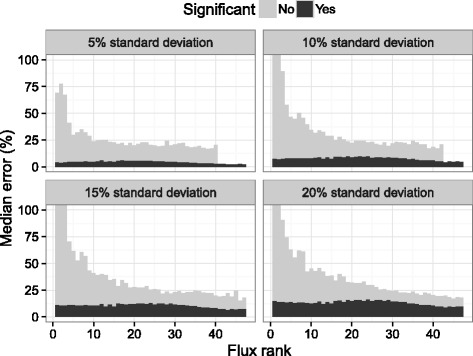
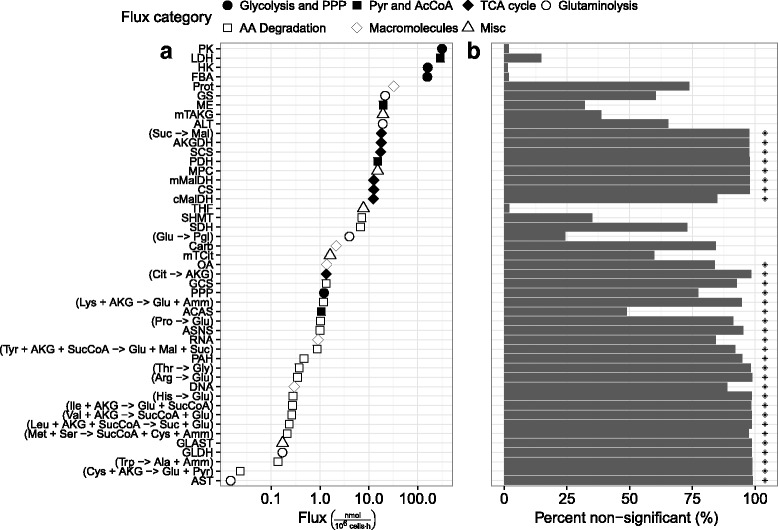
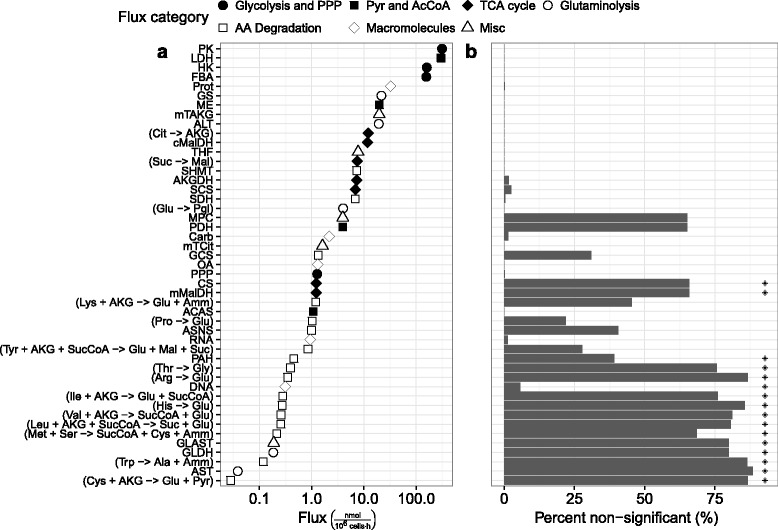
In this work, MFA calculation is framed as a generalized least squares (GLS) problem, highlighting the applicability of the common t-test for model validation. To differentiate between measurement and model error, we simulate ideal flux profiles directly from the model, perturb them with estimated measurement error, and compare their validation to real data. Application of this strategy to an established Chinese Hamster Ovary (CHO) cell model shows how fluxes validated by traditional means may be largely non-significant due to a lack of model fit. With further simulation, we explore how t-test significance relates to calculation error and show that fluxes found to be non-significant have 2-4 fold larger error (if measurement uncertainty is in the 5-10 % range).
The proposed validation method goes beyond traditional detection of "gross measurement error" to identify lack of fit between model and data. Although the focus of this work is on t-test validation and traditional MFA, the presented framework is readily applicable to other regression analysis methods and MFA formulations.
通过使用超定方程组的传统代谢通量分析(MFA)来估计细胞内通量是代谢工程中一种成熟的做法。尽管自该方法引入以来一直在不断发展,但除了识别“总体测量误差”之外,很少关注模型拟合不佳的验证和识别。越来越多从基因组水平数据生成的代谢模型的复杂性增加,使得需要能够直接评估模型拟合的稳健验证。
在这项工作中,MFA计算被构建为一个广义最小二乘(GLS)问题,突出了常用t检验在模型验证中的适用性。为了区分测量误差和模型误差,我们直接从模型中模拟理想通量分布,用估计的测量误差对其进行扰动,并将它们的验证结果与实际数据进行比较。将该策略应用于一个已建立的中国仓鼠卵巢(CHO)细胞模型,结果表明,由于缺乏模型拟合,传统方法验证的通量可能在很大程度上不显著。通过进一步模拟,我们探索了t检验显著性与计算误差的关系,并表明被发现不显著的通量具有大2至4倍的误差(如果测量不确定度在5 - 10%范围内)。
所提出的验证方法超越了传统的“总体测量误差”检测,以识别模型与数据之间的拟合不足。尽管这项工作的重点是t检验验证和传统MFA,但所提出的框架很容易应用于其他回归分析方法和MFA公式。